Card, mobile credential, payment and security
Autumn Cafiero Giusti, contributing editor, Avisian Publications
Fast, cheap or good. The old adage says you typically can’t have all three. The same has been true when choosing a card printing technology, but things are changing.
The direct-to-card method has long filled the “fast and cheap” niche. The newer retransfer printing method delivers the “good” in the form of superior image quality. More recently, it’s become cheaper, too.
Lower costs and a rise in chip card use are driving up the demand for retransfer card printers. In addition to the high-quality images, the technology also enables over-the-edge printing and printing on uneven surfaces often found when cards contain chips or other embedded technologies.
This is due to the way color is applied to the card during in the imaging process.
The direct-to-card method uses a print head to apply dye from a printer ribbon directly onto a plastic card. This tends to be faster and less expensive, but often provides a noticeably lower quality image and misprinting on uneven surfaces. It also causes wear and tear on the sensitive and costly print head, particularly as it encounters hard edges and surface imperfections.
The retransfer method addresses these problems by applying the ribbon’s dye to a separate clear transfer film. This film is then attached to the plastic card as a single overlay so the print head never comes into contact with imperfections in the card’s surface or its hard edges.
Today, secure applications from driver licenses to government IDs and corporate badges to student ID cards are moving to retransfer printing at an increasing rate.
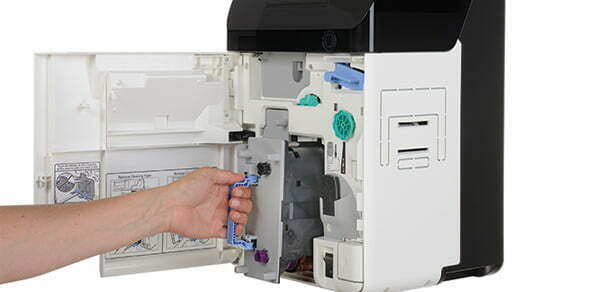
Evolis is the latest card printer manufacturer to leverage retransfer technology with the addition of its Avansia printer. Evolis introduced the new line of printers late in 2014 after seeing an increase in demand for higher quality cards, especially in government applications.
“Avansia gives us access to different segments in transportation and government that we didn’t have access to before,” says Gerardo Talavera, managing director for the Americas for France-based Evolis.
The Avansia printer line complements the company’s existing line of direct-to-card printers, and as Talavera says, the two printing technologies cater to the needs of different markets.
He says retransfer printing generally serves markets that require cards with higher durability, security and image quality. Direct-to-card offers a lower cost alternative for high-volume print jobs in which a card’s life span and image quality are of less concern, such as short-term ID badges and loyalty cards.
What makes the Avansia printer noteworthy is that it prints images at an ultra-high 600 dpi resolution, whereas the current standard for most high-resolution printers is 300 dpi. Talavera expects 600 dpi to rapidly become the new standard for ID printing.
Government and financial institutions prefer retransfer printing because it enables printing on different card materials with uneven surfaces and embedded chips. To further improve image quality in such situations, Talavera says the Avansia includes a built-in card flattener.
Retransfer printing is a more complex technology and costs more. It tends to be about 40% more expensive, Talavera says, for both printing costs and the price of the unit itself.
Direct-to-card printing is ideal for inexpensive, entry-level print jobs that might require single-side printing with only a photo and text, such as convention ID badges, he says. There’s also greater speed with the direct-to-card method, which can make it more appealing for larger printing jobs.
The Avansia prints 140 cards per hour while direct-to-card printers produce 180 cards per hour.