Card, mobile credential, payment and security
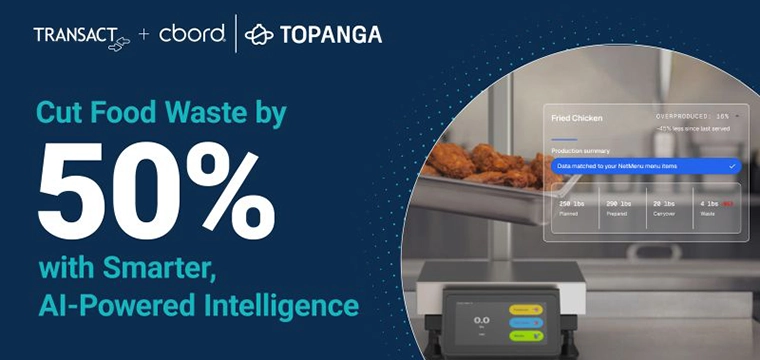
AI-powered kitchen intelligence platform reduces overproduction without disrupting workflows
Food waste is a massive financial challenge for the commercial foodservice industry. In 2023, the U.S. sector generated nearly $10 billion worth of unsold or uneaten food, according to Transact + CBORD. Kitchens discarded between 7% and 15% of their annual food budgets.
Higher ed dining services is a prime example as food waste is a major cost leak. With ingredient costs volatile and margins tight, campus dining is under pressure to improve forecasting accuracy and production efficiency.
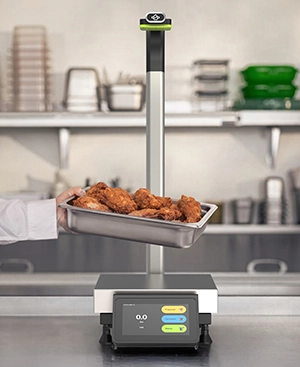
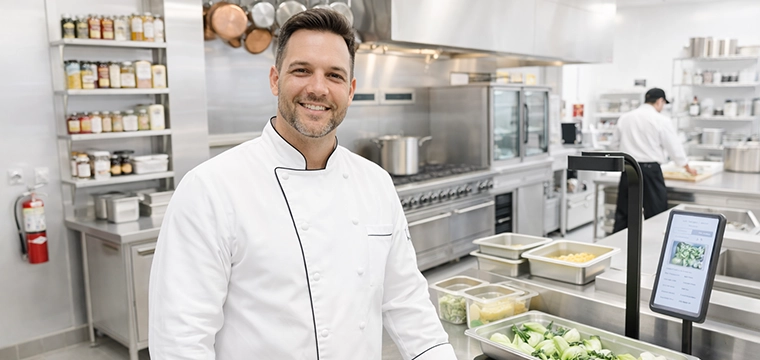
StreamLine AI-powered scales give dining operators insight into production volumes and food waste.
To address this challenge, Transact + CBORD and Topanga are partnering to help commercial kitchens reduce food waste and improve operational efficiency through AI-powered production tracking.
The collaboration integrates CBORD’s popular NetMenu platform with Topanga’s StreamLine solution. Together, they are working to deliver real-time insights that enable kitchens to optimize production, cut costs, and minimize waste without disrupting existing workflows.
Waste persists, at least in part, because culinary teams lack reliable, actionable data. Manual service worksheets rely heavily on estimates, and many staff members are reluctant to adopt systems that slow down kitchen operations.
This new partnership addresses these challenges by embedding AI-driven intelligence directly into the tools kitchens already use.
CBORD’s NetMenu platform is a menu management and foodservice production solution for large-scale dining operations like higher education. It enables operators to plan menus, manage recipes and ingredients, analyze nutritional and allergen information, forecast demand, and control food costs – all from a single, centralized system.
StreamLine’s AI matches captured food items to NetMenu, creating a complete picture of production, carryover, and waste.
The integration connects NetMenu’s menu planning and recipe data with StreamLine’s compact, AI-powered smart scales. The scales automatically identify, weigh, and analyze food items throughout preparation and service, eliminating the need for manual tracking.
StreamLine’s AI matches captured food items to NetMenu recipes, ingredients, and associated costs, creating a complete picture of production, carryover, and waste.
It provides culinary teams with access to real-time dashboards and automated reports that highlight overproduction trends and optimization opportunities. Better data, enables dining leaders to adjust prep volumes, refine menus, and forecast demand more effectively. Key to success is that it does this without adding administrative or operational burden to staff.
Topanga reports that kitchens using StreamLine reduce food waste by an average of 50% within just four months of deployment. Some operations have lowered cost-per-meal by 5% in a single semester.
Vanderbilt achieved a 53% reduction in total food waste and an estimated $150,000 in food cost savings in the first year.
Vanderbilt University Dining serves as a compelling early example of the integration’s impact. After deploying the combined NetMenu and StreamLine solution in July 2024, Vanderbilt achieved a 53% reduction in total food waste and an estimated $150,000 in food cost savings in the first year.
Analysis from the Vanderbilt experience revealed that nearly 90% of recorded waste stemmed from overproduction. The solution empowered chefs to make immediate, data-driven adjustments to prep volumes and menu plans.
"What excites us about this partnership is that StreamLine doesn't ask kitchens to change their workflow – it makes their existing NetMenu data work harder,” says Chris Setcos, Senior Vice President, Partnerships and M&A at Transact + CBORD. “We're seeing operations identify six-figure savings opportunities within weeks, not months. That's the kind of transformative impact our customers need right now."