Card, mobile credential, payment and security
PKOC, Aliro, and LEAF Verified are new, but IDs and hardware already exist
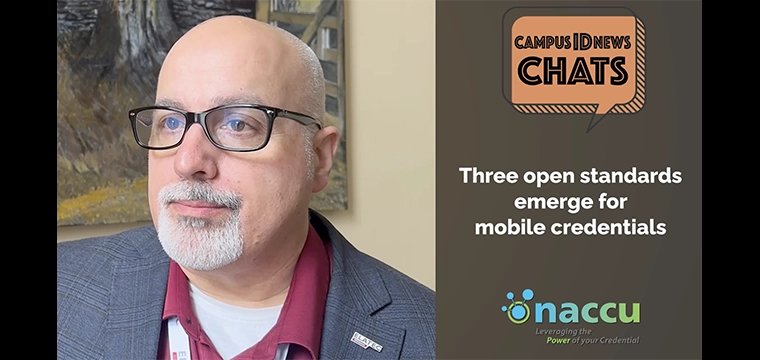
Jason Ouellette, Global Head of Product Management for ELATEC, now an Allegion brand, explains why open standards are becoming increasingly important as mobile credentials gain traction. At the center of that shift is interoperability – creating credentials that can work across different locations, systems, and readers without forcing organizations into a single proprietary technology.
For Ouellette, the growing use of mobile wallets makes that interoperability even more important. For mobile credentials to reach their potential, institutions need the confidence that the technology they implement today can continue working as their systems evolve.
Ouellette points to Public Key Open Credential (PKOC), Aliro, and LEAF Verified as examples of emerging open standards built on similar cryptographic foundations. Because of those similarities, it is possible for reader manufacturers to support multiple standards on the same platform. ELATEC, for example, is already supporting all three on a single reader platform.
Rather than viewing open standards as something still on the horizon, he says products and commercial deployments are available today.
That flexibility can give organizations more options as they plan future upgrades and migrations. Rather than viewing open standards as something still on the horizon, Ouellette says products and commercial deployments are available today, with vendor support continuing to expand.
Because these technologies are still new to many organizations, Ouellette encourages campus professionals to spend time learning how the different standards work before making decisions. Industry organizations and communities offer resources ranging from introductory information to deeper technical guidance.
The larger goal isn't simply adopting a new credential format. It's creating a more flexible infrastructure that gives institutions a clearer path from the systems they use today to the mobile credential environments they may want in the future.
TRANSCRIPT:
Why are mobile credentials and the impact of open standards important? It really comes down to the word interoperability.
As we think about the growth, interest and convenience of what wallet means, people don't forget their phones, but they can forget badges. That tends to be human nature.
But it becomes meaningful when I don't have to worry about whether this format works at one location and what happens when I go to another. Open standards are the only way to create that type of scalability.
The question is around the readiness for open standards and what's available out there. There are three different standards that are based on the same foundation. They use the same type of cryptographic engines and asymmetric technology, which is considered more secure and future-proof. It's what the financial industry has used, what retail uses, and now what the security industry is moving to embrace.
You look at Public Key Open Credential (PKOC), which has been out for over a year, and now we have commercial deployments. There are products available that are supporting and driving the growth of Public Key Open Credential.
Because they're all based on this same public and private key pair, the public key and the derivative of that become the credential. The format that people define works the same for all three standards.
Now we have Aliro and LEAF Verified, which both launched in February 2026. In just that short time, when we went to the ISC West trade show, we saw the number of vendors supporting these standards. You're seeing it happen in real time.
It's this year. It's not a fantasy. It's a product, and it's available now.
Open standards help people become more future proof about the direction they're going and help build migration paths for how to get from where you are to where you want to be. I think that's a very important part of what open standards are doing.
One of the benefits of being a manufacturer of readers and looking at these open standards is that they're based on the same elliptic curve cryptography engine. If you're supporting one, the ability to support them all, when implemented properly, is readily available.
This is one of the powerful elements of what we're doing at ELATEC, because we're already supporting PKOC, Aliro and LEAF Verified on the same reader platform.
Because they're all based on this same public and private key pair, the public key and the derivative of that become the credential. The format that people define works the same for all three of them.
It takes interoperability to another level, and that is a game changer for our industry.
There's a lot to digest when we think about these open standards. It's new to a lot of people, so I encourage everybody to go to some of the resources that are available.
The Physical Security Interoperability Alliance has an incredible white paper on what Public Key Open Credential is. It explains it at a simple level and then has further deep dives if you want to get down to the bits-and-bytes level.
That's a great resource to learn more about PKOC. There are also resources for Aliro through the CSA website. If you become a member of CSA, there are working groups and a lot of information to support your journey in learning about and properly implementing Aliro.
The LEAF community is another incredible resource for learning about LEAF Verified and the foundation it's built on.
There are some great resources available, and you can also reach out to any of our regional sales teams at ELATEC to find out more about our reader technology and how we're supporting these open standards.