Card, mobile credential, payment and security
Tying access control to event platform lets security team schedule unlocks and relocks
The University of Kentucky integrated event scheduling software with their electronic access control system. This allowed the university to automatically unlock and relock classrooms, conference rooms, and other facilities based on approved event schedules. Stephen Cornett explains that this has helped to maintain an open, welcoming campus while still providing secure access for constituents and public events.
This automation – with the help of partner Detrios and its DAX solution – eliminates much of the manual work previously required. It also allows the access control team to focus on more strategic operational priorities.
One of the most significant outcomes of the integration has been its operational impact. As one example, Cornett shares that automating event scheduling allowed the department to better utilize an employee who had spent 40 hours per week managing event access. The technology effectively recovered a full-time position and allowed the team member to perform higher-value work.
When an event begins, the appropriate doors open. When it ends, they close again without requiring a lot of manual intervention.
The system also improves consistency, reduces human error, and creates a better experience for students and visitors by ensuring buildings are accessible when they should be while maintaining campus security.
Cornett emphasizes that successful event management still begins with a thorough review process involving departments like security, housekeeping, catering, and event management. This is required before any event is approved, but once approved, the integration handles access automatically.
He encourages institutions to explore new technologies, learn from peer universities, and work closely with technology partners, noting that collaboration across higher education helps everyone build more efficient and secure campus operations.
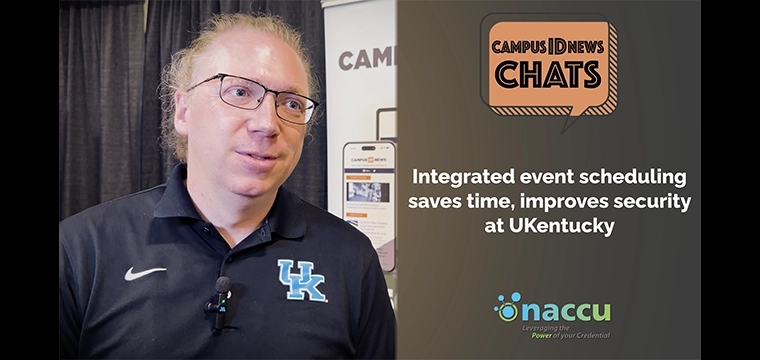
To listen to the full discussion, click the image at the top of this page.
TRANSCRIPT:
One of the biggest challenges we face as a university with event scheduling and access is that we're an open campus. We have a lot of events, members of the public coming onto campus, and people who aren't affiliated with the university. A big part of our job is figuring out how to remain both secure and open at the same time.
With electronic access control integrated into our scheduling software, we're able to schedule doors to unlock and relock automatically based on an event's schedule. When an event begins, the appropriate doors open. When it ends, they close again without requiring a lot of manual intervention. That saves a tremendous amount of staff time.
The benefits really are extensive. We reduce manual labor, improve security, and, perhaps most importantly, create a better experience for students and visitors.
Our goal with this integration was really to improve operations. We started as a two-person team, grew to four people, and now we're a team of about 13. Even with that growth, we're responsible for managing more than 10,000 access control points across campus.
The integration allows our relatively small team to spend less time managing routine access schedules so we can focus on larger initiatives and more valuable work.
The return on investment has been significant. We previously had an employee assigned almost entirely to event scheduling in our student center. After implementing the integration, that work became automated, allowing us to bring that employee back into our regular operations to work on service tickets, projects, commissioning, and other priorities.
Essentially, we recovered the equivalent of a full-time, 40-hour-per-week position through automation. That's a pretty strong return on investment.
The benefits really are extensive. We reduce manual labor, improve security, and, perhaps most importantly, create a better experience for students and visitors. Our goal is to balance safety, security, openness, and hospitality. These integrations allow us to provide a welcoming campus environment while still maintaining strong security.
Essentially, we recovered the equivalent of a full-time, 40-hour-per-week position through automation. That's a pretty strong return on investment.
On our campus, every event goes through an event management process. Organizers work with our event management team to schedule their event, and it goes through a review involving departments like catering, housekeeping, security, and any other stakeholders who need to be involved.
Once the event has been reviewed and approved, the integrated systems automatically schedule the required access. The manual work happens during the review process, but once approval is complete, the access scheduling is fully automated.
Lead times depend entirely on the size and complexity of the event. Smaller events can move through the review process quickly, while larger events with more moving parts require additional planning time.
My advice would be to continue exploring what's available. There are a lot of software solutions that can improve access control operations. Talk with your technology partners, connect with other universities, and learn from what they're doing. Higher education is a community, and we're all willing to help each other. I'm always happy to answer questions because I enjoy talking about these systems.