Card, mobile credential, payment and security
 By Andy Williams, Contributing Editor
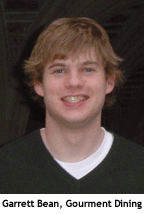
A 21-year-old Duke political science major has created a business that utilizes the efficiencies of the DukeCard and the Blackboard Commerce Suite. Garrett Bean, Charleston, SC, says he is about ready to launch his Gourmet Dining and Bakery online ordering system to allow DukeCard users to order meals from five restaurants via the Internet. “I want this out before the semester ends, around May 10,” he said.
“The way our business works,” explained Mr. Bean, “is that students go online to our website. Four of the restaurants they can choose from are new. One (a chain) is a current vendor (of the DukeCard system). The students can click on the restaurants, decide what they want, pay for it with their DukeCard, and submit the order, which is processed in real time.” The order is then delivered to the student by drivers hired by Gourmet Dining.
A signed receipt goes to the DukeCard office, the office deducts its percentage from the order, and sends the remaining funds to Gourmet Dining. Gourmet Dining then takes out its own percentage and sends the remainder to the restaurant. said Mr. Bean. The order itself should be delivered in 30 to 45 minutes.
Where did he get the idea? He was aware of Duke’s Merchant on Points off-campus program. For food orders, students would call the dining office to place the order. It was all phone-based. “It can take a long time, you get put on hold or you can’t get through,” he said. “It’s more efficient with internet orders. You never miss an order and it increases accuracy.”
“Having been a student, I’ve seen other online ordering programs and I thought, ‘Wouldn’t it be nice if you could just order your food online?’ ” said Mr. Bean. “I also wanted to add new restaurants. I saw a need for a different variety.”
 Moving from concept to reality
“I’m always interested in entrepreneurial students,” said Tom Bell, vice president of commerce industry relations for Blackboard. “I said ‘wow’ when I first heard about it. I saw the service he was providing. Students today live on the web. So much of what they do is focused on their PCs. So, this is a very natural extension.”
Mr. Bean said he first came up with the idea in 2002 when he was a freshman. “And we’re still not quite there yet.”
But what he went through could serve as a roadmap to others. “The first challenge was my age,” he said. “I was 19 then. Rather at Duke Dininig or the restaurant, they see someone not 30 or 40. It was just something I had to overcome. I had to dress and speak professionally. We also didn’t have a product yet. I was trying to sell Duke and the restaurant that they were going to make X number of dollars, but I didn’t have anything to show them. It was difficult to share my vision with them.”
He also has had to hire drivers to handle the deliveries. “Since I was only 19 then and talking about a product that didn’t exist, it had to be an all-in-one package,” he said. “We also had to buy new computers for all the restaurants. Being a company that was young and that sort of had a concept that was out there in thin air, we had to have one package that wouldn’t cost the restaurant anything. We supplied them with a Dell computer, a printer, an LED screen. We also developed a proprietary program that runs on the computer, similar to a point-of-sale service” that links the restaurant with the online ordering system, he said.
He found five student inventors willing to put up anywhere from $2,000 to $10,000. Mr. Bean said he put in $10,000 of his own money.
“Insurance and liability issues (for the drivers), creating the web site, and advertising were some of the other issues we had to deal with,” he added. “There were not a whole lot of templates we could look at. For example, the ordering system will support multiple ordering. Students with four or five friends, they can each pay for their order with their own card,” he said.
As to the types of restaurants Mr. Bean said he had access to surveys taken by the Duke University Dining Advisory Committee, “so I knew what kind of restaurants the students wanted.” That included a restaurant specializing in Indian cuisine, barbecue, and an upscale Asian restaurant. “We’re focusing on high quality food but at a reasonable price, below $10,” he said.
Gourmet Dining will get a percentage off every sale. “Order volume is what will make it work,” he added. Students will be paying for convenience though, because the online prices for delivered meals will be about 15% more than published menu prices, said Mr. Bean.
He’s letting students know about the new dining service via newspaper ads, flyers, and emails. “Everyone is more aware of it, now. We’ve even had two articles written about us in the newspaper.”
But it took more than just his idea, investors, a web site and calling on restaurants to make it work. There were two other entities Mr. Dean had to convince: Duke Dining Services and Blackboard.
“We first had to pitch the idea to Duke Dining. Do we have your permission to solicit new restaurants. They were very encouraging about it,” said Mr. Bean. Next on the list was Blackboard, where he received similar encouragement.
“We were thrilled that Blackboard wanted to work with us and that they would let us integrate with their system,” said Mr. Bean. “When I first envisioned the concept, I didn’t even know about Blackboard.”
Support from the DukeCard office moves the concept forward
He also had to pitch Matt Drummond, director of the DukeCard office. “Is it feasible, not feasible, that sort of thing,” said Mr. Bean.
While there were roadblocks to overcome, none of the barriers were created by Duke or Blackboard, added Mr. Dean.
“When Garrett first approached us,” said Mr. Drummond, “we were very interested, because it seemed like a service students were looking for. It sounded like a great opportunity. At the time, Duke didn’t have the resources; and Blackboard didn’t have a food ordering service online.”
Duke’s Merchants On Point program has been around since 1991, said Mr. Drummond. “We’re really excited there was a student group who took a big interest at adding a service and possibly an even better service that would benefit our students.”
Besides the Duke’s 12,000 students (about half whom are undergraduates), the college also has 25,000 employees who can benefit from Gourmet Dining and Bakery.
“We had not looked at online food ordering before,” said Mr. Drummond. “We’ve been processing payments online for telephone bills, cable bills, parking permits, where students can pay in real time using their flexible spending account. The food piece is what’s unique about this.”
Gourmet Dining’s secure transaction from the student will be integrated through the Blackboard Transaction Integration Agent, said Mr. Drummond. “I’ve been advising Garrett how to make secure transactions to our server. Garrett is working to become a certified Blackboard Transaction partner. We’ll set up things in the DukeCard system. When someone orders food from a vendor and provide the pin and card number, the information Garrett sends will meet all the qualifications Blackboard requires,” explained Mr. Drummond.
“We met with Garrett when he pitched the idea. We gave him information on the Points program and some of the things we had in mind with furthering this program, such as potentially using handhelds, swiping cards through a wireless device, so that we would be on the same page. We had our contract people at Duke go over what was involved for him to be a vendor, such as background checks for drivers, and from the DukeCard office, assisting him on contacting Blackboard,” added Mr. Drummond. “We’re excited about this and we’re interested in seeing what the student reaction will be.”
Blackboard provides support
Blackboard, too, is excited. “We can’t wait to see it at work next year,” said Mr. Bell. “There’s been lots of businesses that have started around campus and have connected with us in different ways, but how he (Garrett Bean) started his business is unique. What he is bascially doing is creating a TIA, a transaction interface agent, that will link to the Blackboard service.”
He said Blackboard has “a variety of TIAs with other companies who work with us and provide different services, such as parking companies or book stores. We interface with them in the same way.”
But with Gourmet Dining and Bakery, “I don’t believe this is happening anywhere else. I’ve asked people about whether we interface specifically with any business like this one and we don’t,” said Mr. Bell.
“We treat him like we do any other vendor who wants to work with the campus system. We create a document, agree to the terms, then we work with him in designing a software piece that connects our two systems,” added Mr. Bell. “Duke has been a longtime, wonderful client that has been very creative in many ways. I’m not surprised that more creativity is coming out of Duke.”
Additional resources:
To visit Gourmet Dining and Bakery online, click here.