Card, mobile credential, payment and security

Designing access strategies to ensure interoperability and flexibility beyond the door
Campuses are being asked to do more with access than ever before. What once centered primarily on opening doors has expanded into a broad ecosystem of physical and digital touchpoints that shape daily campus life. From dining and retail to printing, events, and administrative systems, access now plays a direct role in student experience, operational efficiency, and institutional security.
As campuses modernize, the question is no longer whether access should evolve, but how to do so in a way that balances innovation with flexibility. Institutions are discovering that long‑term success depends less on choosing one “right” credential and more on designing access strategies that can adapt over time to meet the needs of multiple stakeholder groups.
Historically, access conversations focused on physical entry points such as residence halls, classrooms, and campus facilities. Today, that definition has expanded.
Now the access infrastructure conversation must include logical access, the ability to securely interact with digital systems and services across campus.
For student’s, the distinction between physical and logical access is invisible. They simply expect their credential to work wherever they are.
From the student’s perspective, the distinction between physical and logical access is invisible. Students simply expect their credential, whether a magstripe card, mobile credential, or smartcard, to work wherever they are.
This broader view of access reflects how campus life actually functions. Students move fluidly between spaces and systems, often dozens of times a day. Modern access infrastructure must support that reality without introducing friction or confusion.
 Student expectations are accelerating mobile adoption
Mobile credentials are gaining momentum across higher education, and in many cases, student demand is the driving force. In discussions with institutions, they’ve reported that mobile initiatives are often sparked not by policy mandates, but by student advocacy.
One campus leader described their experience this way:
“It wasn’t the university or even me driving mobile credentials. The students drove the whole thing. The student government association went to the chancellor wanting a mobile solution.”
Beyond convenience, campuses cite tangible benefits. Mobile credentials can reduce reliance on plastic cards, lower fraud risk, and streamline card office operations during peak periods like orientation. From a security standpoint, phones are less likely to be shared than physical cards, and mobile credentials allow for remote provisioning and revocation when needed.
Despite growing interest in mobile access, it’s understandable that most campuses operate within complex credential environments. Many support a mix of magstripe, low frequency prox, high frequency smartcards, and mobile credentials simultaneously. Each option brings its own cost, infrastructure, and lifecycle considerations.
Magstripe and prox credentials may be economical but lack encryption. Smartcards provide stronger security but require compatible readers. Mobile credentials add new considerations related to device compatibility, provisioning workflows, and user support.
Rather than pursuing immediate, all‑or‑nothing mobile rollouts, institutions should adopt a phased migration strategy. This allows campuses to modernize while preserving stability.
Additionally, the higher ed environment produces its own set of challenges. Student populations turn over annually, which affects card production, replacement cycles, and administrative costs. At the same time, access control systems are among the most significant infrastructure investments on campus, often maintained over many years. These realities make a rapid, campus‑wide transition difficult for many institutions.
Rather than pursuing immediate, all‑or‑nothing mobile rollouts, it’s advised that institutions adopt a phased migration strategy. This approach allows campuses to modernize while preserving stability.
Your campus can support a phased migration by:
These are just a few guiding principles that give schools room to learn, adjust and scale at their pace. It also allows campuses to accommodate users who rely on physical credentials while gradually expanding mobile access where it delivers the most value.
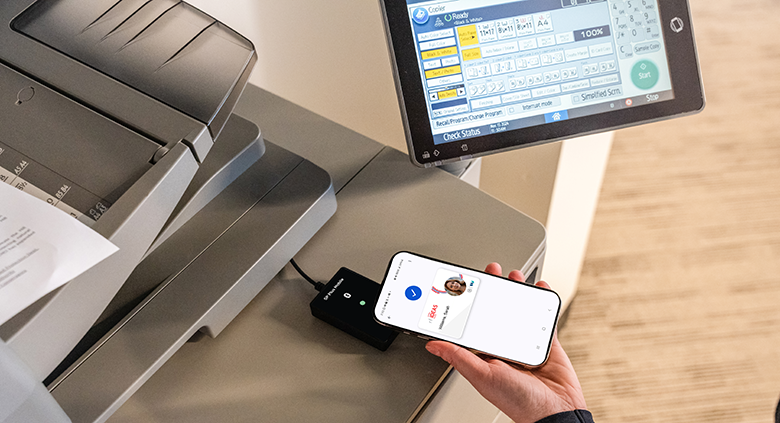
One challenge campuses consistently encounter is discovering how many systems rely on the ID credential. Dining systems, printers, bookstores, event access, and administrative tools often surface during migration planning, reinforcing the need for flexibility.
 Interoperability and consistency build long‑term confidence
As credential ecosystems become more diverse, interoperability and consistency increasingly work hand in hand. Campuses need access solutions that can support multiple credential types, integrate across physical and logical systems, and behave predictably as they scale.
Interoperability allows institutions to introduce mobile credentials without abandoning existing investments or locking themselves into a single future path. At the same time, consistent access behavior across departments and systems reduces operational risk by limiting exceptions, workarounds, and one‑off integrations.
Rather than trying to forecast which credential technology will dominate next, campuses that prioritize interoperable access are ready for whatever comes.
When access works the same way across dining, academic systems, events, and administrative applications, IT and security teams gain confidence in the environment they manage. This predictability strengthens security, reduces technical debt, and makes it easier to extend access into new use cases without disruption. Rather than trying to forecast which credential technology will dominate next, campuses that prioritize interoperable and consistent access ensure today’s decisions leave room for whatever comes next.
When access systems work well, they fade into the background. Students move through campus without interruption. Staff focus on service rather than troubleshooting. IT teams gain confidence that their systems can scale and evolve.
This type of experience is the freedom to campus. The freedom to modernize without disruption. The freedom to support multiple credential strategies. The freedom to extend secure access beyond doors and into every corner of campus life.
Learn more about how flexible, interoperable access strategies are helping institutions create freedom to campus experiences at https://www.rfideas.com/industries/education