Card, mobile credential, payment and security
Shift to mobile created an unexpected need, and the solution is replacing lost card revenues
When the University of Alabama transitioned to a Mobile First credentialing model, physical student ID cards were largely eliminated. Students, however, still had an affinity for the plastic memento, and thus the UA commemorative was born.
Courtney Petrizzi, Communications Director for Finance & Operations at the University of Alabama, explains that the assumption was that mobile credentials would fully meet student expectations. After all, the new credentials were wildly successful on campus. Feedback from students, however, revealed something was missing.
Revenue from the commemorative card is now high enough to make up for the replacement card fees they lost in their transition to mobile credentials.
“Students still wanted a tangible piece of campus,” says Petrizzi. That desire wasn’t about access or technology, but about pride and connection. Graduates wanted something they could take home, show family, and keep as proof of accomplishment.
Rather than returning to mass issuance of physical IDs, UA created a graduate-only commemorative card. The card is intentionally non-functional – no access privileges, no embedded technology – serving purely as memorabilia.
“It’s literally just a piece of plastic that you carry around with you,” Petrizzi emphasizes. Eligibility is restricted to students who officially graduate, reinforcing its symbolic value. The card includes clear language stating it does not confer current student status, which was important for compliance and clarity.
UA partnered closely with Strategic Communications to design and brand the card appropriately, recognizing it as an external-facing item once students become graduates. This collaboration extended into marketing, with careful planning around messaging, timing, and visual consistency.
Launching the program required new operational processes, including shipping credentials for the first time. UA coordinated with its mailing services, legal team, and registrar to manage graduate lists, refunds, and quality assurance.
Marketing efforts spanned email campaigns, social media, digital signage with QR codes, bookstore partnerships, and word-of-mouth promotion through student leaders.
While early adoption was slower than expected, awareness has grown steadily.
According to Petrizzi, revenue from the commemorative card is now high enough to make up for the replacement card fees the card office lost in the transition to mobile credentials.
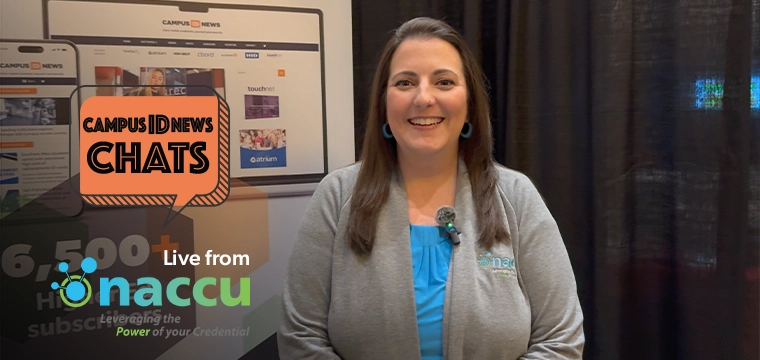
To watch the full interview, click the image at the top of this page.
TRANSCRIPT
In this episode of CampusIDNews Chats, we spoke with Courtney Petrizzi, Communications Director for Finance & Operations at the University of Alabama. She detailed the institution’s launch of a commemorative card offering for graduates that did not receive a traditional campus ID card because UA now issues mobile credentials.
Here is a transcript of what she said:
Our commemorative card started when we transitioned to Mobile First. That means none of our students get issued a physical credential unless they have an ineligible device.
We thought, Mobile Card – that's it we're done. That's all the students wanted. But then we started getting feedback that students still wanted a tangible piece of campus.
They wanted to have something that they could take home with them, show their parents, show off that they were a part of the university.
We asked the students what that would look like, because we weren't going to go back to start printing all of these physical cards again. We asked the students, why do you want this memorabilia? What's the most important thing?
They said they want to show that they graduated from the University of Alabama. That's what you hold on to when you're a graduate.
That is what we decided to tie into for the commemorative card. We wanted it to be restricted to just students who have graduated from the university. That's a point of pride for us, because anybody can say that they've gone to the University of Alabama for a semester or two or a couple of years. It's a whole different story when you say, I graduated.
And I can prove it.
You can't carry your diploma around, but you can stick that right in your pocket. You can pull it out any time and have proof that I graduated. We wanted to commend that hard work and effort.
Our commemorative card is just a piece of plastic. There is nothing attached to it. There is no technology. You can't get into the library. You can't do anything with it. It's literally just a piece of plastic that you carry around with you.
On the back of our card, we have a statement saying that this does not guarantee current UA student status.
Because we have a student who had just graduated with a bachelor's, but they turn around next semester and they're going for their master's. They can't use this card for anything.
Setting up the commemorative card was super easy for us. We went to our strategic communications office. We told them what we wanted to do, why we wanted to do it, what the commemorative card was going to be, what we wanted it to look like, how we wanted to tie it into graduation for graduating students.
They took it from there. They gave us design options. We said these are the parameters, this is what we would like to see.
But what do you, as UA STRATCOM, need as a brand to send this out into the world?
It's an external card at that point, once it becomes a student graduate. So we had to get approval from strategic communications. They helped us market it.
We had to create a marketing plan to surround that.
When are we going to announce it to students? How are we going to get the outreach to the students? What are we going to tie into?
Then we had to think about the process of shipping these cards. We have never shipped any sort of credential from our office whatsoever. So this was completely new territory.
We had to get with our mailing office. We have a USPS-based service in our student center. We had to connect with them, see what the requirements were, what we had to do to get those shipped out. What the legal components were. What if their card arrives damaged? What if they don't receive their card and they pay money for it? We need to ensure that they're getting it.
So we had to talk with our legal department, work with the registrar on the statements of what we wanted to, you know, if someone didn't receive their card or it was damaged.
We also had to put in the request for the registrar's office to receive a list once graduation applications closed.
We received a list of all the students that have applied to graduate, so then we market to them.
They can start purchasing the card. They come to our office. We validate that they're on that list.
We also received another list from the registrar's office once graduation has completed, the final grades are in, we had the final say and who graduated.
We will refund students if they didn't graduate, if they had that one course that they need to finish. We let them know, we email them, we say, hey, we noticed this. We're still here for you.
If you're adding that one class, if you have any questions, if you're going to go back through, you know, another semester, this is still going to be an option for you. But right now, we are going to refund that for you.
I'm a big marketing communications person, so I was super excited to get my hands on this one.
We wanted to start with commencement, but we couldn't nail it down. That's a little tough. The real estate is very small.
But then they raised a great point. In our bookstore, they do diploma frames and alumni sweatshirts. They do all these things and they are a partner under our Enterprise Services umbrella.
I connected with their office and they let us put an ad for free graciously in their newsletter that goes out to graduating students as well saying, hey, get your memorabilia.
Get your fun diploma frame or whatever they have that they're offering. They let us put that in their materials. That was one of our biggest touch points because everybody's looking for that really cool alumni sweatshirt, right?
So when we had that in there, it was a big pull for us.
We also do email campaigns, which is typical for our office for anything we market. We reach out to the students’ university email. We do social media pushes. Not only straight from our office, but we rely on strategic communications.
Our campus partners like the bookstore, anybody who is celebrating the students for graduation, we latch on to them. That's why we love our campus partners, they didn't even question it. They said absolutely because we want to have that cohesive communication strategy across all of our areas.
We also do digital signage, which is really big for us. We put QR codes that link students directly to the online store to purchase their card.
We have UTM parameters associated with that so we know digital signage in housing was great for this. We know students are scanning like crazy, but over here in the business school, they're not really scanning.
They’re not looking at the signage, so what can we do to reach those students specifically and help grow the awareness of it.
Of course we always rely on word of mouth too. We have some of our big influencers on campus. Our capstone men and women are student leaders. We had a couple of them purchase the card organically on their own. We did not reach out to them specifically.
They purchased one on their own and when we went to pull the card I said, hey, I know him. I know that face, so I reached out and talked with that student and said, do you mind sharing this?
Is there an avenue I'm missing? He pointed out some newsletters that go out to students that I wasn't aware of, and he told me “I'm telling everybody about it. I'm showing people because a lot of students rely on that word of mouth.”
You know, they're not going to actually do it if it comes from the university. Sometimes they want to hear like, oh, my friends got this. They're all doing this. I obviously have to do it too.
Ultimately, our results were slightly disappointing at first. I'm not going to lie.
The students told us they wanted it. They said this is a need. We are so excited. But we didn't see that traction. So we were a little confused about that separation.
What we realized is when we launched – we originally started issuing community cards in 2023 – but we went Mobile First in 2020. So there was still a year of students that had a physical credential.
They didn't really have that need anymore.
Since then, we've done more marketing to the students. We've increased our digital signage. We've increased our ads that we place in the student newspaper, and things like that.
We are seeing that uptick.
I would want to sell, if we have a graduate class of 4,000, I would sell 2,000 cards, right? That's the ultimate goal.
But it's growing and letting students know that this is now a new part of the campus experience towards the end of your time at Alabama.
As we, as we evaluate that further, we're hoping that it's going to grow.
It's successful now. In one day, we sell enough cards to cover what our previous replacement cost was.
To rephrase that, we sell the commemorative cards for $50. Our replacement card fee when we had physical credentials was $35.
When I do the math and figure out how much it was in one day's time, we're getting about 40 to 50 lost card revenues.
So for us, our alumni affairs, we adore them, but we're not partnering with them at this time.
That's why our card is called the UA graduate commemorative card, instead of like the UA alumni card.
They're not involved at this time. We are looking at the opportunities for the future to maybe get them involved, but we wanted to see what the revenue was going to be.
We wanted to understand what the labor was going to be, because when you involve another department like that, especially alumni who has their own branding, their own identity, you know, they have parameters that they want to work by.
We really wanted to control this for now because we're in cards. We know what we need. We know what's going to look good. We know how the students interact with that material.
Alumni affairs, while we love them and they know our students, they don't know this industry.
The biggest student group that we've seen that love these cards so much is our online students. They don't get the same campus experience that our on-campus students do.
They don't get to come do free stuff days. They don't get to come and get the t-shirt and the swag and all the stuff that kind of is that on-campus experience.
When we launched this our UA online sent us an email saying this is awesome. This is a great way for our students to feel connected, to validate their experience.
We wanted to celebrate those students and let them have their moment as well, and say they're a part of this just because we live 10 hours away. They're part of the university, so we wanted them to have that opportunity.