Card, mobile credential, payment and security
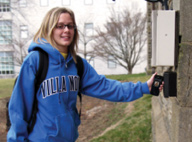
Villanova, University of San Francisco expanding trials in fall
Near field communication is going to college and finding the campus to be an ideal testing ground full of students hungry for the newest technology.
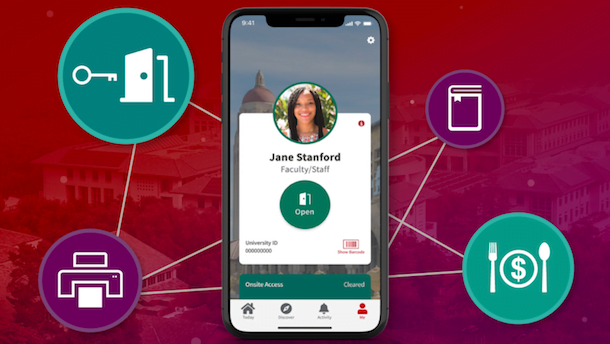
NFC’s promise – to let users do just about anything with a single mobile
device – is a little hard to pass up.
But like their business counterparts that have tested NFC, universities admit that its promise will remain unfulfilled until more NFC handsets are available.
Both the University of San Francisco and Villanova University near Philadelphia are piloting NFC programs with the help of campus card provider CBORD. The results so far show that the technology works, students like it and they want to use it more.
Ingersoll Rand developed the app and provided the hardware that turned an iPhone into an NFC-capable device, says Jeremy Earles, product marketing manager for readers and credentials at Ingersoll Rand.
To begin, the participant connects a specially designed hardware accessory to the iPhone 4 or 4s. This hardware ‘sleeve’ slides over the phone and connects to the port at the bottom of the handset. The sleeve, manufactured by Wireless Dynamics, turns a non-NFC equipped iPhone into an NFC-capable device.
Currently no other type of phone is supported, although Earles says Ingersoll Rand is considering developing the app for Android handsets as well. For the pilot, iPhones were selected because of their popularity on campus.
With the sleeve connected, the participant requests an electronic credential for the phone. He receives an email with a link to download the dedicated app from Apple’s App Store. The app is launched, a password is presented, and the cloud then sends the credential to the iPhone, explains Earles.
Now that the credential is securely in place in the handset, the student simply opens the app and taps the phone against the reader, says Earles.
Offering NFC was the brainchild of Max Steinhardt, CBORD’s new president, says Bob Lemley, CBORD’s director of software development. “Max came to me a year and a half ago and said he wanted to do something with NFC.
CBORD then went to its partner Ingersoll Rand. “They really got aggressive finding and managing pilot implementations,” says Lemley.
Villanova was chosen for two reasons, says Lemley. “First, they’ve been a leading partner with us, they’ve done a lot of new software implementations,” he says. “We’ve worked with their student government to design and build a laundry notification feature among other projects. We have a long and rich history of working with Villanova for creative technologies.”
The second reason is technical and made it easier to roll out an NFC project there. “They had just switched over to MIFARE contactless cards on campus,” he says. Thus they were already deploying contactless card readers to read the MIFARE technology, and these readers are also capable of reading NFC.
“The NFC technology works with MIFARE readers right out of the box,” explains Earles. “It’s a plug-and-play type implementation … the reader communicates with the NFC phone in the same way it would communicate with a MIFARE smart card, so no additional configuration is necessary.”
Kathy Gallagher, director of University Card Systems for Villanova’s Wildcard, says the school was looking for new technology that would enhance the student experience. “There was something exciting about being a pilot and our students are always looking for technically-advanced projects,” she adds.
She says there were 54 participants including 22 staff members and 32 students. Seven locations, mostly dorms, were equipped with NFC readers.
“We didn’t open this up to everyone on campus. We just wanted a small pilot,” says Gallagher. It involved students in three dorms covering exterior doors only. “We also had four locations for academic offices and buildings; my office was one of the four,” she adds.
Villanova’s phase two will begin with the fall semester in August and will include the school’s two larger dorms, says Gallagher. The phase two pilot will also focus on laundry and point of sale in addition to the dorms, says Lemley. “We’ll be firing that up soon. It will have different participants and a larger population.”
As soon as the opportunity became available, the University of San Francisco jumped on the NFC pilot opportunity, says Jason Rossi, the director of One Card and Campus Security Systems at the school. “NFC is the wave of the future. Students need their smart card and their smart phone to get through the day. Why not make them the same? Our students are very tech savvy, so we knew this would be right up their alley.”
Rossi says that NFC hits three main criteria: increasing security, improving service and reducing costs. “It increases security by acting as a de facto tool for secure access and transactions. It improves service because students enjoy the convenience of using their phones instead of their cards. And we project it will reduce costs by reducing the number of lost cards, meaning we won’t have to carry as extensive an inventory of replacement smart cards.”
Rossi says that USF students cannot get by for more than an hour on campus without their smart card and the same goes for their phone.
Phase one at USF focused on traditional undergraduate students in a residence hall, says Rossi. Twenty students participated along with several staff members.
The second phase will test NFC at the point-of-sale in addition to continued use in access control. The participant base will include a larger number of staff members and will also incorporate graduate students. “We want to see how working professionals are susceptible to it,” says Rossi.
The feedback to both pilots has been positive. “Students loved it for access control and want to use it for other purposes,” says Earles. “We need to make sure we’re meeting all their needs before we commercialize the product,” he says, adding, “this will be a viable product.”
The pilot saw heavy usage, says Lemley. “We’re extremely happy with the results. From a technical implementation, everything worked flawlessly.”
“Students loved it,” adds Gallagher. “They want to use it in other areas. I consider the pilot a real success.”
She says Villanova was “looking for the good, bad and ugly in the pilot but there was no bad or ugly. It was a very simple pilot and it went very well. One thing you always have on you is your phone.”
Reactions from USF students were also positive, says Rossi. “There are some barriers in its current incarnation. For one thing, NFC is currently not native to the phone,” he adds.
“Students loved it but they wanted it to be native so they could use their own handsets,” says Rossi. “And they wanted to use it everywhere. We didn’t make it clear to them when we started that we were testing it in one building.”
He believes that when NFC becomes more widely available, universities will have an advantage with its implementation. “We don’t have the barriers that exist in the private sector,” says Rossi. “I am the merchant, the bank, the transaction processing system. We don’t have to worry about getting Walgreens or other businesses signed up.”
The pilots have increased Rossi’s desire for more NFC activities. “I know it works, it’s proven. Now we’re waiting for the industry to give us the next step.”