Card, mobile credential, payment and security
Integrated software ties reusable container solution to mobile ordering, declining balance
Reusable container tracking software is elevating sustainability efforts in residential dining at Washington State University (WSU). Topanga’s reusable container solution, ReusePass, is simple and effective: check out, enjoy, and return.
In August of 2023, WSU introduced ReusePass at their mid-sized dining center, Northside Café. The goal was to enable students and dining staff to test the reusable containers and management software prior to a full rollout. The test was successful, and in the spring of 2024 ReusePass launched at all three residential dining locations.
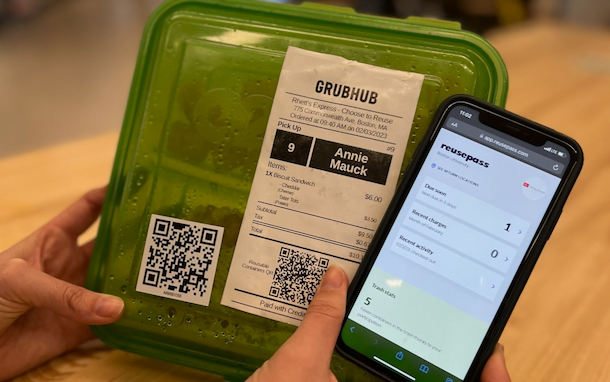
To participate in Topanga’s ReusePass, students setup an account using their WSU credentials. Then they have the option to add their unique QR checkout code to their mobile wallet for easy access.
When a student enters one of WSU’s three participating ReusePass locations, a dining services employee scans the student’s QR code and a reusable container’s unique QR checkout code, labeled on the container. The student pays using their declining balance account and enjoys the meal wherever and whenever they please.
We scan your unique QR code and the QR code on your container, and now we have made that one-to-one connection between person and container.
The container is now marked as “in use” by the system, and its status is tracked until it is returned, sanitized, and prepared for reuse.
“If we see that you are checking out a container, we scan your unique QR code and we scan the QR code on your container, and now, we have made that one-to-one connection between person and container,” said Jason Butcherite, the director of dining services at Washington State University.
To return the container, the student simply drops it off at a return receptacle located in one of the participating dining locations.
At Topanga’s 70-plus dining partnerships, the return rate averages 98%. Butcherite reports the same impressive return rate at WSU.
Topanga created the ReusePass software that powers WSU’s reusables program, but they do not make the containers or endorse a particular manufacturer. Butcherite explains that Topanga is container agnostic, and his team was empowered to choose the containers that best met their environment.
For WSU, selecting the right shape and size for the containers was important. They opted for two reusable containers, different in both shape and color.
The general-use container is an 8x3x3-inch clear clamshell manufactured by Whirley Drink Works. It is broadly available across all three residential dining locations, and it is used when students opt to carry out a meal from a dining facility.
Our grill station operates exclusively off mobile ordering. By default it comes in a green container, so when they come into our check out space we aren’t trying to ring them up for the order.
For to-go orders made online or via the mobile ordering app, they use a 6x9x3-inch green container manufactured by GET Enterprises. This was chosen with intent as the green color signals to staff that the student placed a to-go order online, and they have already paid for it.
“When students place an order for our grill station, for example, it operates exclusively off our mobile ordering and payment solution, and so by default, it comes in a green container,” explains Butcherite. “That way, when they come into our check out space, we aren’t trying to ring them up for the order.”
Staff simply scans the student’s unique QR code from their phone and the QR code from the container holding their order. The container itself serves as the visual indicator to let the cashier know that the person has already paid.
“Green means go,” he jokes.
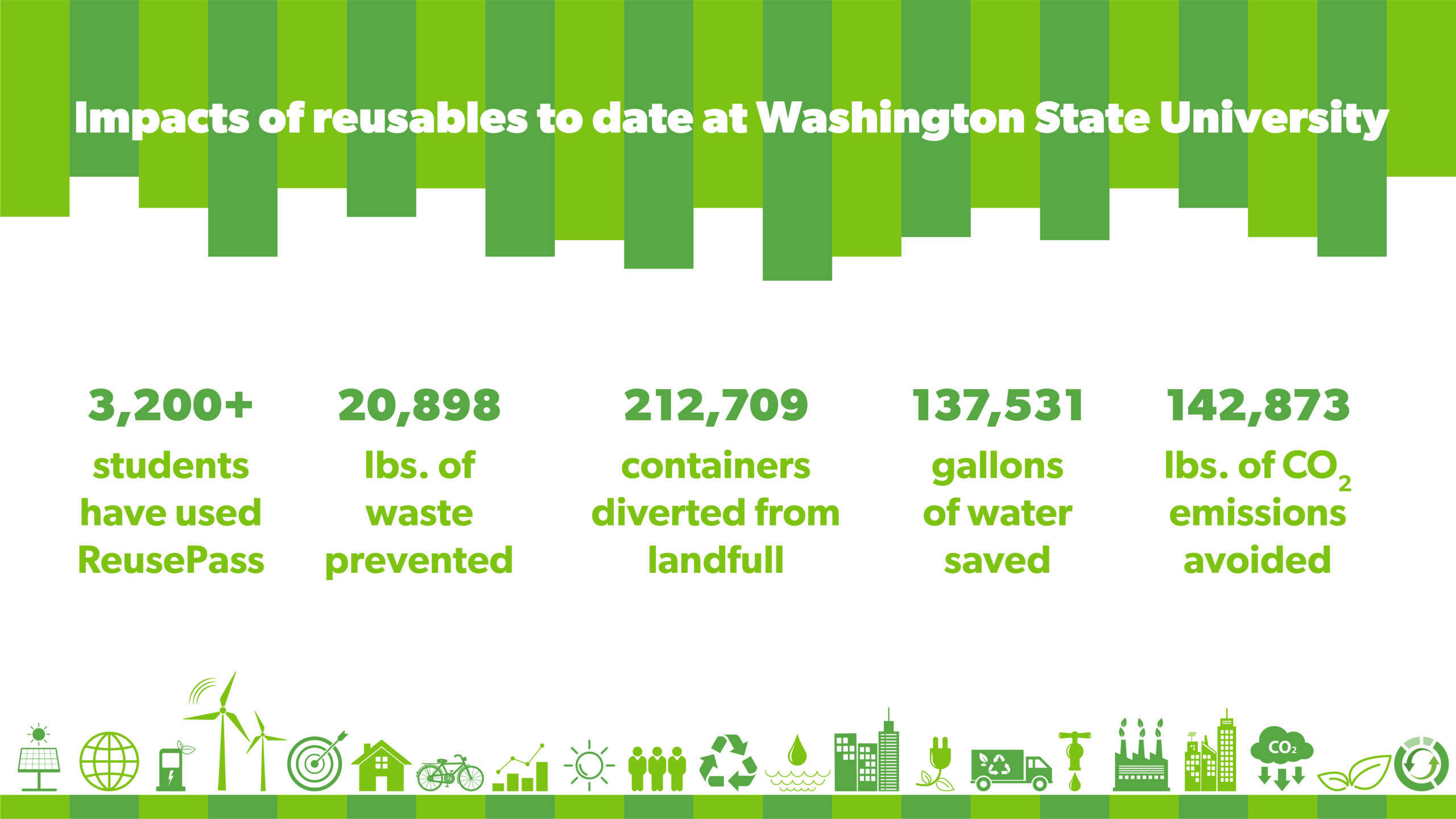
Assuming the container is returned in WSU’s allotted three-day window, there is no charge to utilize ReusePass. For the 2% of containers that are not returned, the person incurs an $8 fee that is applied to their WSU student account.
Butcherite notes that some of the fee money is used to recoup the cost of the lost container, but a portion of it sponsors future sustainability initiatives.
Many of WSU’s containers have been in use for two years, and 99% of Topanga’s RFID labels have remained intact wash cycle after wash cycle. Butcherite says the Topanga operator dashboard shows the number of uses for each container, and some containers have topped 70 uses.
We added RFID readers into our dish rooms to negate the need for a dining services employee to manually scan the containers back in.
The efficiency of the return process keeps the return rate high.
Receptacles, like those used to collect trash, are stationed at the dining centers to make it easy on users. The receptacles – also from container-provider GET Enterprises – streamline collection processes for dining service employees as well.
When the used container makes it to the washing facility, WSU further automates the check-in process.
“We added RFID readers into our dish rooms to negate the need for a dining services employee to manually scan the containers back in,” says Butcherite. “As they enter the dish washing system, the reader scans and registers them as the cleaning process begins.”
For now, WSU utilizes ReusePass solely in residential dining, but there are bigger plans.
“Right now, it is purely residential, but we have a roadmap of future plans for how it can enhance our retail dining as well,” Butcherite notes.
Aside from the advantages it offered in support of WSU’s sustainability initiatives, Topanga’s technology made financial sense for the institution.
We had good pricing on our single-use containers, but when you do the financial pro forma and look at the environmental impact of reusables, it is a win-win.
“When you do a financial analysis and run the numbers, ReusePass made a lot of sense for us,” Butcherite says. “We had pretty good pricing on our single-use containers, but when you do the financial pro forma and look at the environmental impact of reusables, it is a win-win.”
Sustainability is valued across the intuition, and it has become an increasingly important pillar of the dining services’ program.
In addition to the ReusePass program, Butcherite cites other initiatives. These include a Marine Stewardship Council certification for sustainably-sourced seafood; a partnership with the Humane Society to increase plant-based options; and a food waste control mechanism called Streamline – also from Topanga – that will launch this fall at WSU’s largest residential dining center.
As his team continues to pioneer initiatives to meet the institution’s environmental goals, he says he’ll always consider ReusePass a key to leading the way. “It accelerated our sustainability efforts, and it showed that environmental stewardship can also make financial sense.”