Card, mobile credential, payment and security
Today’s ID badges are very different from their predecessors. Laminated badges with a photo, name and job title have given way to advanced technology cards containing biometric templates and secure payment information. Companies want increasingly advanced credentials and they expect a lot from their card printing software.
“In the university space, for example, campuses have been migrating from mag stripes – to get in dorms and enable cashless vending – to smart cards that control everything on campus,” says Nils Wahlander, senior product marketing manager for HID Global.
These contemporary ID cards are being personalized inside and out, and the card personalization software has had to adapt. “They’re adding various tools to help with the enrollment process: capturing a photo, a signature or biometric information in the form of a fingerprint or even an iris scan,” Wahlander says. “The software now has to work with all these various vendors that sell those tools and integrate it into their product. That’s been the biggest change (to issuance software) over the last five years, adding in these various enrollment tools to enable a higher security ID.”
The look and use of ID badges have undergone a swift transition. “If you step back 10 or 20 years, a lot of the software didn’t even exist,” Wahlander says.
The work back then involved printing a plastic card with a few key elements of identifying information. Issuers and the issuance software were simply sending some basic data to a card printer to add to the card. “You could have used Microsoft Word at that point or Microsoft Access to keep track of all this information and just hit print,” Wahlander says.
Fast-forward a decade, and all this information – cardholder data, demographics, biometric templates, privileges and more – now lives in databases. “Issuers are capturing the various details – whether it’s from an HR database within Oracle, MySQL or a SQL server-type system – and they’re pulling it in to personalize the card,” Wahlander says.
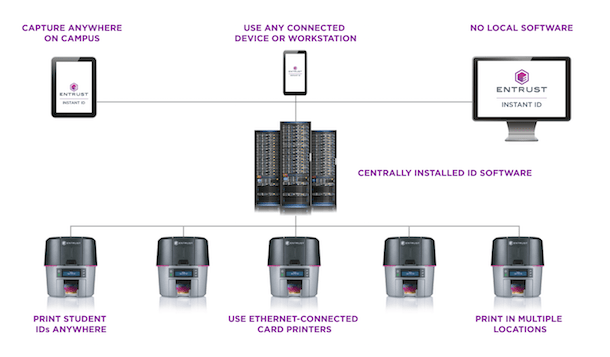
Issuance software has had to evolve to keep pace with market needs, including strong security and encryption capabilities. “There’s a greater and greater focus on making sure the information that is sent from one location to another is securely transmitted and not tampered with,” says Connell Smith, vice president at Entrust Datacard. “The use of cards is part of the bigger ecosystem within an enterprise, and in a similar way the card printing software needs to connect to other systems. So, you’re seeing expansion into greater connectivity and more intelligent use of smart cards.”
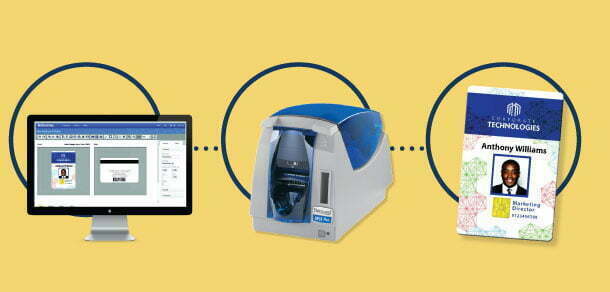
The cardPresso software offered by Evolis was created in 2012 to accommodate clients that want advanced, easy to implement features. “Card printing software is an essential component of the product when selling a card printer,” says Vincent Menard, software product manager for Evolis. “It’s the best complement to the printer for decentralized card customization and printing. It helps users design their own card with their logo and pictures and to work with their own database.”
The race toward a smarter card has the competition constantly looking for ways to stand out in the market.
“Adding text, logos and images or capturing data from a camera or a signature pad is very easy,” Menard says. “Once the card design is created, users are able to print card batches thanks to the database operations management that allows them to print a limitless number of records in one printing job. Excel, Access or any ODBC-compliant databases are compatible with cardPresso.”
Card printer settings can be accessed directly from the software. For more advanced features, customers can choose between five upgrade editions depending on their needs.
Datacard’s TruCredential platform provides a range of solutions built to simplify the process of credentialing. “We have tools that can manage complex implementations driven by API’s or the other end of the spectrum in which customers who know nothing about credentialing step through a wizard in the software to create basic IDs,” says Eric Sander, senior product manager at Datacard. “The strength of the software is really the diversity of features and functions that help manage the complexity in the industry.”