Card, mobile credential, payment and security
Annual research reveals student attitudes towards campus technology and pathways to improve satisfaction
Year after year student expectations continue to rise, and the higher ed institutions that stay ahead of the curve leverage data to strategically improve their student experience. The Student Financial Experience Report, an annual survey commissioned by TouchNet, sheds light on how mobile payments, digital IDs, and other technology affect campus life.
The 2026 report surveyed 3,020 students from the U.S., U.K., Australia, and Canada. The findings explore student attitudes on the state of campus services and the features they wish to see implemented in the future. Tracking these shifting priorities will be essential to tailor services toward this increasingly diverse and tech-savvy student population.
Topics included in the report include:
Students across all markets report expending considerable effort managing financial responsibilities, but students in the U.S. are better off than their international counterparts. Only 29% of U.S. students say that managing financial-related activities at their institution requires very high effort, while the U.K. students lead at 57%.
Nearly all students across every market use mobile pay for everyday purchases, but students in the U.S. and Canada are slightly less frequent users, and overall students are less likely to “always use mobile payments” than they were in 2024.
Features such as payment reminders, instant notifications, easier refunds, and auto-payment systems are no longer luxuries; they’re necessities.
Still, two thirds of students regularly use mobile pay (e.g. Apple Pay, Google Pay) to pay for rent, utilities, and other expenses.
Mobile phones still dominate across the board for students accessing personal financial information, but students are more likely to prefer web portals over mobile apps when accessing their student account and tuition payment information.
Mobile applications are the dominant second choice overall, but the preferences are regional. U.K. students preferred mobile apps overall, the only set to do so.
Convenience and immediacy remain a key factor in student choices as “students increasingly expect seamless digital transactions,” according to the report.
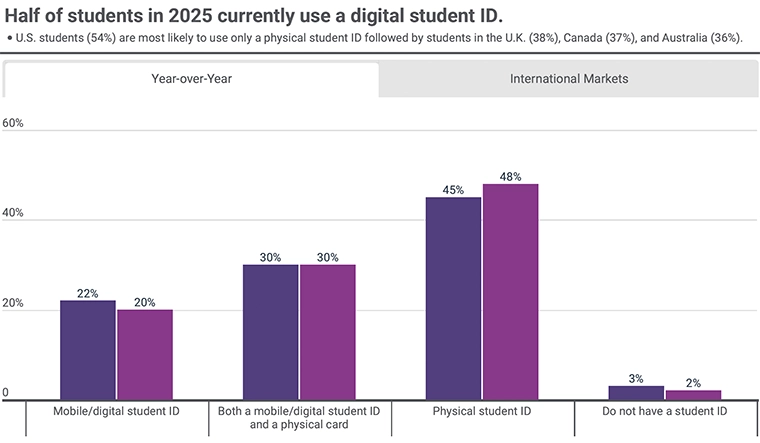
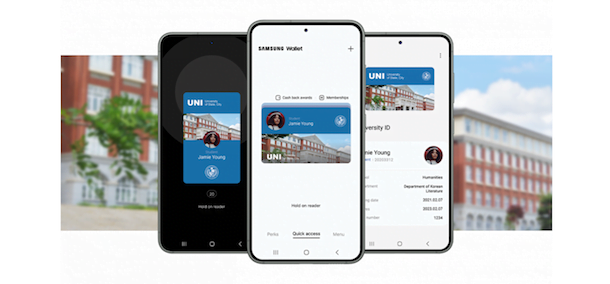
Today's students are digital natives, used to managing almost every aspect of their lives through their mobile devices. Half of students surveyed in 2025 currently use some form of digital student ID, though only 20% of students rely solely on a digital ID.
Half of students surveyed in 2025 currently use some form of digital student ID.
Students in the U.S. exhibit a stronger attachment to physical IDs, with 54% still relying on traditional cards. Globally, students are more likely to prefer to use a digital student ID (42%) over a physical one (25%). One-third of students prefer the flexibility of having both a physical and digital ID.
Students overwhelmingly prefer their student ID to serve multiple functions. Highest on the list is mobile identification (54%) and academic building access (50%), but meal transactions, campus accounts, and residential building and parking access also rank highly on student priority lists.

Students increasingly expect easy access to mobile and digital solutions on campus. Features like payment reminders, instant notifications, easier refunds, and auto-payment systems are no longer luxuries; they’re necessities.
At 56%, payment reminders top the list of what students suggest would most improve their campus payment experience, but refunds, mobile notifications, and live chat options follow shortly behind.
One survey question asked, “If your institution could improve its technology for up to three student-related services, which ones would most enhance the experience for you and other students?”
Tuition/financial aid and course registration were the clear winners. Academic student support and dining options were selected by three in ten students, while non-tuition financial processes and on-campus stores were also mentioned.
Campus technology improvements are central to the student experience, and the report notes “students expect technology that reduces friction in administrative tasks.”
The shift towards mobile solutions is holding strong while reshaping how students manage their finances and campus movements. Understanding more about student behavior and preferences can help mold products and programs for better accessibility, productivity, and satisfaction on campus. Find additional information in the complete report by TouchNet.