Card, mobile credential, payment and security
HID commissioned to provide secure issuance, verification solution for students
Exams are an important facet to a student’s educational life. Here in the U.S. they help determine a student’s aptitude and mastery of the subjects necessary to succeed in higher education.
The same holds true in Nigeria, where every year millions of students take their exit exams from the high-school level. The unfortunate truth, however, is that not everyone that takes these exams is honest about their identity.
To help combat this, a new mobile ID system is being implemented for Nigerian students in an effort to improve exam validation processes and cut down on identity fraud. The West African Examinations Council is spearheading the project along with HID Global who has provided contactless smart cards to more than 2.2 million Nigerian students enrolled in the testing program.
Comprised of five member countries – Nigeria, Gambia, Sierra Leone, Ghana and Liberia – The West African Examinations Council (WAEC) conducts public exams for primary, junior and senior secondary school levels; aptitude tests for institutions and corporate bodies; and issues results and certificates of completion for all administered exams.
Each year, WAEC registers more than 2.2 million students for exams conducted at more than 13,000 testing centers across Nigeria alone. It’s a staggering number of credentials no matter how you cut it.
To complicate matters, the old ID system saw exam registration and authorization done manually in a time consuming and fraud-susceptible process. Students registered online and were provided a paper receipt that would be manually inspected by a proctor at the time of testing.
The system lacked a secure process to confirm that students were who they claimed to be. According to a WAEC spokesperson, students were able to manipulate the exam process by fraudulently enrolling for and attending exams, with cases of impersonation a common occurrence at testing centers.
Understandably, tracking and recording cases of identity fraud was difficult, and a new system was needed. So WAEC turned to Lagos, Nigeria-based tech company, Botosoft, who in turn commissioned HID Global to assist with the development and deployment of a secure card issuance and mobile ID system.
Botosoft is the prime contractor to the WAEC, with HID acting as a subcontractor and partner. The two have worked together on other projects, such as the Biometric Central Motor Registry, explains Robert Smith, senior director of professional services, Government ID Solutions at HID Global.
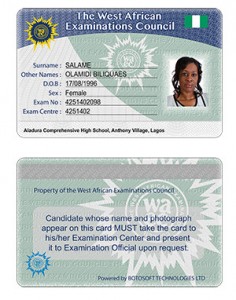 The WAEC student ID card features the name and photograph of the student and must be must presented to exam proctors at the exam center. The cards feature multiple embedded technologies not visible to the naked eye, including:
The solution to WAEC’s problem came in the form of online registration for an ID card that could then be read using a mobile device at each exam site. The cards are valid only for the exam being held for that particular semester and expire immediately upon completion of the exam. Without a valid card, students are not allowed to take the exam.
With the new system, candidates are verified in real-time, making it difficult for students to manipulate the results. The system also reduces paperwork significantly.
To get the cards into students’ hands, WAEC needed a secure issuance system.
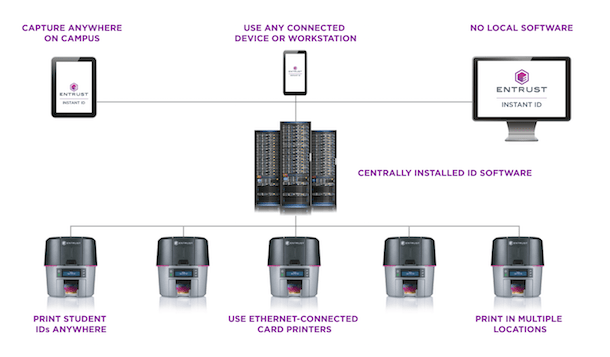
The personalization solution developed by HID relies on centralized issuance from the Botosoft facility in Lagos. “This configuration manages 48 HID printers and produces approximately 80,000 cards per day,” says Smith. “The 1.8 million cards produced for the spring 2015 exams were completed in less than four weeks running 20 hours per day. Cards are batched and packaged per state, with the WAEC state offices completing the final delivery of the cards to the students.”
The system will produce another 400,000 cards in fall of 2015.
“The FARGO DTC4500e printer was chosen for this application, in part, because it has an optional built-in RFID encoding module,” explains Smith. “The cards are encoded inline during the personalization process.”
HID provided a solution that accepts the raw data from WAEC’s online enrollment process, validates the information, and prepares it for use in personalizing the cards. HID also assisted with the design and development of the mobile reader application software used in the project.
Under the new system, students register online and the information is used to personalize and issue a contactless smart card rather than the previous paper credential. This same information is also stored in a central biometric database that can be accessed in real-time by the mobile readers at the exam sites.
“All data captured during the registration process is stored on the WAEC server, and only a subset of the student information is sent to Botosoft for personalization,” explains Smith. Once personalization is complete, the Botosoft application sends a notification of issuance and cardholder ID number back to the WAEC servers.
“Student data is then purged from the Botosoft servers,” he adds.
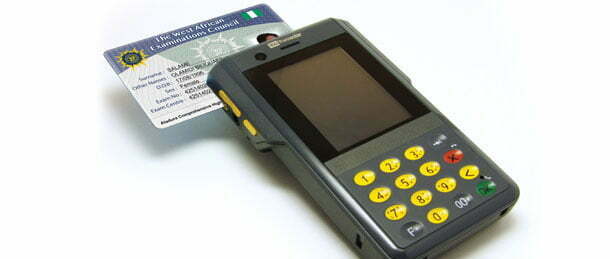
More than 18,000 Chainway C2000 mobile readers have been distributed to 3,500 exam centers across Nigeria. They enable supervisors to identify and authenticate test takers by accessing student information from the smart cards and validating it against the central database. The company is looking at alternative readers with smart phone being considered as a future option, says Smith
[pullquote]More than 18,000 mobile readers have been distributed to 3,500 exam centers across Nigeria. They enable supervisors to identify and authenticate test takers by accessing student information from the smart cards and validating it against the central database.[/pullquote]
Botosoft was contracted to visit 36 state centers and train approximately 1,000 test center employees who in turn trained the remaining 15,000 examiners who would operate the mobile readers.
The mobile readers are distributed to the disparate Nigerian states at the same time as the cards. Each reader arrives with only the necessary, site-specific student and exam center data stored locally in the device, explains Smith.
If there is a loss of cellular service, the application can validate students in an offline mode. “Any information collected – such as the date and time a student checked in, exam center location, or any malpractice attempts – is stored locally and synced at a later point,” explains Smith.
Exams like those in Nigeria are an important stepping-stone in the lives of students seeking admission to college. Without verification that the proper scores are attributed to the right individuals, the credibility of the entire process can be compromised.
The WAEC solution adds trust to the Nigerian examinations, and with this success WAEC plans to expand to its other member countries in Ghana, Liberia, Sierra Leone and Gambia.