Card, mobile credential, payment and security

Online card revalue is becoming the norm, but it carries hefty transaction fees and can leave certain users out in the cold. To combat this, many campuses complement it with old school value transfer stations.
The student ID is a great way to pay for that late night snack or last-minute print job from the computer lab, as long as there are funds in the account. But when it runs dry, there had better be a convenient way to reload.
Reloading funds has traditionally been handled in three different ways: in-person deposits at the card or bursar’s office, unattended deposits at value transfer stations or online transfer via a web revalue service.
Whether you call it value transfer station, an automated deposit machine or something else, the dominant method for loading funds to campus card accounts has been these dedicated machines strategically located around campus. They enable a student to manually insert cash or use a credit or debit card to transfer money to the campus card account.
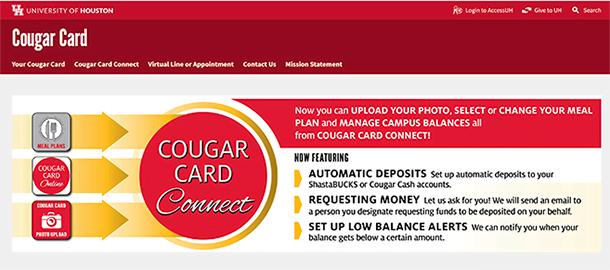
In recent years, online revalue has taken over providing students, faculty, staff and parents the ability to remotely add money from any Internet-enabled device. The online method certainly offers greater flexibility and convenience, but does that make it the clear winner?
Or is there still a place for the revalue stations of old?
“Value transfer stations absolutely still have a place on campus,” says Kent Pawlak, product strategy director at Blackboard.
He points to students needing a quick influx of funds at a printer station, individuals without a debit or credit card and campus visitors. “Campuses are often closely tied to the community, so guest cards are necessary for library print and copy or purchases at a coffee shop.”
“I would say campuses certainly give pause to whether or not they should replace an outdated value transfer station with a new model,” says Pawlak. “It’s easier to top off cards online or via a mobile app, but the vast majority of institutions purchase at least one value transfer station.”
[pullquote]Campuses certainly give pause to whether or not they should replace an outdated value transfer station with a new model[/pullquote]
Moreover, Pawlak explains that there are still campuses that don’t offer online revalue. “Some campuses prefer the student come into a card office or visit a value transfer station,” he says. “Others keep a transfer station on campus because some people are hesitant to enter credit card or personal information online.”
“Our campuses are still installing revalue stations, so much so that we are releasing our newest generation of the devices,” says Jim Perkins, director of sales for colleges and universities at CBORD.
The company’s new Value Plus Reload Station accepts both cash and credit cards using secure end-to-end encryption, explains Perkins. It has a lockable bill magazine so the person emptying the machine does not have access to the cash.
No matter how you slice it, the trend is certainly moving away from hardware to software, says Fred Emery, director of OneCard sales at Heartland Campus Solutions. “We are seeing a massive shift from deposit machines to web and mobile,” says Emery. “With all of our installs this summer, we do not have one as of yet installing these machines.”
But just because new installations may be focused exclusively online, many mature programs still rely on the hardware option. At the University of Massachusetts Lowell, a Heartland client, revalue machines still play an integral role.
UMass Lowell is a public university with two public access libraries – ideal environments for a revalue station. “Patrons often visit our libraries that do not have a UCard but want the ability to print,” says Jon Victorine, security technology director at the University of Massachusetts Lowell. “To avoid badging visitors that may only come to our libraries once, we deployed a machine in each library so they can purchase a UPrint visitor card and add value to it.”
Another added benefit to the revalue machine is that it provides students with a quick and easy means to add funds when they are running low and needing to print.
UPrint is deployed to 57 printers across campus, six of which are in libraries. “Revalue stations allows students to load funds onto their UCards in a pinch, although they also get $15 of free printing per semester and can add funds to their cards online,” says Victorine.
UMass Lowell uses Heartland Campus Solutions’ ADM-3 machines. “It’s a sturdy machine with a built-in card dispenser, cash acceptor, card reader and receipt printer,” says Victorine. The university opted not to accept payment cards at the machines to avoid the need to meet the Payment Card Industry Data Security Standard (PCI-DSS).
As for maintaining the machines, the costs are justifiable for UMass Lowell’s needs. “Our only recurring costs are licensing and hardware maintenance – the latter of which is optional but we want the insurance policy,” says Victorine. “We opt to not print receipts, so we only replace the paper every 3-4 years as audit report print outs require it.”
As far as staffing the operation, UMass Lowell’s internal collection policies require that two staff members be present when cash is emptied, says Victorine. “We have to empty the machines every week or two,” he adds.
The usage makes them essential to the program. “They receive a great deal of traffic and yield $250 to $500 per machine week, and during finals the usage triples,” says Victorine.
Though online revalue is widely used by the campus population, there is no plan to move exclusively online as the machines serve both students and library visitors.