Card, mobile credential, payment and security
Established infrastructure including door locks, privilege readers, and campus app pave the way
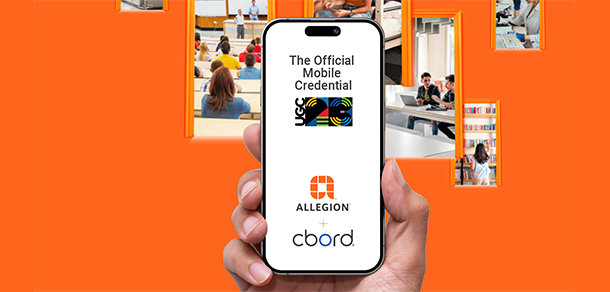
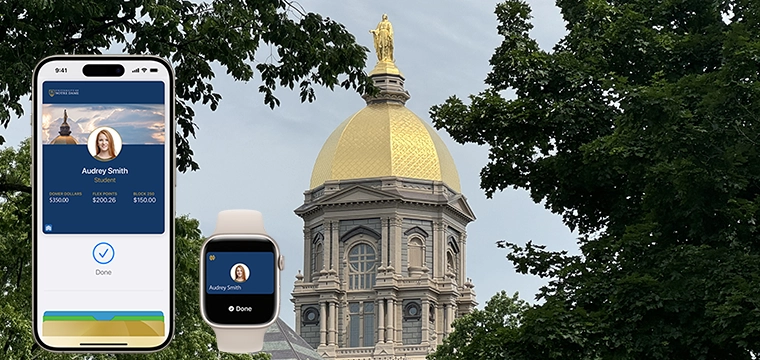
Last week, the University of Notre Dame community began adding student IDs to their mobile devices. With the help of partners CBORD and Allegion, the successful launch saw thousands of credentials issued in the initial days.
Students, faculty and staff can choose to provision the credential to either their Apple Wallet or Google Wallet.
To do so, the individual uses the GET app from CBORD to download the credential. The benefit of the GET app for provisioning is that most students already use it for other services like account management, adding funds to declining balance accounts, photo upload, and a variety of other services.
After just two weeks, 4,000 users had provisioned their mobile credentials, particularly impressive because a large portion of the 13,000 students are not on campus during the summer.
Within the app, logged in users simply click the Add to Wallet button.
Users without the GET app must first download the app from the app store and select Notre Dame from the dropdown list of institutions. Next, they sign in using their secure Okta login at which point they can select the Add to Wallet button.
All new users will be issued mobile credentials, however existing cardholders can continue to use their plastic IDs. The cards will be deactivated if the user opts to provision a mobile credential.
“This initiative marks a significant advancement in campus connectivity and convenience,” says Dan Park, president and CEO of CBORD. “Students will be able to use their mobile credentials anywhere they used their Irish1Cards, including secured facility entrances, express dining spots and even at the turnstile gates in the dining hall.”

New mobile credential works with thousands of Allegion MT and AD400 locks across the campus
The comprehensive rollout enables access residence halls, academic buildings, dining facilities and other campus services, on and off campus.
“Notre Dame, CBORD and Allegion worked diligently to ensure all use cases for mobile were addressed, being mindful that full use-case support corresponds to high adoption,” says Jeff Koziol, Business Development Manager – Mobile Credentials, Allegion.
And even in the initial days of the credential’s availability, the adoption rate has been high.
On the first day, more than 2,000 users provisioned their credential. By the end of the first week, that number topped 3,000. The results are particularly impressive because a large portion of the 13,000 undergraduate and graduate students are not on campus during the summer.
In many ways, the groundwork for the project began back in 2017 when the campus began issuing contactless cards and upgrading its physical access control environment.
Lenel provides the physical access system and Allegion provides the institution’s readers.
Over the years, between 1,500 and 2,000 Allegion MT readers were deployed at perimeter doors, offices, and labs. An equal number of Allegion AD400 locks secure interior residence hall doors. These locks facilitated the transition from contactless cards to mobile credentials.
“The launch not only simplifies access and transactions for students, faculty, and staff but also aligns perfectly with Notre Dame’s commitment to innovation and sustainability,” says Read Winkelman, CBORD’s VP Sales. “It’s a privilege to support Notre Dame as they lead the way in creating a smarter, more connected campus environment.”