Card, mobile credential, payment and security
North Dakota State finds huge benefits tracking all key card office actions via support tickets
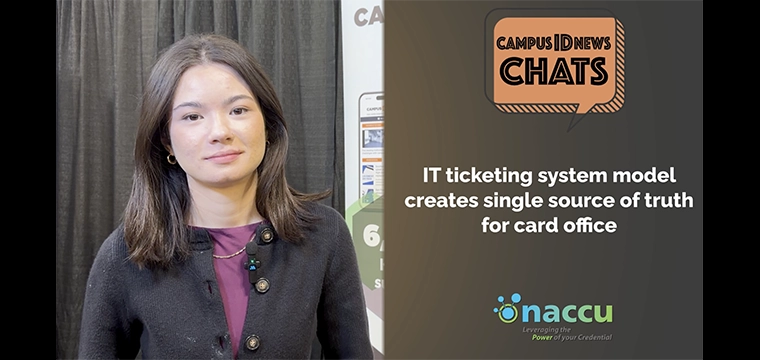
Olivia Bedard, IT Service Center Associate at North Dakota State University, explains how her campus card office transformed day-to-day operations by implementing a structured support management system. After merging with the IT Help Desk, they ceased tracking issues manually with spreadsheets. Instead, every interaction that results in support is documented through a ticket, creating a reliable audit trail and giving staff a single place to find information when questions or problems arise.
The office created service request forms for common card transactions, including new, lost, and replacement Bison IDs. Conditional prompts guide student employees through each request, automatically changing requirements based on whether they're helping a student, employee, or another type of cardholder. The result has been more consistent service and a simpler training process for student employees.
She explains that if a student comes in, I select "student" on the form, and it tells me that the charge needs to go to the student's account rather than a credit card. If an employee comes in, I select "employee," and the form tells me the charge goes to departmental funding.
When a new employee previously came in, we needed a letter from their supervisor confirming that the person was authorized to receive an ID card and providing the appropriate funding information.
Now, an HR representative or the employee's supervisor goes to our service request portal and requests the Bison ID card. We've also created service requests for things like summer program cards.
Bedard says the benefits extend beyond the front desk, creating a single source of truth for her entire operations. Standardized data makes records more reliable and gives the office a much clearer picture of its operations. Staff can quickly analyze when certain types of IDs are being produced, identify busy periods, and track trends that were much harder to see when information lived in spreadsheets.
While Bedard's office uses an IT service management platform, she stresses that campuses don't necessarily need the same technology to adopt the approach. Tools such as Google Forms or SharePoint could also provide structured documentation and a reliable source of information.
Just as important is keeping the process flexible. She encourages card office leaders to listen to the student employees who use these systems every day. Questions or confusion from staff can reveal gaps in a process and provide opportunities to improve the forms over time. For Bedard, the goal is a system that is consistent, auditable and reliable, but also able to evolve as the office's needs change.
TRANSCRIPT:
Having some sort of card job tracking system or log sheet that exists outside of your one card service is helpful because it gives you a single source of truth.
If something happens with my printer or systems, my students have an audit trail. They can go back, find the correct information, and make sure nothing gets lost.
It's completely changed our ability to provide consistent service to our campus. We don't run into situations where a student walks in and we're not quite sure what happened. We're not fumbling around looking for information to try to solve the problem. It's completely changed the scale of our operations.
One of the things I've learned is that there really is no single standard or method for how a card office operates at a university.
For us, having that separate tracking system and doing things within our IT service management system has been very important. But there may be other services or programs that can provide that same single source of truth and ensure the information you need is available and reliable.
I worked in the card office as a student, and my typical day involved looking at an Excel spreadsheet. Every credential number from a new box of cards would go onto that spreadsheet. From there, I would enter the first and last name and ID number.
But this was all on a static Excel sheet. If I typed in the wrong number, made a typo in somebody's name, or didn't save my sheet at the end of the day, essential information could be lost.
Our card office merged with the IT Help Desk in August 2024.
One of the requirements of that merger was that any contact at our front desk that resulted in a student, staff member, or other person receiving support had to be documented through a ticket in our IT service management system.
That was the main push that got us into the system.
We use a set of service requests. At many universities, if you need a new computer, docking station, peripheral, or software service, you fill out a form that includes required information such as departmental funding and information about the person making the request.
We took that model and built service request forms for our ID cards.
Anything that comes to our front desk, whether someone needs a new Bison ID, lost their Bison ID, or is a new student, gets documented using the same form with conditional prompts.
If a student comes in, I select "student" on the form, and it tells me that the charge needs to go to the student's account rather than a credit card. If an employee comes in, I select "employee," and the form tells me the charge goes to departmental funding.
It's completely changed our training systems and our students' ability to understand what's required of them right away on their first day.
We have one form that controls everything that comes through the front desk. That's our walk-in Bison ID form, and we use it for all our front desk operations. That's what our student staff fills out.
We also have forms that are completed by other members of campus.
For example, when a new employee previously came in, we needed a letter from their supervisor confirming that the person was authorized to receive an ID card and providing the appropriate funding information.
Now, an HR representative or the employee's supervisor goes to our service request portal and requests the Bison ID card. We've also created service requests for things like summer program cards.
We have one form that works internally and then additional forms for approvals that need to be made by other individuals on campus.
For our office, there's currently no additional cost because it's all handled through our IT Help Desk and IT team.
This doesn't necessarily have to be done within an IT service management system. I could easily see this being accomplished through Google Forms, SharePoint, or other tools that may already be available on different campuses.
Standardizing that data has completely changed our audit trails.
I can't type in the wrong name anymore because I have to select the person from the directory. Again, that's the single source of truth, relying on other data that we already have on campus.
It's also completely changed my ability to look at our output and understand trends throughout the year.
At what times of year are we making IDs other than standard Bison IDs? When are the largest number of new employees coming in? I can answer those questions immediately through data exports from the system.
It's completely changed my ability to provide consistent service.
Doing things in a system where "if it's not in a ticket, it didn't happen" has really improved our processes. I like adhering to the IT service management model because it's consistent, auditable, and reliable.
One piece of advice I would offer is to leave the door open for criticism and questions from students and consistently check in with them.
These can be living documents. Things can change. You can change what's included in your forms based on the data you need.
If a student comes to me and says, "Hey, I don't understand what's going on," I can explain it and give them the information they need to provide that service. Or they may have just identified a major gap in my process that I need to fix.
Leaving that line of communication open is essential.