Card, mobile credential, payment and security
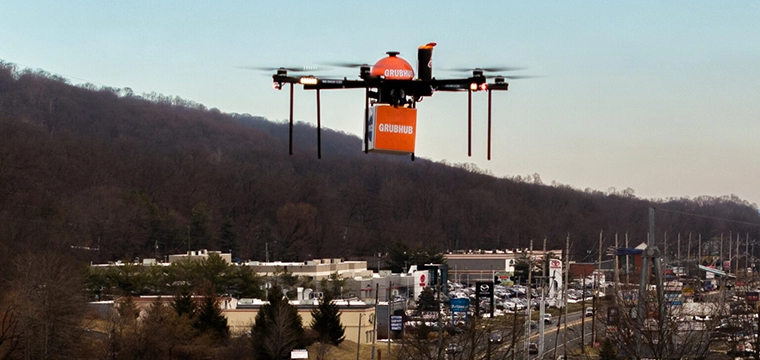
Mobile ordering company pilots autonomous aerial delivery in New Jersey
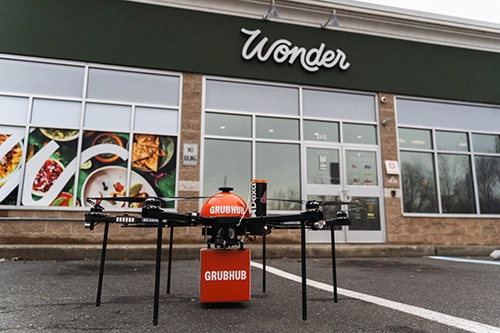
Customers ordering from a multi-concept dining location in Green Brook, NJ are having their food delivered through the skies. It’s a pilot project between food delivery company Grubhub, its parent company Wonder, and drone developer Dexa.
This spring, customers within a 2.5-mile delivery radius of the Wonder location began opting for drone delivery in the Grubhub app – with food delivered faster and at no additional cost beyond standard delivery fees. The three-month program marks the first time Grubhub and Wonder have offered drone delivery to customers.
Wonder operates a multi-restaurant model, where diners choose from a dozen or more concepts prepared to order from a single location. According to Grubhub, “the blend of culinary variety, quality, and operational efficiency creates a seamless experience that pairs naturally with the speed and precision of drone delivery.”
Campus dining facilities are similar to Wonder locations because food preparation and delivery can initiate from a single point, thus streamlining drone delivery.
The drones are Dexa’s DE-2020, a fully automated delivery aircraft designed to transport goods directly to customers. Dexa is one of four U.S. companies that both manufactures and operates Federal Aviation Administration–certified delivery drones.
According to Dexa, it is transforming last-mile logistics through autonomous commercial aviation to help restaurants, retailers, and enterprise partners deliver products faster and more efficiently via airborne delivery. By combining advanced aircraft design, FAA-certified operations, and deep operational expertise, Dexa is making autonomous drone delivery a practical, everyday reality.
Before each flight, Dexa’s flight crews verify that orders are packaged to meet food‑safety standards.
Using “advanced autonomy and secure communications technology … deliveries follow approved flight paths designed to prioritize safety and minimize noise and disruption to surrounding communities,” says Grubhub.
We are fully autonomous, but we always have a pilot at the controls ... monitoring and able to steer the aircraft.
When the drone reaches the delivery point, it places the order on the ground via a tether system.
Company officials say the drone goes about 40 mph but add safety comes first, says a CBSNews report. "We are fully autonomous, but we always have a pilot at the controls, always monitoring the aircraft, and always able to steer the aircraft," says Joe Houghton, Dexa COO.
In the same way that it does with traditional or robot delivery, the Grubhub platform tracks orders and communicates with customers. Diners and restaurant staff receive real‑time GPS tracking, estimated arrival notifications, and order confirmations.
“By connecting Grubhub’s marketplace expertise, Wonder’s innovative mealtime platform, and Dexa’s expansive drone technology, we’re proud to introduce a faster and more efficient [food delivery experience],” says Abhishek “PJ” Poykayil, SVP of Customer Delivery Operations at Wonder and Grubhub.
 Grubhub drone delivery coming to campus?
Grubhub says that following the three-month test program, it will explore expanding drone delivery.
Though there has been no specific reference to campus expansion, the higher ed model fits well with the New Jersey pilot.
In both cases, food preparation and delivery can initiate from a single point – Wonder’s multi-concept restaurant or a campus multi-concept dining facility. In normal food delivery scenario, however, orders are picked up from locations spread throughout a city or region. In this scenario, drones would have to be dispatched to the field for pickup, then delivery, then ultimately returned to the operations center. This adds significant complexity and cost.
The tight geographic delivery area also makes a campus ideal for drone delivery. The current pilot is limited to a 2.5-mile radius. Limiting the flight distance keeps aerial delivery costs down, potentially making the business model competitive with other delivery modes. The compact area of a traditional campus fits this profile perfectly.
Keep your eyes to the skies.