Card, mobile credential, payment and security
Software automations reduce card office bottlenecks, save 40 hours per week of manual labor
Faced with thousands of incoming students and a growing volume of conference credentials, the University of Michigan found itself relying on a surprisingly manual process. Its legacy card production software lacked print queue functionality, requiring staff to repeatedly initiate print jobs throughout the day. To keep up, the institution hired temporary workers each summer, but the process was inefficient, error-prone, and led to duplicate card production.
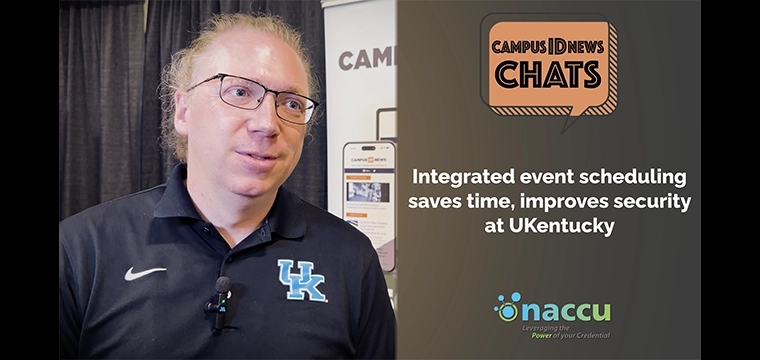
In this episode of CampusIDNews Chats, we spoke with Paul Bower, Program Manager for the Mcard at the University of Michigan. He describes how his team worked with the university’s automation and robotics department to build a software-based workflow that eliminated 40+ hours per week of manual labor while improving efficiency and accuracy.
Card printing became more consistent, reporting improved, and staff no longer needed to spend their days monitoring repetitive print jobs.
Rather than waiting years for a software replacement through the RFP process, the team partnered with the campus robotics process automation group to create a Power Automate workflow that mimicked the actions of a human operator. The automation enters student records, initiates card production, waits for printing to finish, and then moves on to the next card.
The project required only about 40 combined hours of development and administrative effort but produced significant operational benefits. Card printing became more consistent, reporting improved, and staff no longer needed to spend their days monitoring repetitive print jobs. Instead, temporary workers were reassigned to orientation support and student-facing activities.
Today, orientation card lists are uploaded into a designated Excel spreadsheet. Power Automate opens the spreadsheet, launches the card production software, and processes each record.
Today, the workflow processes orientation card lists automatically while staff oversee exceptions and printer issues. The university has since expanded automation efforts into other areas, including conference attendee processing and database validation.
Bower says the key takeaway is that institutions do not need to wait for major system replacements to improve operations. By identifying simple, repetitive tasks and leveraging tools already available through platforms like Microsoft 365, campuses can reduce manual work, improve accuracy, and create more time for higher-value initiatives.
To listen to the full interview, click the image at the top of this page.
TRANSCRIPT:
A recurring challenge at the University of Michigan was managing the annual influx of conference cards while simultaneously preparing for thousands of incoming undergraduate and graduate students. The problem stemmed from legacy card production software that lacked a print queue. Staff had to manually click “print” every time a card finished processing.
To keep up with demand, the office hired four temporary workers each summer whose primary responsibility was repeatedly initiating print jobs. This created inefficiencies, wasted labor, and increased the likelihood of duplicate card production when multiple people worked from the same print lists.
The team's first thought was to replace the card production software, but the RFP process would take months, if not years. Instead, they looked for a short-term solution that could reduce the burden while a long-term replacement was pursued.
Working with the university's robotics process automation team, they developed a Power Automate workflow that replicated the manual printing process. The attended bot enters a person's unique ID, pulls up their record, initiates card production, waits for the process to complete, and then repeats the cycle automatically.
The automation project required approximately 30 hours of development time from the robotics team and about 10 hours from the card office staff.
The automation project required approximately 30 hours of development time from the RPA team and about 10 hours from the card office staff. After testing, the workflow eliminated the need for employees to manually monitor card printing throughout the day.
The automation also improved reporting and tracking.
The bot logs printed cards, records statuses, and flags exceptions that require manual review. Rather than assigning staff to repetitive printing tasks, the university redirected those workers toward orientation support and student engagement activities.
Today, orientation card lists are uploaded into a designated Excel spreadsheet. Power Automate opens the spreadsheet, launches the card production software, processes each record, and updates the spreadsheet with print results and status information. Staff primarily monitor the printers for jams or exceptions while focusing on other projects.
For institutions interested in automation, the recommendation is to start small. Many campuses already have access to tools such as Microsoft Power Automate through existing Microsoft 365 licenses. Even without a dedicated automation team, institutions can begin by identifying simple, repetitive tasks that consume time and resources.
The University of Michigan has since expanded automation efforts beyond card printing, including automating portions of conference attendee processing and database validation. The lesson learned is that once organizations begin exploring automation, they often uncover many additional opportunities to improve efficiency and redirect staff toward higher-value work.