Card, mobile credential, payment and security
The platform offers an alternative to nationwide delivery companies and autonomous robots
As university life evolves, so does the way students access food delivery. Traditional services like Uber Eats and DoorDash can be challenging to integrate on a campus. Key delivery points are often inaccessible via cars and physical addresses can be vague. This frustrates drivers unfamiliar with the campus.
The departure of Starship’s delivery robots from campuses across the country has also impacted delivery options. All this has the founder of BYPPOCampus excited about growth opportunities, for the company’s delivery platform that employs students as ‘runners,’ delivering food to students from on-campus dining options.
Victoria Liu founded BYPPO as a way to improve the on-campus food delivery system for students. After spending time in grad school lamenting the lack of convenient delivery options, she founded the platform in March 2019.
Via partnerships with Illumia and Atrium, students can pay for delivery orders using their meal plans, dining dollars, or stored-value accounts.
At first it connected students to local restaurants, but they soon pivoted to focus on integrating student meal plans for delivery from on-campus dining locations. Today, the BYPPOCampus app enables students to order delivery to dorms, libraries, and other facilities.
“I often call this almost an Uber Eats for college campuses,” says Liu.
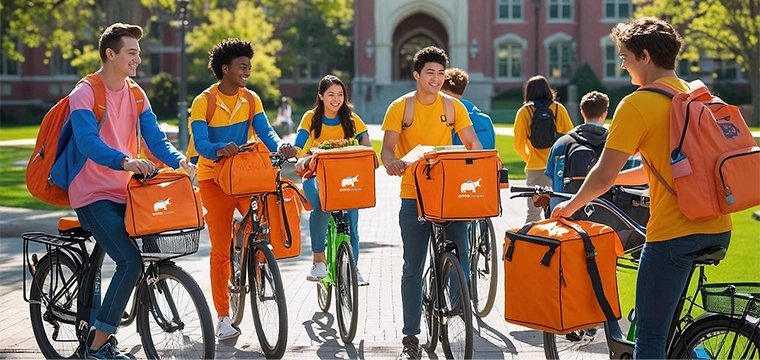
The app both serves and employs students. It offers a flexible way for students to earn money and build work experience, as they can decide when and where to accept delivery orders. As orders appear on the BYPPO Delivery Hero app, student runners can tap to accept the run. They are able to hold up to two active orders at one time.
BYPPO recruits and trains student runners, valuing the insider knowledge students bring to the service. According to Liu, they know the best shortcuts on campus, understand building access, schedules, and can navigate paths unavailable to traditional vehicle-based delivery services or their robot counterparts.
BYPPO first launched at the University of Florida and the University of South Florida, and then, according to Liu, “moved to California in August 2024.”
Since then, they have partnered with Illumia and Atrium to integrate campus meal plans into the platform. Students on BYPPO campuses this fall can order from any on-campus vendor and pay instantly using their campus funds.
The average tip is $3.50 per order, which is higher than standard given the average order subtotal of $11.
Student runners earn tips and are paid per delivery based on time, distance, and demand. Runners are paid through Stripe.
According to Liu, the average tip is $3.50 per order, which is higher than standard given the average order subtotal of $11.
“From our surveys and experience, we have learned that students have a sense of responsibility and care for their community,” she says, comparing how student experiences with BYPPO contrast from Uber Eats or DoorDash. “That’s another student from your school delivering food.”
BYPPO student runners benefit from the safety of an on-campus workplace, delivering to familiar buildings and people within a known community. During sign-up, students connect their university email address to confirm their affiliation. BYPPO maintains a “meet-outside only” policy, so runners are not allowed to enter dorm rooms, private residential spaces, offices, or restricted buildings.
Student runners benefit from the safety of an on-campus workplace, delivering to familiar buildings and people within a known community.
Runners are prohibited from using vehicles, so they must walk, bike, or scooter to different locations. If students are unfamiliar with an address or facility, they can coordinate delivery to campus hot spots—designated well-known locations like the library or student union to meet runners for food delivery.
BYPPO offers a full-service model, taking charge of restaurant coordination, student runner recruitment and training, and delivery operations and logistics. The platform takes about 60 days to launch on campus, but Liu cautions that different campuses have different needs.
The best campus prospects for the platform have a minimum of five on-campus dining options to order from along with an enrollment of 8,000 students or more.
Dining options and enrollment are key pieces to the student-powered delivery platform. “If [the campus] population is too small, we won’t have a student force to do the deliveries,” says Liu. Commuter schools can also complicate rollout, depending on how many students remain on campus for extended periods of time.
Campuses pay a flat fee to integrate the program, depending on size and the amount of delivery locations. BYPPO’s flagship university campus, the University of Florida, has 44 official on-campus dining partners, 120 on-campus hot spots, and more than 300 runners.
Liu declined to comment on the number of institutions currently served. The company's website lists University of Florida, University of South Florida, and Cal Poly Humbolt as clients.