Card, mobile credential, payment and security
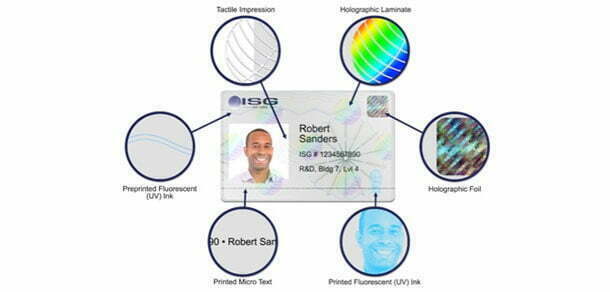
The first feature, UV ink, is perhaps best known for its ability to appear when held under a black light. Credit cards and driver licenses routinely leverage this security feature to verify the validity of the credential. This, of course, requires use of a simple, low-cost black light to verify. If your campus is currently using pre-printed cardstock, the addition of UV ink should be easy and inexpensive.
The second common security feature, holographic foil, can also be added during the card manufacturing process. Holographic foil is a strong visual indicator of a card’s authenticity. The foil can be applied at the card factory and can either be embedded under the card lamination, or applied on top of the lamination. As with UV ink, the use of holographic foil is also reasonably priced.
It’s important to note, too, that there are a variety of other secure printing options available from various card manufacturers. Other security features include the use of micro text, guilloche patterns, lenticular imagery and opacity marks. However, UV inks and holographic foils remain the most popular options.
Once your cardstock is on campus, there are still several security options that you can implement onsite through the use of your card printers. The security features you choose will ultimately depend on the printer technology your disposal (direct-to-card or retransfer), your visual security preference (overt or covert), and your budget.
When it comes to adding security features during the issuance process, a campus should first consider whether overt or covert security is preferable. Overt security features can be seen by the naked eye and/or felt by the fingers. Examples of overt features include holographic foils, holographic laminates and tactile impressions. Covert security features, on the other hand, aren’t visible to the naked eye and require a tool to verify. Examples include UV printing and the use of a black light, or micro text printing and the use of a magnifying instrument.
Similar to printing UV ink at the factory, most desktop ID card printers now offer UV fluorescing or UV ink panels on color ribbons, which enables the printing of static or variable images and information in an ultraviolet layer that can be seen with the use of a black light. This is an extremely inexpensive way to add easily verifiable information on a student ID card.
It is important to note that not all card printers can provide the same level of quality, as some can only print a static image or text field that is common to every issued card. Using a variable field, such as person’s photo, for the UV image is much more secure.
Custom or generic holographic laminates can be used on most ID card types. An overt security feature, holographic laminate images can be seen by the naked eye without the need for a special tool.