Card, mobile credential, payment and security
Simple add-ons upgrade thousands of Allegion AD series locks from magstripe to NFC
At Ohio State University, a multi-year project to modernize physical security is underway. It will replace security system software, thousands of door access readers of different makes and models, and credentials as well.
Ohio State is a perfect example that higher education has never stood still when it comes to access control. Credential formats evolve, expectations shift, and campuses must balance security and cost across thousands of doors.
Few people have witnessed the evolution of campus security as closely as Jeff Koziol, Business Development – Higher Education at Allegion.
The “AD” stands for adaptable. Rather than locking institutions into a single credential type or security system, the AD family was designed to evolve alongside campus strategies.
“I’ve been around long enough to see campuses migrate from managing doors with pin codes to managing them with mag stripe, then prox and later contactless,” Koziol says. “And now, of course, we’re in the mobile credential age.”
He estimates he has lived through five iterations of credentialing on college campuses, each bringing improved functionality but also a familiar pain point. Historically, every major shift required ripping out and replacing readers and locks across exterior doors, residence halls, offices, and academic spaces.
“Every time a campus moved from pin codes to mag, or mag to prox … or contactless … or mobile, they had to forklift all their locks,” he explains. “That is a very expensive endeavor.”
That repeated cycle of reinvestment drove Allegion to rethink how electronic locks should be designed – less as fixed hardware and more as adaptable infrastructure.
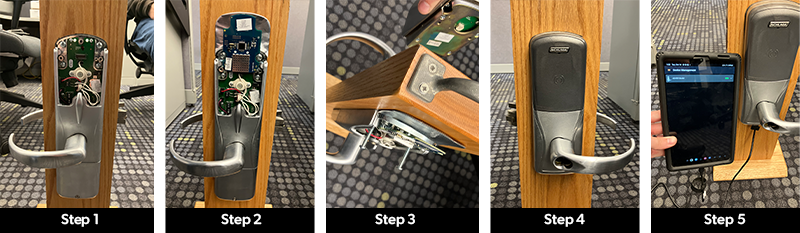
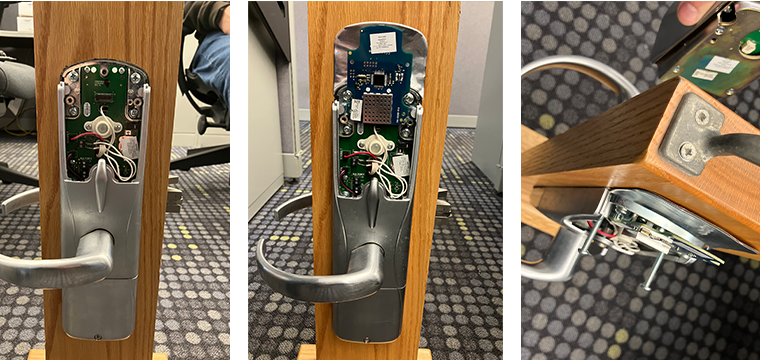
At Ohio State, the process to upgrade their offline Allegion AD250 locks to online wireless AD400 locks took several steps. Step 1: Remove the faceplate from the interior side of the door. Step 2: Add a wireless board to bring the lock online. Step 3: Remove the mag stripe module from the exterior side of the door. Step 4: Add the contactless/NFC module to the exterior side. Step 5: Update the lock's software to let it know it is now an online device.
The result of that thinking is Allegion’s AD lock platform, where “AD” stands for adaptable. Rather than locking institutions into a single credential type or security system, the AD family was designed to evolve alongside campus strategies.
The electronic lock is designed to extend access control economically, particularly in interior spaces, but they can support exterior use cases when needed.
Rather than forcing campuses into proprietary ecosystems, AD locks integrate with a wide range of access control platforms.
“They work with Lenel, Genea, CBORD, TouchNet, Software House – fill in the blank with the 50 or 60 other access control systems out there,” Koziol says.
By swapping out components and updating firmware, the lock can go from one configuration to another. You keep the physical lock, thus preserving your investment and removing the need to rip and replace.
The AD platform comes in three primary configurations:
Where ‘adaptable’ comes into play is that campuses can migrate between these configurations without replacing the lock body itself.
By swapping out interior components and updating firmware, the lock can go from one configuration to another. You keep the bulk of the physical lock, thus preserving the original investment and removing the need to rip and replace.
Few campuses better illustrate the value of adaptability than The Ohio State University.
In a NACCU webinar, Josh Bodnar, Director of Ohio State’s BuckID program, explains that when he started at the institution, the access control environment reflected years of building renovations and technology transitions.
“When I arrived in 2019, we had a mixture of electronic and other locks, especially in the residence halls,” he says.
At that time, the university had 2,300 Allegion AD250 offline locks managed through a Vanderbilt software system. They also had 2,500 Best BASIS G locks controlled via a dedicated instance of Lenel OnGuard.
A separate online security system from Transact Door Access managed the perimeter doors in residence halls and student life buildings. This system supported 400 Allegion AD400 locks.
The locks were originally installed more than a decade ago. Instead of writing off that investment, Ohio State leveraged the AD platform’s modular design to replace the ‘guts’ and extend the lifespan of the hardware.
Even with this large number of electronic locks, mechanical locks were and are still widespread. Approximately 4,000 individual locks using brass keys exist on residential suite and room doors.
Credential technology was also in transition.
When Bodnar arrived, credentials were almost exclusively magnetic stripe, but the institution has steadily moved toward contactless NFC cards with an eye toward mobile credentials.
One of the most impactful changes at Ohio State has been the upgrade of its offline AD250 locks to online AD400s. During summer 2025, all 2,300 were upgraded.
The locks were originally installed more than a decade ago as part of a major construction project. Instead of writing off that investment, Ohio State leveraged the AD platform’s modular design to replace the ‘guts’ and extend the lifespan of the hardware.
“We were able to leverage the adaptability and were hoping to get another 10 years out of that investment,” says Bodnar.
The work was done in-house rather than outsourced, saving the university $1 million in labor costs compared to hiring contractors to update the 2,300 locks.
Over the summer, Ohio State installed wireless infrastructure across eight buildings, upgraded the locks, added communication kits, and deployed new readers. While most students already had tap-enabled cards, some upper-class students required re-carding to ensure compatibility.
“That was a fun adventure for my team over the summer,” he says. “But it was a much easier lift because we could use the Mr. Potato Head nature of the lock to quickly change components.”
Crucially, the work was done in-house rather than outsourced. Bodnar estimates that decision saved the university $1 million in labor costs compared to hiring contractors to update the 2,300 locks.
When the upgrade was complete and all locks were online, Ohio State was able to shut down one of its legacy security software platforms – its Vanderbilt system.
Ohio State’s modernization extends beyond hardware to its software environment as well. The university has been migrating the student life access control system from Transact Door Access to Lenel S2. The goal is to bring all entry points managed by BuckID into a unified, online access control platform.
According to Bodnar, they moved the last readers from the old Transact system and onto Lenel S2 Netbox just before the end of 2025.
With the AD250-to-AD400 upgrade complete, Ohio State is already seeing the benefits of mobile-ready infrastructure.
Mobile support was baked into the deployment from the beginning.
We made sure the new locks were set up to read both our plastic card and our pre-deployment mobile credential. Every one of those 2,300 locks already have our mobile keys.
“At the time we installed them, we made sure that those locks were set up to read both our plastic card and our pre-deployment mobile credential,” he explains. “We have mobile keys already, so every one of those 2,300 locks already have it.”
That puts Ohio State well on the way toward its goal of making all student room doors tap- and mobile-ready.
The next phase however – replacing the remaining Best BASIS G locks with AD400s – will be more complex.
This will require taking a legacy lock off a door and installing a totally new piece of hardware. They plan to pilot the approach in a single building before scaling the effort across the remaining 2,500 doors.
Down the road, they are evaluating how best to handle older buildings that still rely on brass keys.
For new construction and major renovations, Ohio State’s direction is clear.
“Everything that gets built or gets renovated in student housing is going to have an online lock on the suite and room doors,” says Bodnar. “And right now that will be the AD400.”
Ohio State’s experience validates the original vision behind Allegion's AD platform. It has delivered on the promise of creating an access control infrastructure that adapts as campuses evolve.
For Allegion’s Koziol, Ohio State’s experience validates the original vision behind the AD platform. It has delivered on the promise of creating an access control infrastructure that adapts as campuses evolve.
The lesson for higher education is straightforward.
Technologies will continue to change and budgets will remain constrained, but institutions that plan now will be better positioned for what comes next.
Infrastructure that enables upgrading security software and credential technology without the need to rip and replace is the very definition of adaptable.