Card, mobile credential, payment and security
Already 10% of students have used new tool to explore and share dining histories
Yale students are visualizing their on-campus dining history in a unique way thanks to a new service called Yale Hospitality Wrapped. It was created by an undergraduate computer science major and based on the incredibly popular Spotify service of the same name.
Spotify launched its Spotify Wrapped in 2016 as a tool to let users see a visual representation of their music preferences over the course of the year. It became a viral marketing phenomenon as millions shared their personal Wrapped on social media. In the years that followed, virtually every streaming service has jumped on the bandwagon and even learning sites like Duolingo have added their own annual wrap-up.
Now it’s campus dining’s turn.
He “reverse engineered” the Transact API to access the HTML data from the user’s account, synthesize the swipe data, and compute the individual account holder’s statistics.
For Yale Hospitality Wrapped, the concept is similar. Show the student when they dined, where they dined, and how often they dined.
Yale undergraduate Anish Lakkapragada created the Chrome extension that – after just one semester – is already used by more than 10% of his classmates.
“Everyone likes to compare and categorize,” he says. “We have things like chicken tender Tuesday and all these traditions, so people want to see how much they go.”
Lakkapragada uses the meal swipe data from Yale’s Transact Campus system to build the users’ dining hall wraps.
He “reverse engineered” the Transact API to access the HTML data from the user’s account, so it grabs the HTML pages, synthesizes the swipe data, and computes the individual account holder’s statistics.
When a student installs the Yale Hospitality Wrapped Chrome Extension, they click the button saying add to Chrome, and it automatically takes them to Yale’s central authentication page where they enter their NetID and password. Once signed in, the extension does the rest.

Campus card and transaction systems hold many more data points beyond meal swipes, and Lakkapragada is eager to explore other areas. Stored value, access control, and rec center transactions are of specific interest.
Currently, Wrapped is available for the fall 2024 semester, but it will be changed to analyze spring 2025 meal swipes at the end of the semester. Though it would not be true to the year-end concept of a typical wrapped, he says the extension could be modified to allow users to set their own timelines.
Lakkapragada has already expanded the dining hall wrapped to another major university, and he emphatically says he’d welcome others to get on board.
Until he built Wrapped, he says he really did not know about his dining usage.
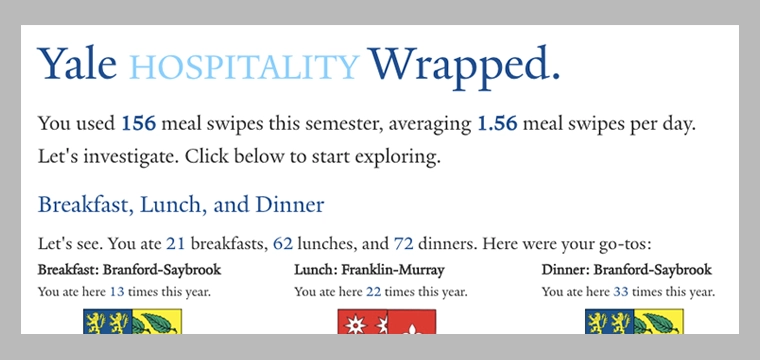
He found he used 156 meals wipes during the semester, averaging 1.5 meals per day. He believes that he, like so many students, under-utilize their meal plans, and Yale Hospitality Wrapped could help them better take advantage of it.
“I pay for three meals wipes per day, but obviously, I'm a student and I’m not waking up for breakfast,” he jokes.

Yale Hospitality Wrapped screenshot
One of the extension’s most popular data points is the diversity score. It is calculated based on the number of dining locations a student visits during the term. If you frequented every location, you’d attain the maximum scored of 100, but if you ate at the closest dining hall for every meal, you score would be zero.
Student are using social media to share and compare diversity scores. Lakkapragada hopes this aspect will encourage students to explore other dining options on campus.
This could be a great benefit to dining services as well.
“We actually did speak with Yale Hospitality about the project, and they were excited and supportive,” he says. “They were surprised and receptive to it.”
Today, the data is disparate and tied only to each unique user. Anonymously aggregating the results across all the participants, however, could give a very different and interesting perspective.

Anish Lakkapragada, Developer of Yale Hospitality Wrapped
Lakkapragada says that is one of the reasons he would like to advance the project from a Chrome extension to a web app. As a website, there would be more flexibility to aggregate data, expand functionality, and include other campuses.
“If any other university that uses Transact is interested – a student, an administrator, a Transact Campus developer – I'm more than receptive to sharing code,” he says.
Why did he do it?
“Creating software is one of my favorite pastimes, and I like seeing my stuff being used on someone else's computer,” he says. “I always feel really happy.”
Anish Lakkapragada is a first-year undergraduate at Yale University double majoring in computer science and mathematics. He encourages anyone interested in contributing to the project or bringing a dining hall wrapped to their campus, to contact him at [email protected].