Card, mobile credential, payment and security
 By David Kelley, Vice President, Product Development, TouchNet
Both Near Field Communication (NFC) and Bluetooth Low Energy (BLE) are valuable technologies for use on higher ed campuses. While they seem similar, in fact they are not interchangeable, as each technology is best used to accomplish different, specific tasks.
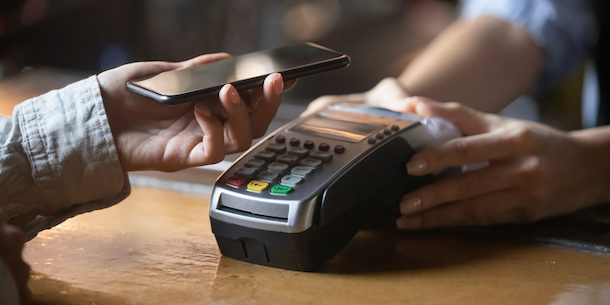
NFC is best for payments and access control because NFC was built to do what payments and access control foremost need to do: quickly and securely transmit data from a single device to a single device.
BLE can send larger amounts of data between multiple devices over longer distances but that’s not needed or desirable for payments and access, and in fact these BLE traits often create problems for these types of transactions. BLE is better suited for other use cases.
Because of how the technology was built, NFC has inherent advantages for payments and access that BLE does not possess. NFC was built to communicate over very short distances (less than 4 cm or about 1.5 inches), employ an automatic connection with rapid data transmission (less than 0.1 seconds), and involve only one device communicating with one device at a time.
The combination of these traits makes NFC the right technology for payments and access because they require secure, stable, fast, and accurate communication. The short distance and one to one connection ensures that the right device is connecting with the right device, transmitting stably and rapidly, and communicating without chance of interference and hacking.
BLE transmits over long distances (up to 30 feet/9 meters), requires a manual connection, and is open to connect multiple devices. These traits make BLE useful for transmitting data that is shared amongst many users and devices and does not require the utmost security, such as audio signal transmission.
But for the use cases of payments and access, these same traits can expose a signal to a wide field of interference and possible hacking from the dozens of devices within range of the BLE transmission. Requiring a manual connection also creates a frustrating user experience due to glitches in permissions and user errors with passwords.
NFC also operates at very low power, even when your phone's battery appears to be dead. In an emergency situation a phone will still be able to communicate with a NFC-enabled reader to gain immediate access and swiftly get to a safe place.
The ability to operate at very low power is especially important on a college campus where the safety of students is paramount and a significant reason why NFC is the best technology for building and facility access. In an emergency situation where speed is crucial, NFC means no worrying about dead phones, no wasting time manually attempting to set up a connection, no interference from allowing multiple devices to connect from across an extended area. In contrast, BLE exposes users to these unnecessary risks.
Very low power can be leveraged in an additional way. NFC allows for the use of passive radio-frequency identification (RFID) tags. The tags are powered by induced electromagnetic energy from a phone and drive data transmission between phone and reader to complete an access or payment transaction.
If a carpenter needs to drive a nail, they use a hammer, which is built to drive nails better than other tools. A carpenter would not use a socket wrench, which could pound a nail but it’s not built for that and won’t be as effective and efficient as a hammer.
NFC was built for rapid, secure transmission of data from one device to one device without interference, which is exactly what payment and access processes need to function correctly, and why NFC is the standard for these use cases instead of BLE.
The advantages of NFC for payments is why the world’s major credit and debit card companies embed NFC in physical cards to securely transmit payment data. The advantages of NFC for payments is why Apple Pay, Google Pay, and Samsung Pay use NFC in their digital wallets to securely transmit payment data. As a result, in most parts of the world NFC is now the standard for contactless payments.
The advantages of NFC for payments apply to access, too, especially in busy, crowded places where there is a high chance of interference and exposure to hackers. The security and stability of NFC is why public transport in many of the world’s largest and densest cities – including Hong Kong, Singapore, and London – use NFC-based cards as the access control mechanism for public transportation.
When developing your payments and access ecosystems, ensure your campus uses the right tools for the task. It is the best way to achieve lasting security, efficient operations, and consistent, high-quality service.
For more on building out your campus transaction ecosystem, visit TouchNet.com.