Card, mobile credential, payment and security
A conversation with CBORD’s Bob Lemley
Each year, more than 600,000 U.S. college students ages 18-24 report experiencing some kind of violent crime while on campus, according to data published by a U.S. Department of Justice study of violent crime on college campuses.
Violent crimes include everything from robbery and rape to aggravated assault. Moreover, 84% of women who reported being sexually coerced experienced the incident during their first four semesters on campus – the period of time that most college students live in on-campus housing.
The statistics are troubling, but universities and vendors alike are working to implement solutions to make campus and campus housing safer for students. Of the many security measures available, visitor management systems offer a first line of defense.
To get a better idea of what’s being done on the visitor management front, CR80News spoke with Bob Lemley, director of software development for CBORD, about the visitor management challenges in higher education and how universities are navigating the issue.
While the idea of visitor management sounds all encompassing, the challenge for colleges and universities isn’t how to manage guests on the campus as a whole, but rather their access to specific locations within the campus. And no location is more crucial than the residence halls.
Think of it as compartmentalized visitor access.
Another facet to visitor management is the issuance of temporary cards or visitor badges. It’s standard fare for a number of market verticals, but higher ed doesn’t always lend itself to these types of solutions.
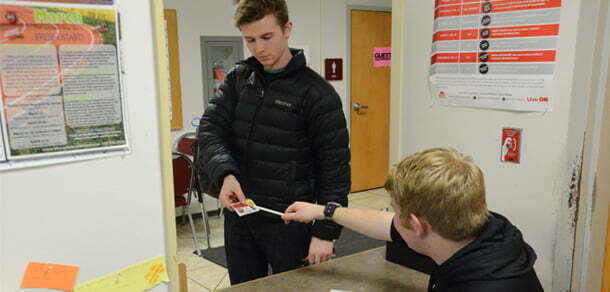
Campuses rarely issue temporary cards or badges to student guests, but official campus visitors, vendors and contactors are almost always issued some kind of temporary credential, says Bob Lemley, director of software development for CBORD.
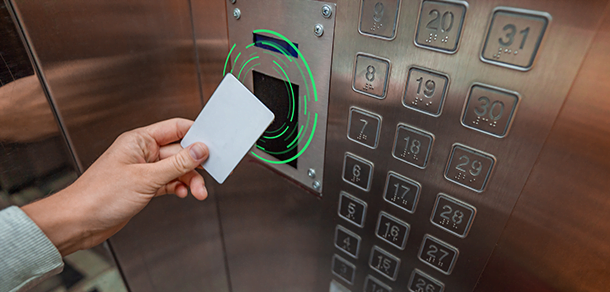
Official university visitors are typically handled the same way as a student or faculty member. “They are issued a card that’s valid for a limited amount of time with limited privileges,” explains Lemley. “That’s a very common set of requirements.”
Where it gets more challenging, though, are summer camps where you’re dealing with the housing office where management systems can be very diverse, explains Lemley. “We have been, and are still, building systems that will make the whole camp experience easier to manage from an auditing point of view,” he says. “And frankly, a lot of it comes back to the residence hall and making sure people can get into the right room.”
“We haven’t built fully fleshed out visitor management solutions for an entire campus, but rather we have focused specifically on residence halls,” says Lemley. “One of the things that you’ll find with visitor management is that the rules and implementations are extremely diverse. It makes the rest of the things we do seem simple.”
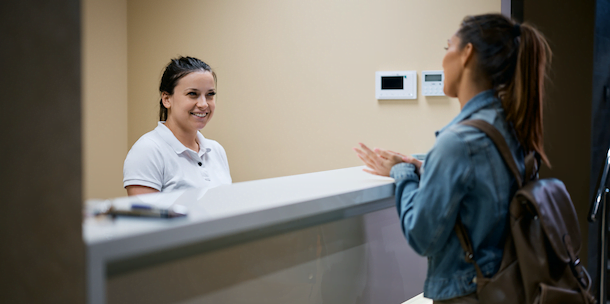
The first challenge with visitor management in residence halls, albeit an obvious one, is that people actually live in the building. “It’s not an 8:00 a.m. to 5:00 p.m. clock-in, clock-out scenario,” explains Lemley. “When someone comes to visit a dorm, they’re visiting someone’s home, and you’re managing that home.”
The typical college campus also tends to be open in terms of general access, making visitor management at the residence hall level all the more important. “Universities have to balance how much protection they provide for students, while also providing the convenience and comfort of a home,” explains Lemley.
Rather than a set of best practices that can be applied across the board, every implementation is highly customized to that institution and the rules are fragmented, explains Lemley.
“Policies typically don’t fit into a standardized set of algorithms like meal plans or the rest of what a campus card system would do,” he says. “You get into all kinds of little detailed things that take a lot of business logic to implement.”
Universities can, for example, have special policies for the handling of minors that requires them to always be accompanied by a parent or guardian. Other universities have a family pass system where residents have two passes each semester for a group of visitors. And it’s not that University X has a specific rule and University Y has another specific rule, rather each tends to have a whole set of unique and complex rules.