Card, mobile credential, payment and security
ColorID's new CHOICE Support Program aims for nationwide on-site support
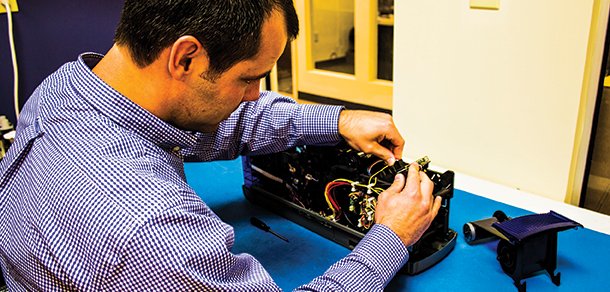
Imagine that it’s orientation and you’re printing student IDs by the dozen. You’re churning out cards until you blow out a printer, bringing the operation to a grinding halt and leaving students lined up out the door. It’s a nightmare scenario for any card office, but whether it’s a high-issuance time or just standard day-to-day use, losing a printer is a mission-critical problem.
For most offices, the first step would be to troubleshoot the problem and hope that the printer can be fixed internally. If not, placing a call for local depot service or to the printer manufacturer will be in order. It’s often a lengthy and stressful process that can leave card issuance down until a replacement or loaner printer can be shipped.
ColorID has recognized some of the inefficiencies in this process and with the company’s new CHOICE Support Program is seeking to personalize service support for each institution’s needs. The program marks a first in that it sees a depot service provider offering on-site support, something only previously offered by local systems integrators, says Danny Smith, executive vice president of ColorID.
[pullquote]Core integrators have their product sets, but there are a lot of things outside their portfolios that still require service[/pullquote]
CHOICE is designed to be comprehensive, maintaining a card office’s current processes and also helping plot a course for future implementations. “In addition to support, the program provides options to advance identity management solutions institution wide,” says Smith. Each institution tailors its approach to both support and advancement, selecting from a menu of services and options.
CHOICE was developed with input from many of ColorID’s campus clients. The new program has already been rolled out to a host of campuses, including Harvard, Northwestern and San Diego State University.
“We rolled it out, cherry-picked some campuses and ran the idea by them,” says Smith. “Of the eight institutions we showed it to initially, six signed on almost immediately, and there was positive feedback from the other two.”
He explains that the program’s formation is the result of working with employees and clients to determine what services campuses need and fill in gaps that exist with other service options.
“We provide products and services to about 1,200 universities, and we are engaged with a lot of migration and technology projects,” Smith says. “Core integrators have their product sets, but there are a lot of things outside their portfolios that still require service.”
When an institution considers a migration we’ll start by visiting the campus to learn about the existing environment and goals going forward, explains Smith. “It’s common for us to provide a technical presentation to campus stakeholders on emerging identity trends and technologies – contactless, biometrics, mobile and other solutions.”
The purpose of these initial meetings, Smith says, is not to decide on a particular technical solution or direction, but to provide perspective and create dialogue between campus stakeholders. “In some cases, these campus agencies have never collectively discussed an institution-wide identity management strategy,” he explains. “It’s a great starting point and it has helped establish collaboration across campus.”
For many years, SDSUcard has enjoyed a good relationship with ColorID mostly regarding supplies, printers and production applications, says Paul Carlisle, manager of the SDSUcard Office at San Diego State University. “They’ve always taken the time to answer questions regarding changing card technology, and we value them as an information source.”
Carlisle sees the CHOICE program as an asset in a market of ever-evolving technology. “Card technology moves inexorably forward, and while we use a contemporary platform at SDSU, the conversation is now moving toward multi-level devices and arguably to eventually eliminating cards entirely,” he says.
[pullquote]Campuses that can really scale this and benefit are those that have large operations where it’s more than just printers[/pullquote]
For Carlisle, stakeholder meetings – a menu option under CHOICE – have been critical. “It was vital to educate and demonstrate how new technology and applications may be of value,” he explains.
The driving force behind bringing CHOICE into SDSU’s solution process was residential room access, says Carlisle. The wear and tear on cards within residence halls led SDSU to the decision to migrate to contactless credentials.
SDSU launched the contactless cards in June, and Carlisle credits ColorID for aiding in the process. “The support program brought an important level of technical savvy to address production problems and make this a seamless transition,” he adds.