Campus ID News
Card, mobile credential, payment and security
FEATURED
PARTNERS
asu nfc 1 1

Campuses show that NFC is more than payments

Zack Martin   ||   Dec 30, 2015  ||   , ,

Near field communication (NFC) is primarily thought of as a payment tool. Google, Samsung and Apple all have payment programs that take advantage of the short-range communications protocol. And while that’s been a popular use of the technology it is by no means the only application.

College campuses have been exploring the use of NFC for aspects other than payments. These uses were highlighted in a Smart Card Alliance white paper looking at non-payment use cases for near field communications technology.

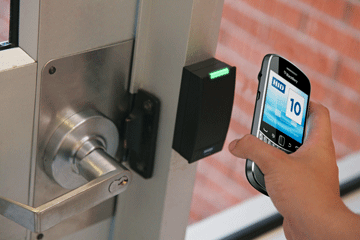
The paper details use cases for NFC for physical access control at Quinnipiac, Villanova and Arizona State University. The value proposition with NFC over cards is convenience – no need to wait for a visitor badge, streamlined ID issuing, Over-the-Air issuance, and secure storage of IDs.

Am important component of the value proposition offered by NFC is the ability for a user to obtain and use a secure credential in real time with little friction. One example of a frictionless transaction is the delivery of a hotel room key or a student dorm-room key to a user as part of a check-in process.

Implementation requires a secure means of generating credentials that can be registered with the physical access control system and provisioning such credentials to a secure environment on an NFC phone that can then be used to present them to the NFC door reader. A wallet application on the smartphone can provide the user interface through which the user can select which credential to activate. More sophisticated apps may use Bluetooth beacons to streamline the selection process, waking the app and prompting the user for some form of authentication, such as a biometric.

Use of the technology on campus has been popular. Villanova reported that by removing combination and key locks and using mobile phone activated doors the university saved a tremendous amount of money in the annual turnover that is required to re-key dorm rooms each year.

The school has also reduced the amount of lockouts because students seldom leave their mobile phone in the room. Another saving is the need to rekey if a master key is lost. Now, with a centralized room-key management system it is easy to do the annual changeover, issuing one-day permission to certain rooms as required, and enabling other key-related actions.

The Smart Card Alliance white paper includes additional information in NFC, including:

  • Discussion of marketing, identity and access, ticketing and gaming use cases
  • Description of the use cases including implementation considerations and challenges and examples of real-world implementations
  • Discussion of approaches for securing sensitive user credentials for non-payment applications
  • Discussions of implementation challenges that are common to all non-payments use cases.

The full white paper can be downloaded here.
Subscribe to our weekly newsletter

RECENT ARTICLES

College student getting a stainless steel reusable container from USEFULL for a take out meal at a campus dining location
Nov 12, 26 /

USEFULL's stainless steel containers remove plastic from reusable dining programs

As colleges and universities look for ways to reduce disposable packaging in campus dining, reusable container programs have become an increasingly popular option. But while many solutions rely on reusable plastic containers, USEFULL is taking a different approach. It provides stainless steel containers supported by technology that tracks checkout, returns, and inventory. For Alison Cove, […]
Student use id card in cafeteria at University of Oregon

University of Oregon selects FutureState for campus credential management

FutureState announced that the University of Oregon has selected its platform to modernize credential management across campus. FutureState provides a credential management platform and an integration management solution that enables flexible connections between access control, transaction, dining, and many more essential campus systems. Under the agreement, the university will deploy CardSync for credential lifecycle management, […]
CampusIDNews: Open standards for campus mobile credentials series intro graphic for part 2 on PKOC

Part 2: Exploring the PKOC standard for campus mobile credentials

Campus access control systems are built to answer the seemingly straightforward question, “Should this person be allowed through this door?” But before the system can make that decision, it first must answer the question, “Is the credential itself legitimate?” That is the precise question the Public Key Open Credential standard was designed to answer, and […]
CIDN logo reversed
The only publication dedicated to the use of campus cards, mobile credentials, identity and security technology in the education market. CampusIDNews – formerly CR80News – has served more than 6,500 subscribers for more than two decades.
Twitter

Great inverview on the Public Key Open Credential (PKOC) standard with ELATEC's Jason Ouellette, Chairman of the Board for the @PSIAlliance.

Attn: friends in the biometrics space. Nominations close Friday for the annual Women in Biometrics Awards. Take five minutes to recognize a colleague or even yourself. http://WomenInBiometrics.com

Load More...
Contact
CampusIDNews is published by AVISIAN Publishing
315 E. Georgia St.
Tallahassee, FL 32301
www.AVISIAN.com[email protected]
Use our contact form to submit tips, corrections, or questions to our team.
©2026 CampusIDNews. All rights reserved.