Card, mobile credential, payment and security
Strong project management from the campus, TouchNet, HID, and Apple proves key to successful rollout
In this episode of CampusIDNews Chats, Dave Borsheim, Director of Functional Support for Campus Services at Northern Arizona University discusses the institution's journey to mobile credentials. He shares how a campus-wide modernization effort improved security, streamlined operations, and led to remarkable student adoption.
The move to mobile credentials began with a practical challenge. NAU needed to replace aging door readers and wanted greater control over campus security. By implementing mobile credentials, the university gained real-time visibility and control over door access. This allowed administrators to manage permissions more efficiently and strengthen overall campus security.
Launching the mobile credential program required extensive collaboration among internal and external stakeholders. Teams across IT, facilities, access control, and the card office worked alongside TouchNet, HID, Apple, and Modo Labs to bring the project to life. Borsheim credits strong project management and clearly defined responsibilities as key factors in the successful implementation.
Everything that our JacksCard does is available with the mobile credential. That changed the game in terms of access – not only to buildings but also to services – and has made the experience seamless.
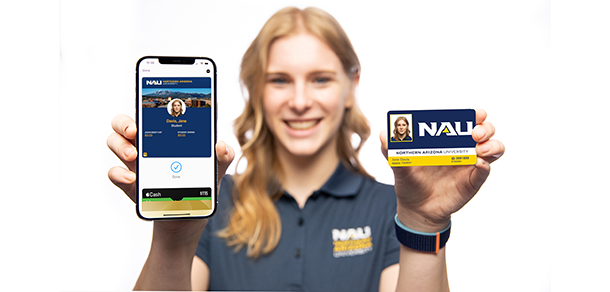
As the first TouchNet client to deploy Apple mobile credentials, Northern Arizona University has achieved an impressive 98% adoption rate among eligible students. According to Borsheim, the remaining non-users are primarily limited by device compatibility issues.
The mobile transition has also improved troubleshooting and support.
By leveraging data from credential provisioning systems, access control platforms, and device information, staff can quickly identify and resolve issues. Combined with single sign-on and two-factor authentication, the mobile credential program delivers both convenience and security for the campus community.
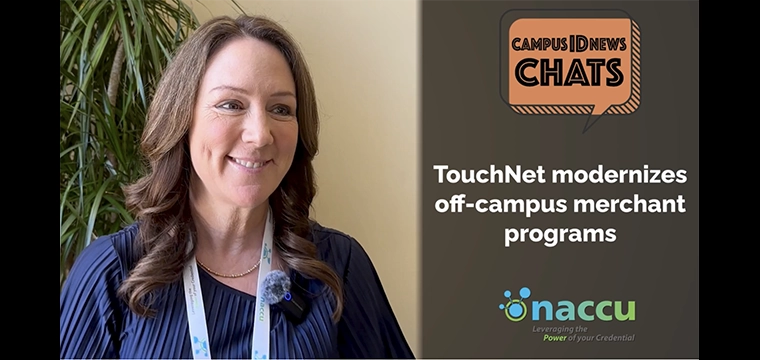
To watch the full interview, click the image at the top of the page.
TRANSCRIPT:
Northern Arizona University wanted to go mobile because we faced aging door readers. We knew we needed to replace those, and we wanted to increase the level of security that we had on campus.
Going mobile definitely allowed us to do that, and we've been able to keep tight controls on door access and really have real-time control over who has access to which doors, at which times.
Going mobile at Northern Arizona University was a large effort that took all types of stakeholders, including TouchNet, HID, Apple, and Modo Labs, which is our campus app provider.
Internal teams such as ITS, our access control teams, our facilities teams, and even card office teams.
I think really, it's just following project management best practices. And that's really what was done. TouchNet does a really good job of assigning the right resources at the right time from their side. We also did the same thing.
I think we had a lot of great partners when we went mobile. I'd say that TouchNet, in terms of project management, does a really great job there. Their customer portal had our project being tracked and monitored. We were able to use the portal for any new documentation that we needed for cases.
It was really just a big, coordinated effort across those many different teams.
Since then, we've achieved at least a 98% adoption rate among students who have a mobile credential. The portion that has not adopted is due to technical constraints, such as phones that are not NFC-capable or devices with older operating systems that don't support the functionality.
It's really convenient and seamless. The feedback that we received is, "I already have my ID. It's on my phone. I don't need to carry additional IDs or multiple cards for different purposes."
Everything that our JacksCard touches on campus is available and accessible with the mobile credential.
That really changed the game in terms of access, not only to buildings but also to services, and has made the experience seamless.
We have two-factor authentication through the Duo application on our campus. Along with signing in through our single sign-on system, users receive a push notification that they must accept in order to authenticate.
One of the main insights we've gained in the JacksCard office is around troubleshooting issues. We want students, faculty, and staff to be able to obtain their mobile credential without any interaction from our card office or central IT.
When that doesn't happen, we're able to assist much more quickly because we can leverage data from a variety of sources to identify the problem. We can review provisioning data from HID, check our access control system to see if it's an access assignment issue, and look at device and operating system information to determine whether an older phone or outdated software is causing the problem.
It allows us to rapidly resolve issues.
We do have two-factor authentication through the Duo application on our campus. Along with signing in through our single sign-on system, users receive a push notification that they must accept in order to authenticate.
To obtain a credential, users must authenticate and go through a process that validates requirements and confirms eligibility. Two-factor authentication is definitely part of that process.
When it comes to using the credential in real time to make a purchase or access a door, there are different settings that can be configured to either require authentication or allow the mobile credential to be used without it. It really depends on the configuration.
I think TouchNet does a really good job of assigning the right resources and the right number of people for a project. I've been on other projects where only a few people were assigned to a monumental task, but for our mobile implementation we had the right people from TouchNet, HID, Apple, and our own team. We had the subject matter expertise we needed to get the job done.