Campus ID News
Card, mobile credential, payment and security

FEATURED
PARTNERS
slider DOE flag 1

Worst-case scenarios for campuses under new DOE financial aid disbursement regs

Campus card offices lose bank partners, financial aid offices lose outsourcing

Chris Corum   ||   Jun 30, 2015  ||   

It was more than three years ago that US PIRG released its report damning the relationships between financial providers and academic institutions that provided payment card products to students. In its wake, other reports from the agencies like the Government Accountability Office, Congressional hearings and consumer protection efforts followed. Then came the Department of Education's efforts to revamp financial aid disbursement.

The DOE convened a 2014 Negotiated Rulemaking Process to gather input from a cross section of concerned groups. After months of meetings and drafts, negotiators reported that they thought they had successfully re-crafted the rules. But representatives from industry and the consumer advocacy groups failed to reach total consensus, leaving the DOE free to draft the rules as they saw fit.

In mid-May, the DOE’s final proposed rules were released, and they are not favorable for industry, campus administration or even students. They appear to be a win only for the consumer advocacy groups that have been pushing to have banks and payment cards completely removed from the process.

Since the Negotiated Rulemaking began, both the service providers and the campuses relying on them to disburse financial aid to students have been on proverbial pins and needles. The future of this line of business and peripheral services -- such as campus card and bank partnerships that deliver accounts and debit cards to students -- have been up in the air.

I have written about this many times before and have worked with associations, providers and campuses attempting to plan for the future. The goal has been to help the DOE develop productive regulations that protect students and grow these services. But from the beginning, the car has been driven by consumer advocacy bodies that seemed devoted to the banishment of these relationships from higher education.

User-friendly T1/T2 definitions

Key to the proposed regulations is the concept of Tier One (T1) and Tier Two (T2) providers. These tiers determine what a provider and a campus using the service must do to achieve compliance under the new DOE regulations.
T1 providers face the most stringent oversight limiting both business processes and fee structures. T2 providers, meanwhile, are immune to the fee structure limitations but still face significant new requirements.

T1: Third-party Servicer

  • DOE definition: “An arrangement between an institution and a third-party servicer that performs one or more of the functions associated with processing direct payments of title IV funds on behalf of the institution and that offers one or more financial accounts to students and parents.”
  • Easier definition: A company a campus contracts with to distribute to students any excess Title IV financial aid dollars – those remaining after tuition and fees are taken out – and also offers an account or payment card option (ex. Higher One, Heartland Acceluraid and TMS)

T2: Financial institution with a contractual relationship with a campus

  • DOE definition: “An arrangement between an institution and a financial institution or entity that offers financial accounts through a financial institution under which financial accounts are offered and marketed directly to students or their parents, with the regulatory consequences of T2 status to apply absent documentation from the institution that students or parents do not have credit balances at the institution.”
  • Easier definition: A bank or company that contracts with a campus to provide students with an account, debit card or prepaid card that could possibly be specified by the student as the place for excess Title V financial aid dollars to be directed (ex. US Bank, Wells Fargo, SunTrust, Commerce Bank, PNC, TCF, BlackboardPay)

Still I always believed that cooler heads and data-driven decision making would prevail. After all, I know that the vast majority of these services are beneficial for campuses and students alike – better in most cases because the campus is involved on the student’s behalf.

I kept this cautious optimism throughout the negotiated rulemaking process, loads of phone briefings, several years of conference sessions and a series of draft proposals and comment periods.

I am no longer optimistic.

I fear that the draft regulations released by the DOE in May are likely to pass without significant changes. I have heard no insider intel to suggest that the comment period that ends on July 2 will produce substantive change.

For the first time, this has me thinking about worst-case scenarios. What if the consumer groups get their wish and some or all of these relationships that both campuses and students rely on actually do go away?

As both a student and a university employee, I remember the “net check” process where everyone receiving aid had to get it via paper check. It was painful on both sides. Are we destined to relive it? As other federal programs from Social Security to Veterans Affairs totally eliminate checks, is the DOE pushing campuses backward?

Do they think forcing campuses to manage ACH processes in-house, increase the use of paper checks and push students to use their existing bank accounts really solves a problem students are facing? Many paper checks will be cashed at rip-off payday loan shops. The students’ preexisting bank accounts all charge non-sufficient fund and other traditional fees the DOE is trying to eliminate.

Sadly, many of the products the new regulations will curtail actually are better, as they offer low- or no-fee alternatives that help students access Title IV funds. In the rush to appease the consumer advocates, it seems the DOE has overlooked this reality.

Does my campus have a T1 or T2 arrangement for financial aid disbursement?

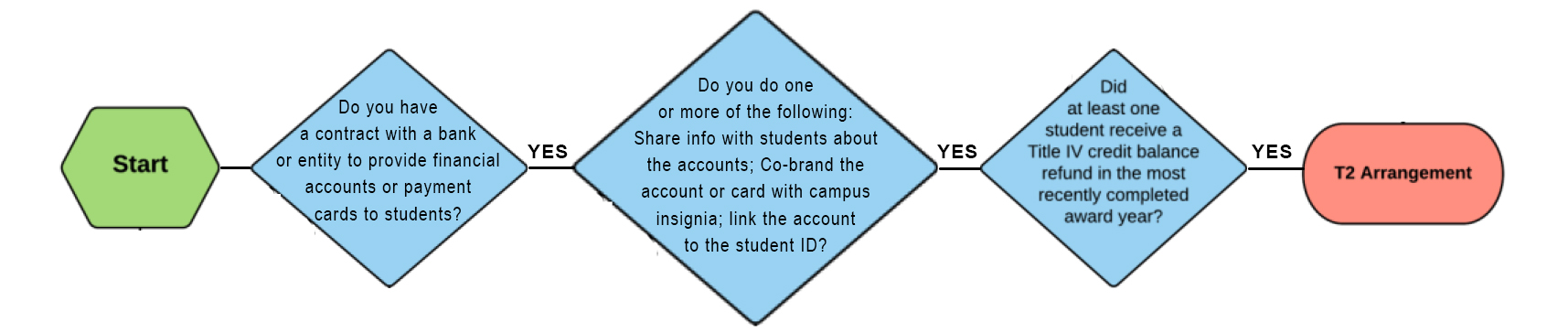
NACUBO created a flowchart to enable a campus to determine whether or not they have a T1 or T2 relationship. In the interest of getting down to layman terminology and simplifying the subject, we have abridged that flowchart to a more basic version.

Do you have a T1 provider?
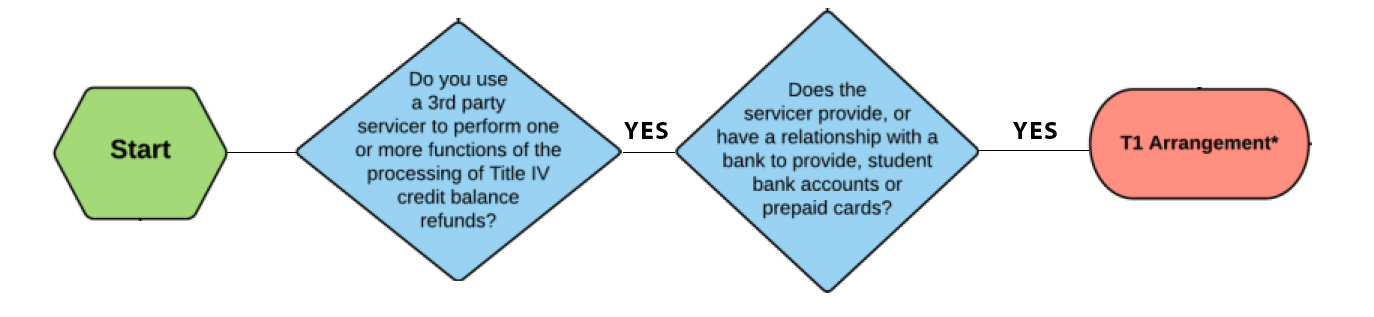
Does my campus have a Tier 1 provider for financial aid disbursement?
Do you have a T2 provider?
Does my campus have a Tier 2 provider for financial aid disbursement

Worst-case scenarios for campuses

Lets make some assumptions and head down the path of worst-case scenarios. Assume that the proposed rules pass without substantive change or perhaps get even more punitive toward T1 and/or T2 entities. What might the implication be for your campus?

To state the question another way, “what if my provider goes away?”

Pages: 1 2 3

Subscribe to our weekly newsletter

RECENT ARTICLES

Ashley McNamara, Apex
Feb 05, 26 / ,

Apex smart lockers drive the evolution of digital dining halls

Smart lockers are becoming a key part of the modern campus dining experience, and Ashley McNamara, vice president of global marketing at Apex, says the shift to fully digital dining halls is driven by student expectations for speed, convenience, and mobile-first experiences. In a conversation with CampusIDNews, McNamara explains how Apex’s smart locker solutions fit […]
Campus card with Trevor Project hotline printed on back
Feb 04, 26 / ,

California law mandates LGBTQ crisis hotline on student IDs and campus cards

A new California law will require public schools serving grades 7 through 12, community colleges, California State University campuses, and University of California campuses to add an LGBTQ youth hotline number to student IDs and campus cards. Assembly Bill 727, signed into law in October 2025, will go into effect on July 1, 2026. The […]
University of Utah sign
Jan 29, 26 /

University of Utah opens on-campus apartment options for employees

Higher ed institutions struggle to attract and maintain staff, but the auxiliary service department at the University of Utah is taking a clever approach, offering cost-effective on-campus housing for employees. This spring, the institution-owned Sunnyside Apartments is opening a new building, and staff are eligible to live there. Originally intended to house graduate students and […]
CIDN logo reversed
The only publication dedicated to the use of campus cards, mobile credentials, identity and security technology in the education market. CampusIDNews – formerly CR80News – has served more than 6,500 subscribers for more than two decades.
Twitter

Great inverview on the Public Key Open Credential (PKOC) standard with ELATEC's Jason Ouellette, Chairman of the Board for the @PSIAlliance.

Attn: friends in the biometrics space. Nominations close Friday for the annual Women in Biometrics Awards. Take five minutes to recognize a colleague or even yourself. http://WomenInBiometrics.com

Load More...
Contact
CampusIDNews is published by AVISIAN Publishing
315 E. Georgia St.
Tallahassee, FL 32301
www.AVISIAN.com[email protected]
Use our contact form to submit tips, corrections, or questions to our team.
©2026 CampusIDNews. All rights reserved.