Card, mobile credential, payment and security
A 'how-to' guide for issuing large-format IDs
By Tom Stiles, Executive Director, Identification Systems Group
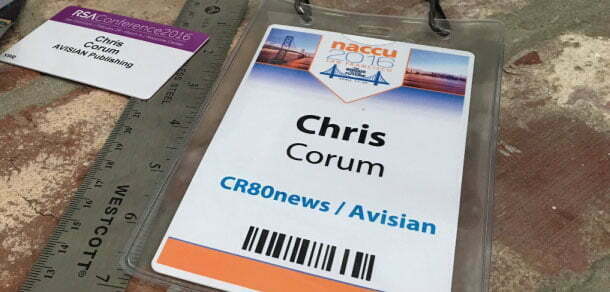
When the topic of card issuance is discussed in the higher education realm, typically we’re talking about the standard CR80 card size – the size of a credit card. We often forget, however, that there are larger format credentials that can be used for a myriad of event ticketing and conference environments.
This begs the questions, then, why would you need a large-format ID? And when does it make sense to issue a larger credential?
When it comes to the “why,” the answer can be simple. It provides a more readable identification credential that can easily be seen from a distance. You may, for example, want the larger credentials to be worn by event attendees or by staff. Which leads us to the “when.” Applications for larger format credentials can include conferences, camps, training sessions and access to special events like campus sporting events or concerts.
Once you’ve determined that large-format credentials are the way to go, the challenge becomes how best to produce these larger credentials – preferably in an easy way and without a high expense. Here are some choices and things to consider.
You may want to issue larger plastic cards if you want the credential to be used more than once, as with a season pass, or if you want it to live on as a keepsake memento. Durability is a major reason to choose plastic credentials.
There are a few card printers on the market that accept larger sizes. They range in price from $3,000 to $10,000 and support either direct-to-card, retransfer or ink jet card printing.
Although the printers will handle larger cards, many direct-to-card printers do not print the entire surface of a large-format ID. They are typically restricted to printing the normal CR80 card size in the middle of the larger card. The remainder of the credential must be preprinted in this case. This gives the ability to have a larger card, but limits how much and how large the printed info can be.
[pullquote]There are card printers on the market that accept larger sizes, ranging in price from $3,000 to $10,000 and supporting direct-to-card, retransfer or ink jet card printing.[/pullquote]
Another direct-to-card printer model prints on a credential that is the same height of a standard CR80 card (2.125”), but twice as long (6.57”). This creates a long, skinny credential that may not be practical for all use cases.
If retransfer printing is your preference, there is a model that can handle 3.375” x 4.875” cards, printing onto the vast majority of the larger card surface. The list price of this printer is about $7,500, and it produces 70 single-sided cards per hour at a cost of roughly $1.15 per card. To put that in perspective, the cost of the blank larger format plastic cards is about 15 cents each.
The final printing method leverages an ink jet plastic card printer that prints on special 3.5” x 5.5” ink-receptive plastic cards. The retail price of the printer is pricier at nearly $10,000, but ink jet plastic card printers operate much faster than direct-to-card or retransfer card printers. The cost for cardstock and ink is just more than $1.00 per card.
As a general rule, larger format cardstock will be a bit more expensive than the standard CR80 card size, either blank or preprinted.
A more affordable option, though, may be an ink jet printer that accepts a roll paper card stock. You’d sacrifice the durability of a plastic credential but would save with a more the cost-effective process.
These printers are used a lot for producing food or packaging labels. For credentials, though, the paper card would likely be inserted into a clear pouch, and then worn with a lanyard, bead chain or strap clip.
The price of ink jet roll printers start at about $1,300 – much less expensive than plastic card printers. The cost of the ink to print the credentials runs roughly 35 cents per 3.5” x 5.5” per card. As for blank paper card stock rolls, a ballpark cost is 10 cents each for 3.5” x 5.5”, based on an order of 10,000.
These units can print 450 cards per hour at a total cost per card of 45 cents. The ink jet printer option provides an outside-the-box alternative to large format IDs using affordable hardware.
Regardless of the card material or print method chosen, the large-format ID is meant to be displayed and will likely require some kind of wearable attachment.