Card, mobile credential, payment and security
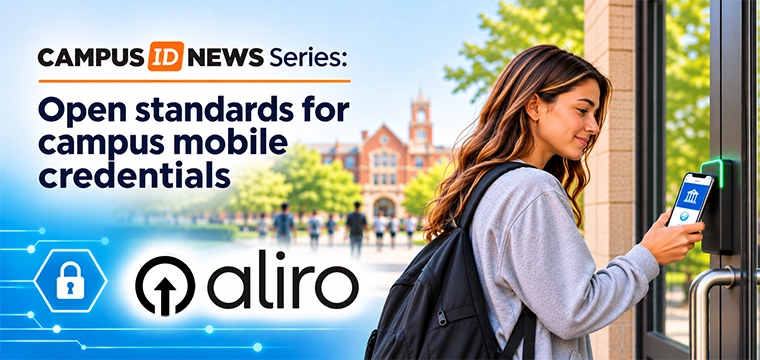
CampusIDNews Series: Open standards for campus mobile credentials
Thanks to mobile credentials, students don’t necessarily need a plastic card to prove who they are at a door. But the problem-solving phase isn’t over yet for mobile credentials.
Behind the phone is still a complicated collection of readers, locks, credential systems, mobile wallets, access control software, and vendor-specific integrations. Getting all those pieces to work together can require a web of technical and business relationships.
A new standard for mobile credentials, called Aliro, is designed to simplify one key part of that equation.
Created by the Connectivity Standards Alliance, Aliro is a common protocol for secure access transactions involving mobile credentials and access devices. Rather than replacing communication technologies such as Bluetooth or NFC, it provides a standardized way for those technologies to support – or communicate with – access control systems.
For higher education, Aliro could eventually mean more freedom to choose how mobile credentials are deployed and where they can be used.
The challenge with mobile credentials is particularly obvious in higher education, where campus cards can serve as credentials for doors, dining, payments, and many other services.
Moving that complicated credential ecosystem onto mobile devices has traditionally meant dealing with numerous existing technologies and relationships.
Olivia Renaud, Group Product Manager for Reader and Credential Software at Allegion says the industry reached a point where the card had become a collection of different technologies rather than a consistent credential.
Aliro does not magically connect two proprietary systems. Instead, it gives those systems a common protocol they can implement.
“It was like a snowball rolling downhill, where everyone was using something different on the card, and the card office didn't really know how the card was being used,” Renaud says. “There was really no standard, and definitely no security around a lot much of it.”
The idea behind Aliro is intended to make mobile credential deployment easier while preserving flexibility campuses have come to expect.
“We wanted to make this a lot easier because we want everyone to be able to get access to mobile credentials and do so in a way that gives them some of that flexibility that the card previously had,” she says.
The standard establishes a common protocol rather than simply connecting systems together.
Aliro does not magically connect two proprietary systems. Instead, it gives those systems a common protocol they can implement.
It is similar in concept to what consumers already expect from a technology such as Bluetooth. Devices from different manufacturers can communicate because they follow a common standard.
 The “last mile” of access control
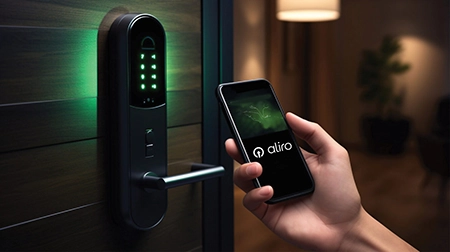
Aliro touches more of the access control stack than simply the exchange between a phone and a reader.
The standard can cover the relationship between the user and device, the device and access hardware, and the software and identity-management systems above them.
“It extends from the user connecting to the device, the device connecting to the software system or panel that informs that device what to do, and then you really go up the stack,” explains Renaud.
But Renaud says Aliro’s particular focus is the last mile – the part of the ecosystem where manufacturers historically have needed to establish individual technical and security relationships.
That could mean fewer instances in which one manufacturer has to provide proprietary keys or custom integrations to another.
Today, it is common for a campus to have an access control system with APIs connecting multiple vendors. But it relies on proprietary credential technologies. Aliro attempts to standardize the credential transaction itself so participating products can share a common security and provisioning model.
The strongest argument for Aliro may be choice.
Renaud describes an example where mobile credentials worked at offices but could not be extended to shuttle equipment because of the proprietary nature of the hardware
An open standard could change that equation.
If a device manufacturer supports Aliro, a campus does not have to wait for that manufacturer to create a proprietary relationship with the mobile credential provider.
If a device manufacturer supports Aliro, a campus does not have to wait for that manufacturer to create a proprietary relationship with the mobile credential provider. The result could be a campus environment in which different readers and access devices from different manufacturers can recognize the same mobile credential.
Universities rarely have identical access control environments everywhere. A campus may have residence halls with one generation of hardware, academic buildings with another, and specialized facilities with still another. It may also acquire buildings, replace locks, or work with different vendors over time.
In the future, an open mobile credential standard could give security and card professionals more flexibility in managing that type of patchwork.
The technology is not without obstacles. One of the biggest is hardware.
Vendors will need to change readers by retrofitting, rewriting firmware, or creating entirely new devices.
Aliro's asymmetric cryptography requires more processing than some older symmetric-key approaches. That can be particularly challenging for battery-powered locks and other devices where processing capability and energy consumption are tightly constrained.
For campuses, the challenge is determining where existing infrastructure can support it, where hardware will need to be replaced, and how a mixed environment will operate during the transition.
Some existing hardware simply may not have the capability to support Aliro.
All this means migration can involve both hardware and software updates.
For campuses, the challenge is determining where existing infrastructure can support it, where hardware will need to be replaced, and how a mixed environment will operate during the transition.
A campus is unlikely to replace every reader and lock at the same time. Security professionals will need a migration strategy that accommodates existing credentials and infrastructure while gradually introducing Aliro-capable equipment.
Aliro also differs from other emerging open credential approaches in its emphasis.
Renaud describes Aliro as mobile-first. That matters because the standard was developed around the realities of smartphones, mobile wallets, and connected access devices. Other approaches were more akin to translating a traditional plastic credential onto a phone.
For a university planning its next generation of mobile access, Aliro offers a potential way to make the phone and credential less dependent on a single vendor's ecosystem. But the payoff will depend on the industry adoption.
Standards only become useful when enough manufacturers implement them, certify their products, and support them in real-world deployments.
For campus security professionals, the practical questions are where and when the standard can be deployed, what infrastructure it requires, and whether its growing ecosystem can deliver the flexibility to tear down a major technology silo.