Campus ID News
Card, mobile credential, payment and security
FEATURED
PARTNERS
OregonSt Starship 1

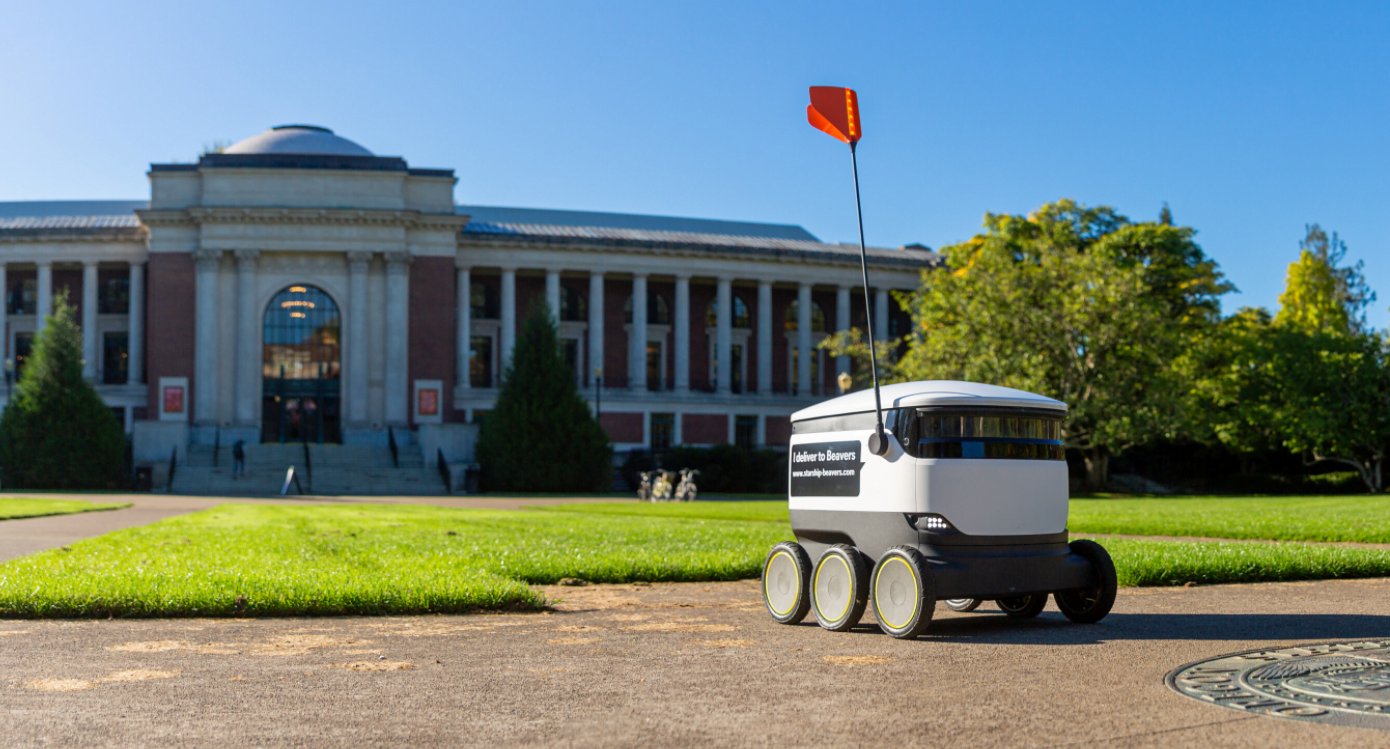
Starship delivery robots roll onto Oregon State campus

Andrew Hudson   ||   Oct 23, 2020  ||   ,

A fleet of 20 Starship delivery robots began processing student orders at Oregon State University this week. The popular autonomous delivery robots are now serving OSU students, faculty and staff with contactless delivery across the university’s sprawling 500-acre campus.

According to an official university release, the arrival of Starship to Oregon State's Corvallis campus marks the first campus in the state to deploy autonomous delivery robots.

The decision to bring Starship to OSU long preceded the arrival of COVID-19, and was a service that Oregon State Housing & Dining Services and Memorial Union Retail Services was excited to add to its portfolio. The coronavirus did delay initial launch, but has also provided an added benefit to the service now as it helps to reduce contact between people during the ordering process.

“This was a long time coming,” says Kerry Paterson, director of residential dining and University Catering with UHDS. “We’d been considering contactless delivery for a while. This service is yet another way we can facilitate COVID protocols regulating restaurants.”

OSU is currently housing roughly 2,200 students in residence halls on the Corvallis campus, and the Starship robots are expected to slot in with OSU's other COVID guidelines in dining services. Other dining-specific safety measures at OSU include:

  • No sit-down dining service in dining centers.
  • All food is served in single-use, take-out containers.
  • Traffic flow has been adjusted to provide six feet of distance between individuals.

To help navigate new food service protocols as a result of COVID-19, Oregon State has expanded express and pick-up options, but the addition of robot delivery allows for even less density across OSU dining locations while still providing service to the campus community.

Starship robots have quickly become a recognizable presence on college campuses, with the roster of partnering institutions continuing to grow across the country. The robots have mapped the Corvallis campus using GPS and can deliver virtually anywhere on campus. Each robot can carry up to 20 pounds of food and use a combination of machine learning, artificial intelligence and on-board sensors to navigate on sidewalks and around obstacles.

When a customer places an order using the delivery app, they can select a location to meet their delivery robot. The customer will then receive a code in the app to unlock the robot when it arrives.

“You unlock it, get your food and then off it goes to get sanitized and prepare for another delivery,” says Paterson.

There is no cost to the university for the robots. Instead, a nominal delivery fee is added to each order.

“Delivery robots are an innovative way to help students with social distancing and they also make sense for a forward-thinking school like OSU,” says Ryan Tuohy, senior vice president of business development at Starship Technologies. “Our robots deliver day and night to get students what they need. We’re looking forward to becoming a part of campus life and helping to make daily life more convenient for everyone at OSU.”
Subscribe to our weekly newsletter

RECENT ARTICLES

CampusIDNews: Open standards for campus mobile credentials series intro graphic for part 2 on PKOC

Part 2: Exploring the PKOC standard for campus mobile credentials

Campus access control systems are built to answer the seemingly straightforward question, “Should this person be allowed through this door?” But before the system can make that decision, it first must answer the question, “Is the credential itself legitimate?” That is the precise question the Public Key Open Credential standard was designed to answer, and […]
Ed Sullivan from EntryReady gives a video interview on EntryReady's expansion into higher ed with Apple, Google and Samsung wallet support

EntryReady expands into higher ed with Apple, Google, and Samsung wallet support

Ed Sullivan, Chief Strategy Officer and co-founder of EntryReady, discusses how the company's experience in hotel access control is shaping its expansion into higher education. After developing NFC- and RFID-based locking systems for hotels and resorts, EntryReady is looking to bring that technology to campus residence halls, replacing traditional brass keys with mobile wallet credentials. […]
Open standards for campus mobile credentials article series intro screen with college girl using phone to enter a building

Part 1: An intro to open standards for campus mobile credentials

Traditionally, campus access control has largely been built around a simple proposition. Start by committing to a credential, install compatible readers and locks, and make sure all the systems behind them can recognize one another. That model works. It also creates a problem that can become increasingly expensive as a campus grows and technology changes. […]
CIDN logo reversed
The only publication dedicated to the use of campus cards, mobile credentials, identity and security technology in the education market. CampusIDNews – formerly CR80News – has served more than 6,500 subscribers for more than two decades.
Twitter

Great inverview on the Public Key Open Credential (PKOC) standard with ELATEC's Jason Ouellette, Chairman of the Board for the @PSIAlliance.

Attn: friends in the biometrics space. Nominations close Friday for the annual Women in Biometrics Awards. Take five minutes to recognize a colleague or even yourself. http://WomenInBiometrics.com

Load More...
Contact
CampusIDNews is published by AVISIAN Publishing
315 E. Georgia St.
Tallahassee, FL 32301
www.AVISIAN.com[email protected]
Use our contact form to submit tips, corrections, or questions to our team.
©2026 CampusIDNews. All rights reserved.