Card, mobile credential, payment and security
Campus opts to go one door at a time rather than mass importing from old system
Jay Bonney's Auxiliary Services department manages more than 4,000 access control points across Mercer University. His team has been undertaking a major transition from an access system that has been in place for more than 20 years. With the existing equipment reaching end of life, the university saw the project as an opportunity to rethink its access control infrastructure rather than simply replace aging hardware.
A key priority was avoiding another proprietary environment that could limit the university's options in the future. The team chose an open platform using Mercury controllers. At the same time, they are moving the environment to the cloud. These steps should provide greater flexibility if technology or operational needs change.
Instead of importing the entire legacy system into the new platform, Bonney's team decided to rebuild it one door and one access point at a time. The approach has made the migration considerably longer, but Bonney believes that decision has paid off.
Working through the system incrementally has allowed the team to uncover roadblocks and resolve problems as they arise rather than discovering them after a large-scale system migration. It also gives the university an opportunity to start its new environment cleanly instead of carrying more than two decades of legacy configurations to the cloud.
Position yourself with a future-forward mindset so you have avenues to move in case the ecosystem changes, administration changes, or financing changes.
For Bonney, that approach is also about planning beyond the immediate project. Funding, technology, university leadership, and campus needs can all change over the life of an access control system. Choosing an open platform and maintaining flexibility gives the institution more options when those changes inevitably arrive.
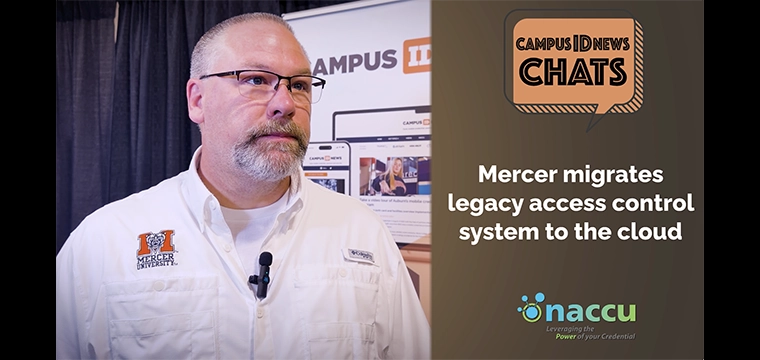
To check out the full interview, click on the image at the top of this page.
TRANSCRIPT:
Our department, Auxiliary Services, manages the entire access control platform for the university.
We're in a current project to migrate our legacy access control system to a cloud-based access control platform. We have over 4,000 doors, and we've got a lot of work ahead of us.
Access control is one of those things that nobody has any problems with until it doesn't work anymore. However, the current equipment that we've had for the last 20 years has come to the end of its life, unfortunately. So, we had to look at going a different way.
We wanted to position ourselves so we wouldn't be stuck in a proprietary environment. We chose to go with Mercury board controllers and then move to the cloud.
We wanted to position ourselves so we wouldn't be stuck in a proprietary environment. We wanted something that would be an open platform if we needed to move in the future.
We chose to go with Mercury board controllers and then move to the cloud.
We have over 4,000 access control points university-wide. We have been working to replace controllers and the back end where all the access plans reside.
It's a lot of work to bring over because we chose not to do a big system dump.
We had an old system for over 20 years. We wanted our new system to have that new car smell. So, we're implementing this one door at a time, one access point at a time. That's what's has taken us a little bit of time to get this migration complete.
Choosing not to take a system import and upload it to the new cloud access control platform was frowned upon. They said it would take way too long, it would be too cumbersome, and it would bog the project down.
We dug our heels into the ground, and I'm so glad we did.
Yes, it is taking time. But because we've done it this way, we've found the roadblocks and have been able to maneuver around them before we would have hit them straight on had we chosen to do a one-time dump of the system into the new cloud-based system.
In our industry, it's always tough to get funding. Technology moves so fast.
You want to position yourself with a future-forward mindset to make sure that whatever platform you land on, you have avenues to move in case the ecosystem changes, administration changes or financing changes.
You always want to look ahead to make sure you're not stuck in a proprietary environment.