Card, mobile credential, payment and security
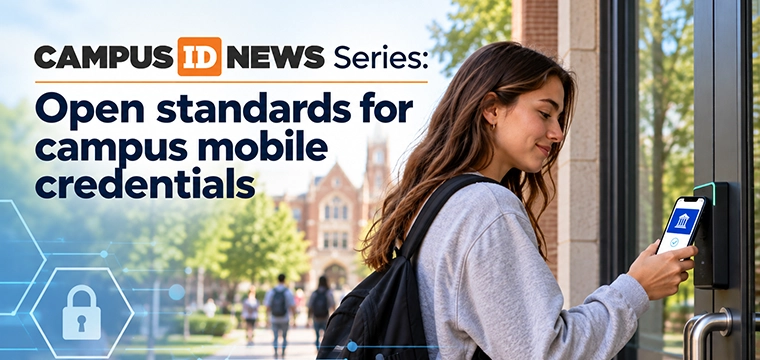
CampusIDNews Series: Open standards for campus mobile credentials
Traditionally, campus access control has largely been built around a simple proposition. Start by committing to a credential, install compatible readers and locks, and make sure all the systems behind them can recognize one another.
That model works.
It also creates a problem that can become increasingly expensive as a campus grows and technology changes. Namely, it is susceptible to vendor lock in.
The credential, reader, and access-control ecosystem can become tied to the manufacturers and technologies that were selected years earlier.
Open credential standards establish common technical rules that any manufacturer can implement. Institutions opting to use the standard can then choose readers and other infrastructure from any participating manufacturer.
An emerging generation of open credential standards is challenging that model. Open credential standards establish common technical rules that any manufacturer can implement. Institutions or organizations opting to use the standard can then choose access control readers and other infrastructure from any participating manufacturer.
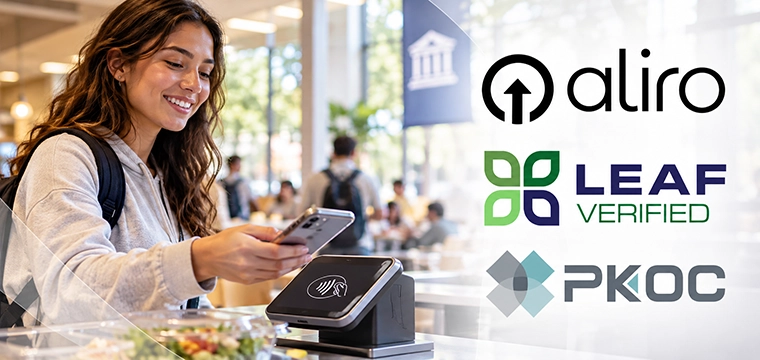
Three efforts illustrate this push toward open standards: the Public Key Open Credential specification (PKOC), the Aliro standard for digital credentials, and LEAF Verified.
All three seek to reduce dependence on proprietary credential technologies.
The basic idea of open credentials is straightforward. Instead of allowing each manufacturer to define how a credential communicates with a reader, an open standard establishes common rules that different manufacturers can implement.
The goal is to make components from different manufacturers work together more easily, much as USB and Bluetooth standards helped make it possible to connect peripherals from different vendors without relying on proprietary connections. Open credential standards aim to do something similar for access control, making it easier to mix and match compatible credentials and readers while retaining the systems that manage access permissions.
Historically, many credential technologies have relied on proprietary formats and symmetric cryptography, in which participating devices share secret keys. Managing those keys across cards, readers, and vendors can complicate procurement, integration, and security maintenance. A university that wants to change suppliers or introduce another credential type may discover that its existing technology makes the transition difficult or expensive.
“Proprietary solutions require business relationships, security relationships, and agreements to be established," says Olivia Renaud, group product manager for reader and credential software at Allegion. “Instead of having to go through that, the standard takes the onus on itself, so those relationships don't need to be created.”
Incorporating open standards for campus mobile credentials can make purchasing options and future upgrades easier.
Renaud describes the fragmentation she encountered while working on mobile access at Apple.
“Everyone was using something different on the card,” she says. “The campus card office didn't really know how the card was being used, and there was no standard.”
Open standards aim to establish common technical rules so that products from different manufacturers can work together without requiring every pairing of vendors to develop a separate, proprietary integration. That can expand purchasing options and make future upgrades easier. It does not, however, by itself guarantee that every credential will work with every reader or that a campus can dispense with its access control system.
A physical access control system will still determine whether a particular credential is authorized to enter a residence hall, laboratory, classroom, or administrative building. An identity-management system of some sort will still determine who the credential belongs to and whether that person is a student, employee, contractor, or visitor.
One important shift behind these efforts is the move from symmetric systems and their shared secrets toward public-key cryptography. In a public-key system, a credential holds a private key that remains protected, while a corresponding public key can be used to verify cryptographic proof. The design reduces the need to distribute the same secret among multiple devices.
Traditional proprietary credential systems rely on shared secret keys that have to be securely loaded and managed in both credentials and readers, but with public key systems, the private key stays securely in the credential and is never shared with the reader.
"Traditional proprietary credential systems generally rely on shared secret keys that have to be securely loaded and managed in both credentials and readers,” explains David Bunzel, executive director of the Physical Security Interoperability Alliance which oversees PKOC. “With public key systems, the private key stays securely in the credential and is never shared with the reader.”
Public-key cryptography is not, on its own, a complete access-control system. It provides a way to establish trust in a credential or device, but the campus still needs rules governing who can enter which spaces.
Once the the cryptographic check validates that the credential is authentic, it hands off to the university’s existing systems to manage authorization and determine where a credential is permitted. Depending on the implementation, existing panels and other access control infrastructure may remain in service, while credential and reader capabilities change.
That separation matters to campus planners. It allows them to evaluate a credential technology as one part of a larger system rather than assuming that a new credential would always require a replacement of readers, controllers and access-management software.
A campus that relies on proprietary credentials can face significant costs when it wants to change reader technology, replace an access control vendor, or add mobile credentials.
An open credential layer could allow the institution to change individual components without rebuilding the entire system.
That does not eliminate migration costs. A campus still has to evaluate readers, controllers, locks, software, and credential-management systems. It may need new hardware in some locations and new software support in others.
But it can change the long-term equation.
Access control systems can remain in place for 10, 15, or 20 years, while credential and mobile technologies change much more rapidly. A campus shouldn't have to redesign its access control architecture every time the technology used to present a credential changes.
"That is particularly important for a campus because access control systems can remain in place for 10, 15 or 20 years, while credential and mobile technologies change much more rapidly,” explains Bunzel. "A campus shouldn't have to redesign its access control architecture every time the technology used to present a credential changes.”
The different approaches being pursued offer different routes toward a more flexible credential environment.
PKOC defines a credential-authentication specification that can be used across supported transport methods including physical cards and mobile devices.
Aliro standardizes mobile credential interactions between mobile Wallets and access control systems.
LEAF Verified packages public-key technology into a physical credential and provides a defined way for compatible devices to verify it. While it not specifically a mobile credential standard, it enables its cards to be used in tandem with Aliro.
The distinction is important when comparing options for both standards-based and traditional credentials. Issuers should understand exactly which readers support it, how credentials are issued and revoked, and whether their access control system can use the resulting authentication information.
Those answers reveal the practical boundaries of compatibility.
Open standards cannot eliminate every integration challenge. It also does not make products interchangeable unless those products implement compatible specifications and pass the necessary testing. Campuses will still need to plan for reader upgrades, credential issuance, system integration and ongoing administration.
The larger opportunity is to make decisions less dependent on a single supplier. As cards, phones, readers, and authentication technologies evolve, institutions can benefit from a clearer separation between the credential, the communication method, and the system that decides who gets access.
For campus security professionals, that separation may create more room to modernize incrementally, compare competing products, and make long-term purchasing decisions with greater flexibility.
This is the first in our CampusIDNews Series titled, "Open standards for campus mobile credentials." Future articles will take a deep dive into the three emerging standards – Aliro, Public Key Open Credential (PKOC), and LEAF Verified. The articles will explore how each standard operates and potential impacts higher education credentialing.