Card, mobile credential, payment and security
Computer vision and AI scanners help campus dining operators cut overproduction by 50%, achieve 500% ROI
April 29 marks Stop Food Waste Day, a global movement that highlights a simple but powerful truth: what gets measured gets reduced. For campus leaders, this day serves as more than an environmental reminder. It is a strategic call to address the "data gap" in auxiliary services. While universities have digitized almost every other facet of the student journey, campus dining remains a frontier where intuition often outpaces information.
The scale of the challenge is significant. According to the Natural Resources Defense Council (NRDC), the average college student generates 110 pounds of edible food waste annually, nearly double the rate of corporate environments. Collectively, campuses discard over 22 million pounds of food each year.
For too long, dining operations have relied on lagging indicators. Leaders can track what was purchased and what was served, but the real story happens at the tray. With roughly 70% of foodservice waste occurring after the meal is served, the lack of granular data makes it difficult to align production with actual consumption.
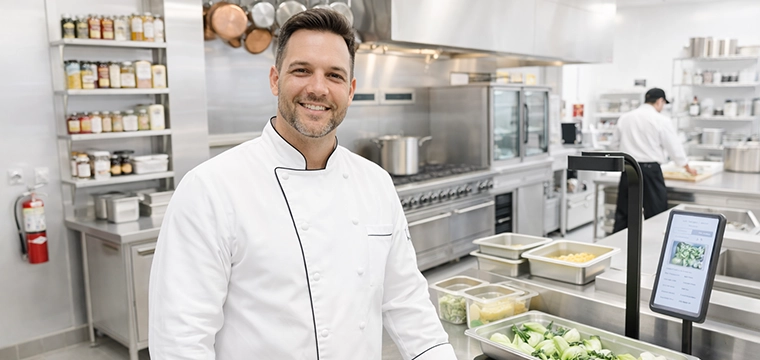
This is where AI and "Kitchen Intelligence" change the equation. By deploying computer vision and smart sensors, institutions can finally see the invisible. These systems track the lifecycle of food in real time, identifying exactly what is eaten and what is discarded. This is not about replacing the expertise of culinary staff, but about giving them the high-definition tools they need to make smarter, faster decisions.
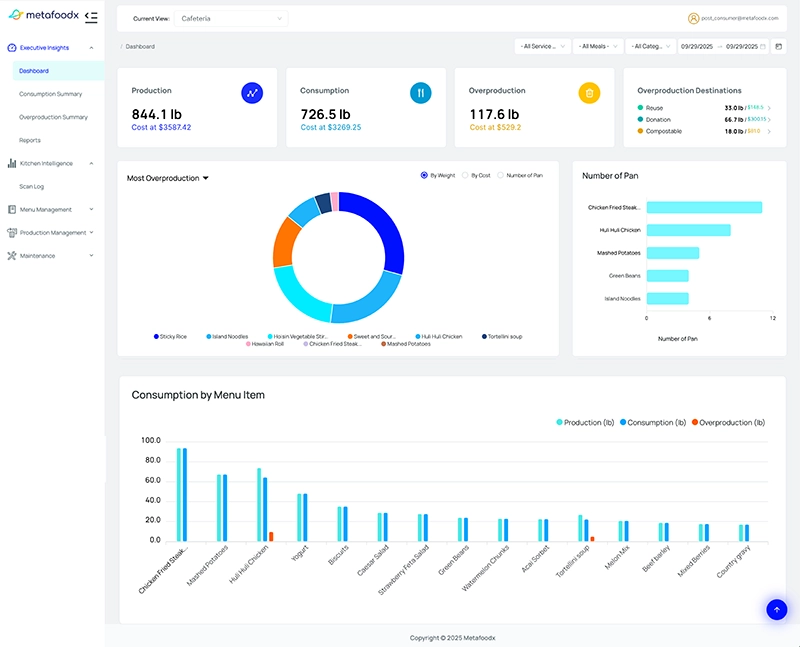
The accuracy of these new systems is redefining "best practices." Research published in 2025 by Dr. Gul Fatma Turker highlights that AI models, factoring in variables like student volume and weather, can predict demand with up to 99.9% accuracy. This level of precision has allowed early adopters to reduce food waste by 28% almost immediately.
The results are felt on the balance sheet as well as the environment. Leading institutions are already proving what is possible with data-driven foodservice operations. UMass Amherst halved its overproduction within a single semester. Pomona College saw a 54% reduction in waste, resulting in a first-year ROI of over 500%. For leadership, these are not just small wins; they are proof that operational intelligence can solve our most persistent sustainability challenges.
On this Stop Food Waste Day, the priority for campus leadership is clear. To reach the ambitious Environmental, Social, and Governance goals (ESG) set at the top, we must empower the teams at the point of execution with better data. Reducing overproduction lowers costs and slashes the carbon footprint of the institution, considering that food waste accounts for nearly five times the emissions of the entire aviation sector.
Reducing overproduction lowers costs and slashes the carbon footprint of the institution, considering that food waste accounts for nearly five times the emissions of the entire aviation sector.
By treating dining as a data-driven system rather than an unmonitored expense, we move from estimation to precision. Real-time data is the key to stopping food waste for good, transforming a traditional service into a model of modern, accountable stewardship.
Dining service professionals have been very diligent at improving their best practices in order to serve up the best food with affordable prices. The biggest hindrance to their effort has been the lack of actionable visibility to where exactly the wastes and inefficiencies lie. AI has come to the rescue to create a trustable and actionable ground-truth data layer with meaningful automation, marking the beginning of transformation for foodservice operations.
Dr. Fengmin Gong is the CEO and Co-Founder of Metafoodx, an AI-driven food operations platform focused on improving efficiency and reducing waste in large-scale foodservice environments. He has a background in technology and data systems, with a focus on applying computer vision and analytics to real-world operational challenges.