Card, mobile credential, payment and security
Seamless integration with mobile ordering apps and transaction systems makes it possible
Smart lockers are becoming a key part of the modern campus dining experience, and Ashley McNamara, vice president of global marketing at Apex, says the shift to fully digital dining halls is driven by student expectations for speed, convenience, and mobile-first experiences.
In a conversation with CampusIDNews, McNamara explains how Apex’s smart locker solutions fit seamlessly into higher education dining ecosystems, helping campuses modernize food pickup without adding friction to back-of-house processes.
McNamara says today’s students expect dining to mirror the convenience they experience off campus. Apex’s smart lockers connect directly to mobile ordering platforms – such as Grubhub Campus, Transact Mobile, Tacit – allowing students to order ahead, receive notifications, and grab their meals without waiting in line. Because the mobile ordering solutions integrate with transaction system providers, meal plans and declining balance payments come out-of-the-box.
Lockers connect directly to leading mobile ordering platforms, and because they integrate with transaction system providers, meal plans and declining balance payments come out-of-the-box.
The result is a predictable, fully digital experience that lets students pick up food on their schedule and move on to their next class or social activity.
Apex works closely with institutions to tailor locker deployments based on order volume, peak times, and space constraints. McNamara explains that some campuses may only need a few compartments while others may need dozens across multiple locations.
At Rider University, students can only order through the Grubhub app to place the orders for Jersey Mike's and pick up through the lockers
“We look at all that data and then figure out what the right hardware is for that customer,” she says. Solutions can be installed indoors or outdoors, and Apex recently introduced a modular system with varying compartment sizes that allows campuses to expand over time as dining demand grows.
One of the most compelling use cases McNamara highlights is the rise of “digital dining halls,” where all orders are placed through mobile apps or kiosks and picked up exclusively from lockers. These spaces have no traditional ordering counter and highly efficient kitchens.
With more than 60 campuses already using Apex lockers, she adds that no two deployments look the same – each tailored to campus culture, scale, and student behavior.
To watch the full interview, click the image at the top of this page.
Don't miss the smart locker demo at the 8:10 point in the video
TRANSCRIPT:
Hello there and welcome to Campus ID News Chats. I'm publisher of Campus ID News, Chris Corum.
Chris: Today we're going to talk about smart lockers and joining me is Ashley McNamara, the vice president of global marketing for Apex, which is a smart locker solution leader in a lot of markets including higher ed. Can you walk us through your smart locker offering and what it brings to campus?
Ashley: Sure. You know, students these days are on the go. They're always on their phone. Campuses are also progressing with mobile ordering and using platforms that allow students to order ahead, whether that's in a retail dining or even in regular dining halls.
They expect convenience, personalization, technology.
What we can do is we offer smart locker pickup solutions. From that ordering process that they're ordering on a mobile app to then pick up in the dining facilities, it's all digital for them. There's no wait time. It's predictable.
They know when their order's ready, but on so many campuses where they're placing the order, grabbing it and heading off to the next class or even just heading to hang out with their friends a little bit longer. It gives them that convenience of being able to pick up as quick as they can and get on their way.
Chris: Tell us about the configurations that are available? I know you've got a new one, but kind of walk through like what's a standard configuration. What are options and things?
Ashley: As we as we start, when engaging with campuses, we look at order volumes? What is that standard peak time? What does that look like? This lets us make sure we get enough of the compartments to handle this?
We see orders sit in the compartments, maybe four- or five-minutes max. They're moving through them quickly. We look at all those orders and kind of figure out, okay, you need seven compartments or you have a big system, you need 23 compartments.
We look at all that data and then figure out what the right hardware is for that. We have solutions that sit indoors or that can sit outdoors if you don't want your students coming in the building.
Then we have a new solution that we launched last year that is just starting to trickle on to college campuses where it's all modular. There are different sizes of compartments, and they can build out a structure of what they need. It gives them an opportunity to grow more compartments as their food service dining grows.
Chris: Great. How about how about some ideal or interesting use cases? I always love talking about ghost kitchens, because it's such a cool concept. But what are the things like that are interesting?
Ashely: Absolutely. We've called them digital dining halls. As you walk in, there's no counter, you can't walk up and place an order.
Everything is either through a mobile app or through a kiosk that's there for maybe your visitors on campus, parents that are on campus, or students that don't want another app on their phone. They can go up, place their order digitally, and it gives them a timeline of when that order is going to be ready.
Then it's placed in the locker for pickup. So that's their only option to be able to pick up.
We've seen a number of these launching this school year – rebuilding these facilities, where they're putting different concepts at each bank, and you're students place orders before they leave class, go grab it, go sit and converse with friends. They're not having to stand wait in line to place the order, stand to wait to get it to pick it up, it's all ready to go for them when they get that notification that their order is ready.
That's a great way for campuses to utilize this, it's all then integrated with their mobile apps.
As we work with different providers, we can integrate to the systems you're already using on campus. It's additive, it's easy for the team, then to be able to do that.
What we're seeing in these digital dining halls, too, is a super-efficient kitchen, to where they're able to move these orders through really, really quickly, and potentially boost transactions and revenues too.
Chris: From the tech stack perspective of the campus, how does this play with the campus card and the payment system or the dining points, declining balance, things like that? And do you work with multiple mobile ordering apps?
Ashley: Yeah, honestly, we could integrate with whatever you're utilizing on campus. We have existing integrations with Grubhub campus, Transact Mobile, Tacit, any of these mobile platforms that campuses are already utilizing. They work with the campus cards, so we fit right into that whole ecosystem of partners to make it one seamless for the student, but two super easy on the back end for the school.
Chris: Okay, great. How many campuses today?
Ashley: We're over 60 campuses now. I think what the fun thing about that is no two of them are the same. They all have applied the solutions in different ways. They've utilized different marketing tactics, configurations, and branding to be able to bring this as part of life on campus.
Chris: That's number is up a lot from when we talked last time. You had a good year and a half or something like that.
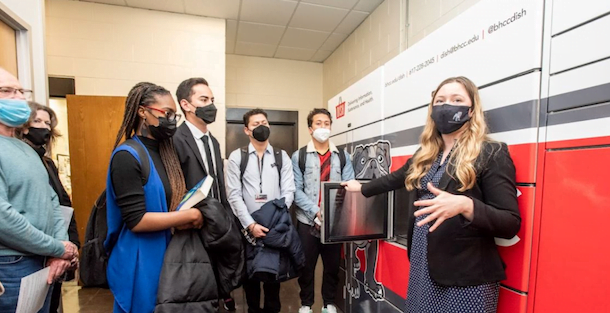
Ashley: Yeah, I think it's becoming something that a lot of schools use this for getting students on campus. Think about as you're taking a high school senior through a campus and you walk through the dining facility and they see this super cool technology to be able to pick up their orders.
The tours are talking about it like it's an enhancement to the things that happening on campus. It’s similar to the robots, the robots are super cool.
We're a nice complement to that, to where it's all this new technology that's on campuses that's drawing students in, giving them something convenient, something they can continue to go back to that's reliable.
And that's just fun to utilize.
Chris: We’ve got listeners who will be from small schools and we got with listeners who will be from really large institutions. Can you give me an example of a small deployment and a large deployment and if that's capable and possible for both?
Ashley: One of our earliest schools that we worked with is Rider University. They had some unused kitchen space, and they didn't have a place for a front of house. So, they built the lockers as a big bank in this digital dining hall, but it was also bringing in a Jersey Mike's brand to campus. The way that students utilize it is they can only order through the Grubhub app to place the orders for Jersey Mike's and pick up through the lockers.
One of the one of the interesting things we saw was a huge spike in orders from before that concept was there to when it was there with the same number of students. They're seeing the convenience of it.
The dining hall is set up so you walk in, grab it, and walk right back out again, or go the opposite direction and go sit and have a nice conversation with your friends. That whole concept of marrying, the mobile ordering and the automated pickup with the national brand worked really well for that small campus.
As we look at big campuses, they're doing a variety of different things. We've got some schools that put our solutions at each retail concept. If you order from Einstein's Bagels, you pick up at Einstein's Bagels, and it's kind of that same repeatable process that they've done before.
We're also seeing a lot of the larger campuses deploy these digital dining halls.
They are working through how do I how do I feed lots of students in a really great, efficient, and convenient way that is efficient for the kitchen and fun for the student.
I'm notified throughout the entire process, and at the end, it's ready for me when I'm ready for my order.
Chris: All right, thanks, Ashley. Let's take a look. Can you give us a quick demo?
Ashley: Sure. [Ashley presents a demo of the lockers]
Chris: How about if somebody wants to talk to you about the product?
Ashley: You can go to apexorderpickup.com. There's a contact us form or you can email info at apexorderpickup dot com and somebody will get back to you pretty quickly.