Card, mobile credential, payment and security
Initiative saves 450 disposal to-go boxes daily, students swipe campus card to check out containers
At St. John Fisher University, a liberal arts institution in Pittsford, NY, a campuswide sustainability effort brought reusable to go containers to campus dining. Together with their campus card and meal plan partner CBORD, students swipe their ID card to check out and check in the containers from the machines located in the dining hall.
The containers and machines are provided by OZZI. According to the company, more than 300 colleges and universities have deployed the system, saving approximately thirty-five million disposable containers.
When the container is returned to a collection kiosk the student swipes the ID card and receives a virtual credit to his meal plan account that can be redeemed next time a container is needed.
Prior to the OZZI/CBORD solution, SJFU used nearly 475 paper containers each day, all of which were thrown in the trash, explains Andrea Maccarone, director of food services at the university. Today, disposable containers have been eliminated from the campus dining.
The program is one part of SJFU’s overall environmental approach. The university’s Center for Sustainability provides environment education and real-world initiatives on campus. According to the Center’s website, students can explore campus operations and get hands-on experience with a variety of sustainability issues. Examples include an ethics class that explores food and energy use on campus and a program where students partner with staff to analyze campus data to assess sustainability performance.

First-year students receive one complimentary container credit when they arrive on campus. When they pick up their initial container, its barcode is scanned, and the student swipes their campus card to link the container to their meal plan account.
The student stores the to-go meal in the container.
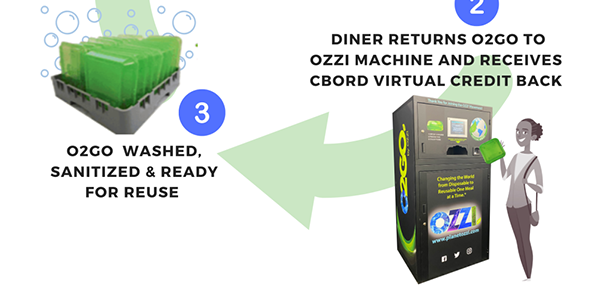
When finished, the container is returned to a collection kiosk in the dining hall. The student swipes the ID card and kiosk reads the container’s barcode. The student then receives a virtual credit to his meal plan account that can be redeemed next time a container is needed.
If the container is not returned, the student cannot take another one without purchasing a $5 credit. According to a CBORD case study, this leads to a nearly 100% container retention.
The OZZI kiosks can store about 100 containers in a plastic lined bin. When the machine is full, a dining services employee empties the bin, and the containers are washed and prepped for their next use. Containers have been tested to withstand 1,000 washes in a standard commercial dishwasher.
As the SJFU Center for Sustainability puts it, “As members of a campus community, each person has an important role in building our sustainable future. Our collective progress requires a holistic, multifaceted approach, with broad participation from campus stakeholders.”
Eliminating waste in dining operations with the help of the campus card and transaction system is a step in that direction.