Card, mobile credential, payment and security
College campuses across the country are facing a growing sustainability challenge as takeout containers and disposable packaging become a permanent part of student life. An article in Bridge Michigan, says that while many of these habits emerged during the COVID-19 pandemic, university officials say they’ve continued long after dining halls fully reopened.
Students increasingly rely on grab-and-go meals, mobile ordering platforms, and food delivery services. This has created a culture of convenience that generates more waste and complicates recycling efforts.
At Michigan State University, campus waste dropped significantly during pandemic shutdowns but rebounded sharply as students returned. It has continued to rise with current volume at or above the levels immediately preceding the pandemic.
Surveys show students generally support reusable containers, but only when they are as convenient as disposable alternatives.
Sustainability leaders say the widespread use of single-use containers has made waste management more difficult because packaging materials are constantly changing, forcing recycling programs to adapt.
Despite these challenges, universities continue to invest in waste reduction initiatives. At the University of Michigan, waste audits revealed that takeout food packaging accounts for a large portion of trash in student-heavy spaces such as libraries. In response, the university has expanded composting options, launched zero-waste event programs and introduced reusable takeout container systems in dining halls.
The institution has also set ambitious sustainability goals, including increasing its waste diversion rate from the current 35% to 50% by 2030.
Officials stress, however, that sustainability programs must align with student expectations. Surveys show students generally support reusable containers, but only when they are as convenient as disposable alternatives. This reality has prompted discussions about a citywide reusable container system within the Ann Arbor community.
While technology and infrastructure are important, sustainability leaders say behavior remains the greatest challenge. Reusable container programs have shown promise at universities nationwide, but their success depends on consistent student participation and convenient return systems.
As students continue to prioritize convenience, colleges need to design sustainability programs around modern dining habits rather than trying to restore pre-pandemic behaviors.
Financial limitations add another layer of complexity. Reusable programs require staffing, equipment and ongoing management, resources that are often limited.
As students continue to prioritize convenience, colleges need to design sustainability programs around modern dining habits rather than trying to restore pre-pandemic behaviors. The goal must be to make environmentally responsible choices as easy and accessible as possible.
Many campus card offices struggle with the same challenge: getting large numbers of students through orientation without creating long lines and bottlenecks. Stephen Courchane, Director of the U Card Office at the University of Minnesota Twin Cities, explains how his office tackled the issue. They did it by partnering with the orientation office to make photo submission a required step for orientation registration.
The team knew that increasing pre-arrival photo uploads was key to streamlining card issuance. They went through multiple iterations, ultimately requiring students to submit the photo before they could sign up for an orientation date.
The results were significant. Photo submission rates increased from roughly 50-60% to more than 80%. During the most recent period, 95% of students received their preprinted U Card during orientation check-in rather than waiting in long lines at the card office.
Our office used to have hour-long lines during orientation. Now we're busy from 8 to 10 a.m. handing cards out at check-in, but the rest of the day is quiet.
The improvements extended beyond operational efficiency. With permanent credentials in hand, students could access residence halls, meals, and classroom buildings during orientation without the need for temporary cards. That familiarity also helps students return in the fall already knowing how and where to use their credential.
Courchane's advice to peers is simple: identify campus partners that can tie photo submission to an existing student requirement, remain patient, and continue building support over time. Small process improvements and strong cross-department collaboration can ultimately transform both operations and the student experience.
To learn more about how they did it, watch the full interview by clicking on the image at the top of the page.
TRANSCRIPT:
I think we've faced the challenge that a lot of people have, which is figuring out how to get students through the card line without having long lines and long wait times.
For years, we have just been trying to think about how we can optimize that. We've talked to partners at NACCU as well as other schools and organizations that have had luck with that. One of the big things that we've heard from them is getting 100% of students to upload their photo ahead of time makes a big difference.
We've struggled with figuring out how do we get all of our students to upload their photo before they actually come for orientation. Talking to partners like Scott Brennan from Temple University and learning that they were requiring the photo upload step within their process for getting signed up on campus really helped.
We had this opportunity with the orientation office to make it a requirement that students upload their photos before they could sign up for an orientation date. By locking students into actually having to complete that step to move forward, we were able to increase the number of people uploading a photo ahead of time. This made it much easier for us to have cards ready to go at orientation.
We were able to eliminate having a line of people at our office. Instead, students go in one line. They get in line to check in for orientation, they get their U Card, and then they leave. It's a much more seamless experience for them and for us.
We built integrations with our systems so that if a student already has a photo in our system, they can skip that step entirely. They don't even see the step to upload their photo.
Specifically, what we did was we partnered with the orientation office to have them include a link to the photo upload site as a requirement. In the first year that we did that, students simply had to click the link to move on, but it didn't really require that they actually take the action once they clicked it.
This last year, we were able to make it so that students have to click the link and submit their photo before it unlocks the next step in the orientation checklist. That took us from maybe 70% of students completing the process to closer to 80% of students getting it done.
They also were able to create some integrations with our systems so that if a student already has a photo in our system, they can skip that step entirely. They don't even see the step to upload their photo. If they don't already have a photo in our system, they get locked into having to complete that step before they move on.
Now when orientation arrives, we've already preprinted the cards. We grab all those cards for that day and orientation session, hand those cards out to each student as they come through check-in, and then away they go.
The primary partnership was with the orientation office. They got a new director a few years ago, and when she came in, she asked, “Is there not a better way to do this?” We said, “We'd love to talk to you about that.”
Additionally, we've worked really closely with the conference and event services group out of the housing department because they're closely tied into orientation, summer conferences, meal access, and residence hall access.
There are other benefits to increasing the photo upload percentage and getting U Cards into students' hands before orientation. Students can immediately use their U Card to access meals, residence halls, and classroom buildings. Instead of carrying multiple cards and being confused about which one to use, students arrive, receive their U Card, use it throughout orientation, and then return in the fall already familiar with it.
Before linking our photo upload process with other departments, we were seeing maybe 50% to 60% of students upload a photo ahead of time. We spent a lot of time trying to get students to upload photos during orientation so we could issue cards before they left.
During the first couple weeks of orientation last summer, close to 95% of students were able to receive their U Card at or before orientation began.
Now we're seeing upwards of 80% of students upload their photo ahead of time. During the first couple weeks of orientation last summer, close to 95% of students were able to receive their U Card at or before orientation began.
Our office used to have hour-long lines during peak orientation season, and now we really don't see any lines. We're busy from 8 a.m. to 10 a.m. handing cards out at check-in, and then the rest of the day is very quiet.
My primary advice is to seek out departmental partners on your campus who can help connect photo uploads to a required student process. If you can find that partner, you'll make significant progress in getting students to complete the process before they arrive on campus.
Other than that, be patient and wait for opportunities. It took us years to get to this point. We kept looking for partners, implementing small improvements each year, making requirements a little firmer, and demonstrating the benefits to other campus departments. That increased buy-in and helped further streamline the student experience.
On July 14-15, the New York University Kimmel Center will be the location for this year's ColorID Identity Summit. The event agenda explores the latest in identity management, mobile identity, and advanced credential technologies.
Ideal attendees include professionals from higher education, healthcare, enterprise, and other vertical markets who are responsible for identity and credentialing at their institutions.
The event is designed to spotlight real-world experiences and provide practical insight into how organizations are approaching their identity journeys.
“We designed the Summit to explore the full spectrum of identity technologies, including physical credentials, mobile credentials, biometrics, and the platforms that bring them together,” says Mark Degan, VP of Marketing at ColorID.
Moreover, he notes that every organization is at a different stage in its identity journey. So rather than promoting a single technology, they wanted to help attendees understand how these technologies can coexist and evolve over time.
According to ColorID, space is limited so register now.
The event agenda includes presentations from end users actively navigating credential modernization initiatives, along with leaders from the identity and security industry.
Sessions will focus on identity strategy, operational best practices, mobile credentials, security technologies, and future planning. Additional discussions will cover approaches organizations are using to help fund modernization and migration initiatives.
According to ColorID, this is not a tradeshow or product pitch.
“It is designed to spotlight real-world experiences and practical insight into how organizations are approaching these transitions today and what is next in their identity journeys,” says Degan.
NYU was a natural choice for this year's Identity Summit, because they represent the type of identity transformation many organizations are working toward.
Additionally, there is no charge for event registration. The site – the NYU Kimmel Center for University Life – is located in Manhattan in the heart of the NYU campus.
"NYU was a natural choice for this year's Identity Summit, because they represent the type of identity transformation many organizations are working toward,” says Degan. “Since 2019, NYU has worked closely with ColorID to implement solutions that are more streamlined, efficient, scalable, and future-focused. Their willingness to share both the successes and lessons learned from that journey provides attendees with practical insights that can be applied within their own organizations."
Hear directly from organizations that actively working to modernize identity within their organization. Learn what worked, what they would do differently, and what comes next. Sessions include:
Register Now
In this episode of CampusIDNews Chats, George Davey, Partnerships Director at Grubhub Campus, discusses how the company’s campus dining platform is designed around partnership, flexibility, and convenience for both institutions and students. The company now partners with more than 400 campuses nationwide and continues expanding its capabilities in 2026, with improvements to offline functionality and enhanced data integrations for campus partners.
He says they focus heavily on listening to customer feedback and working collaboratively with colleges and universities to improve the dining experience. That approach extends across support services, customer success management, and product development. The goal is to create a smoother and more connected experience for campus administrators, dining teams, and end users alike.
The platform enables students, faculty, and staff to connect campus payment methods directly within the Grubhub app, including declining balance accounts, meal swipes, and meal equivalencies. Users can then order from participating campus dining locations while skipping traditional lines. Because the system is powered by the broader Grubhub marketplace, students can continue using the same app experience off campus or while traveling during breaks.
Students can add their student tender, declining balance, meal swipes or meal equivalency, and then order from their favorite merchants on campus while skipping the line.
Davey also highlights Grubhub’s wide-ranging technology ecosystem, including kiosk solutions, POS hardware, kitchen display systems, robot delivery partnerships, reusable container initiatives, lockers, and frictionless technologies.
TRANSCRIPT:
My name is George Davey. I'm the Partnerships Director at Grubhub Campus. At Grubhub Campus, we take a partnership approach to everything that we're doing.
Whether that's our support function, whether that's our best-in-class CSMs, or the products we're delivering, we're always listening to the voice of our customer to make sure that we enhance the experience on college campuses for our partners, and also for the end users.
The Grubhub platform allows students, faculty and staff to affiliate with their campus. They can add their student tender, declining balance, meal swipes or meal equivalency, and then they're able to order from their favorite merchants on campus while skipping the line.
Because we're powered by Grubhub, we have access to hundreds of thousands of restaurants in the marketplace as well. So, when students are perhaps visiting home or it's spring break, they're able to jump into the same app they use on campus and order from their favorite merchants off campus as well.
Some recent exciting developments is further enhancing our offline mode across our kiosks, POS and KDSs. This will continue to improve our platform stability.
Grubhub has what we call our Ultimate Solution, which provides hardware to a front of house staff through our POS and also for customers with our kiosk solution. We also have KDS's (Kitchen Display Systems), so orders are easily seen and you can pick up your order when it's ready.
Grubhub currently partners with over 400 campuses across the United States, and we're continuing to grow in 2026. As well as our campus partnerships, we also have partnerships with ancillary providers such as robot delivery, frictionless technology, reusable containers, and lockers.
Some recent exciting developments is further enhancing our offline mode across our kiosks, POS and KDSs. This will continue to improve our platform stability.
Moreover, we understand the importance of data, so we've enhanced our outgoing data feeds to our partners while also working on projects where we can actually ingest your data and publish it to our front end.
To find out more, please visit grubhub.com/about/campus.
Each year at the NACCU Annual Conference, a series of awards are presented to individuals and institutions for innovation and dedication to the profession. At the 2026 Annual Conference in Covington, Kentucky, three institutions and five individuals were recognized. Congratulations to all the winners and nominees.
 The University of Utah has earned the NACCU 2026 Best Video Award, recognizing outstanding use of video to promote campus card programs and related technologies. HID’s Amy Surprenant presented the honor to Bryon Buchmiller, Director of the Ucard program. Chosen by popular vote among NACCU members, the winning video creatively showcased the advantages of mobile credentials while humorously highlighting the inconveniences of physical cards. To check out this extraordinary marketing piece that combines education and humor, click the image at the top of this page.
 Georgia Institute of Technology is the recipient of the NACCU 2026 Best Card Design Award, recognizing excellence in the visual appearance of a campus card. The award was presented by Jennifer McNeill of TouchNet, and it was accepted by Jennifer Rocke of Georgia Tech’s BuzzCard office on behalf of the institution. Selected by popular vote of the NACCU members, the award celebrates card designs with strong visual impact, creativity, and institutional representation. NACCU praised Georgia Tech for its innovative design and highlighted the creativity and passion consistently displayed across the campus card community.
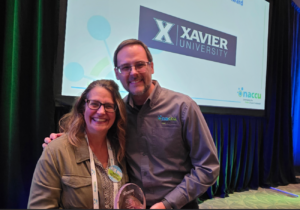 Xavier University is the winner of the NACCU 2026 Innovative Technology Award for its creative approach to addressing campus food insecurity. The award recognizes institutions that develop innovative technology solutions supporting campus card services. Michelle Dietz, Assistant Director of Auxiliary Services, accepted the award from Josh Bodnar, Ohio State University and NACCU President.
Xavier’s solution leverages the institution’s existing meal plan and transaction system to enable anonymous meal donations and requests through the university’s mobile app. Students with unused meal swipes can donate them, while students facing food insecurity can request assistance discreetly. When a donated meal becomes available, it is automatically added to the recipient’s mobile credential and they receive a notification.
The program removes barriers and stigma often associated with food assistance while promoting student belonging, engagement, and retention. It also helps reduce food waste and maximizes existing campus resources.
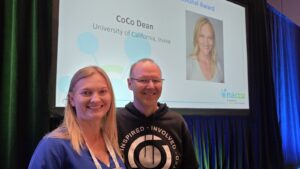 CoCo Dean, OneCard Specialist at the University of California, Irvine, is the recipient of the NACCU 2026 New Professional Award. The award, presented by SECANDA’s CSO Sebastien Dayer, recognizes emerging professionals with five or fewer years in the campus card industry who have made significant contributions to their institutions, the profession, and NACCU.
Dean was honored for her leadership and commitment to building community within the industry. Though relatively new to the industry, she has been actively involved in NACCU through programs such as the Industry Essentials Institute and the Data Summit, chaired the Engagement Committee, and presented at conferences and webinars. Her student-centered approach and dedication to collaboration have made a lasting impact on both NACCU and UC Irvine.
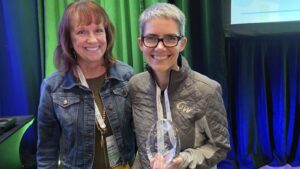 Emily Dieker, Director of the GWorld Program at George Washington University, is the recipient of the NACCU 2026 Outstanding Volunteer Award. The honor recognizes exemplary volunteer service, leadership, and commitment to the NACCU community.
Entrust's Julie Beckius presented the award to Dieker for nearly a decade of contributions to the association. She has been a frequent presenter at NACCU conferences, webinars, and round tables, while also supporting conference operations, facilitating networking groups, and contributing blog posts.
Perhaps her most impactful role is as a faculty member for NACCU’s Standards and Guidelines (SAGs) program. In that role, she has mentored and encouraged professionals across multiple cohorts, helping shape the future of the industry.
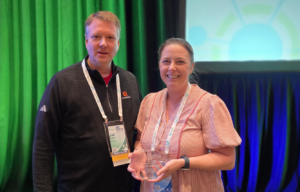 Cassie Bruner, Director of Cougar Card Services at the University of Houston, has been honored with the NACCU 2026 Campus Card Champion Award. Introduced in 2025, the award recognizes professionals who advance campus card programs through advocacy, collaboration, and strategic leadership. It was presented by Allegion's Jeff Kozior.
Bruner was recognized for transforming Houston's ID card into a strategic campus asset. By partnering with departments across campus, she has improved card distribution processes, expanded attendance and event tracking capabilities, and generated valuable data to support student success initiatives. She has also played a key role in the university’s transition to mobile credentials, helping ensure the campus ID remains innovative and relevant.
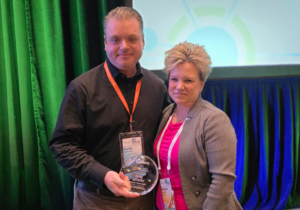 David Anthony, Executive Director of Finance and Chief Business Officer for Student Affairs at the University of Texas at Austin, is the recipient of the NACCU 2026 Distinguished Service Award. Illumia's Rachael Sepcic presented the award that recognizes individuals who have advanced the campus credential industry through leadership, innovation, and active involvement in NACCU.
Among his many contributions to the association, Anthony was recognized for his leadership during the COVID-19 pandemic, helping NACCU navigate financial and operational challenges and positioning the organization for long-term stability. Known for making complex financial concepts accessible and actionable, he has played a key role in supporting NACCU’s strategic decision-making. He is a former board member and current chair of the association’s Investment Committee.
 Janet Rauhe, Director of Phoenix Card Services at Elon University, is honored with the NACCU J. Paul Melanson Award, one of the association’s highest recognitions. Named for one of the organization’s founders, the award celebrates individuals whose leadership and innovation have helped shape both the campus card industry and the association.
Atrium's Sami Takieddine presented the award to A NACCU member for nearly 30 years, Rauhe was recognized for her exceptional service, leadership, and commitment to helping others succeed. Throughout her career, she has contributed to NACCU through committee work, mentoring, conference support, and service on the Board of Directors, including two terms as Board President during a critical period of transition.
At Elon University, Rauhe built Phoenix Card Services from its initial implementation into a comprehensive campus credential program, supporting thousands of users and a broad network of campus and community partners.
In this episode of CampusIDNews Chats, Audra Forsberg discusses a growing challenge facing campus card offices – fraud risks created by misplaced trust and weak internal controls. While trust is necessary in any organization, Forsberg emphasizes that trust without oversight can create opportunities for both internal and external fraud.
Forsberg shares examples of internal fraud that can happen in campus card environments, including unauthorized access changes, printing cards for friends, and adding funds to personal or outside accounts. External threats can also emerge through stolen credit cards used to fund guest cards, creating difficulties in tracing transactions.
A major theme throughout the discussion is that many issues arise not from malicious intent alone, but from weak processes and a lack of accountability. Training, written policies, and clearly documented procedures help staff understand what is allowed and what crosses the line. Managers also need to pay attention to employee pressures and warning signs that may indicate risk.
If people don't know policies and procedures, they don't know what is and isn't allowed. One common response when fraud is investigated is, "I didn't know I couldn't do this."
Forsberg stresses the importance of practical safeguards such as daily and monthly reconciliations, activity reporting, and requiring multiple people to review financial transactions. She also highlights the importance of leadership setting the right example through ethical behavior and policy compliance.
TRANSCRIPT:
I'm going to say this out first, trust but verify.
We're seeing card office fraud because people are overly trusted in their positions. Card administrators are not verifying that they're doing the work or making sure people are not taking advantage of the system. Ways people can take advantage of the system include adding access onto a card, printing out a card, and giving it to a friend for access into a residence hall room.
They may also have access to stored value accounts for student, faculty, and staff transactions and add money to their own account or a friend's account. Some external fraud includes credit card fraud. Someone might buy a guest card from a machine and use a stolen credit card to add money to it, making it difficult to track who used those funds.
Card office fraud can be common if organizations don't have internal controls in place.
One important control is training. If people don't know policies and procedures, they don't know what is and isn't allowed. One common response when fraud is investigated is, "I didn't know I couldn't do this."
Managers also need to recognize pressures people may be under. Students may experience financial stress, and there can be red flags managers miss.
Opportunity is often the biggest factor. Organizations can create opportunities for fraud by over-trusting people and failing to run daily or monthly reconciliations.
Another important control is tone at the top. Leaders should set an example by following policies and procedures themselves and not misusing resources.
Opportunity is often the biggest factor. Organizations can create opportunities for fraud by over-trusting people and failing to run daily or monthly reconciliations. Reports should track who granted card access, printed cards, added money to accounts, or changed meal plans.
These systems and reports should either be automatically delivered or consistently reviewed. Sometimes people become too busy and overlook them.
Written policies and procedures are critical. Organizations should define how transactions should be processed and when access should or should not be granted.
Reporting is also essential, particularly for financial transactions. Even when business managers are involved, trusted individuals still require oversight.
For financial transactions, a second person should always verify deposits. This not only prevents fraud but also catches mistakes and errors.
Resources are available through the NACCU Vault, which provides sample policies, procedures, manuals, and onboarding guidance. Universities also have their own ethics guidelines and policies related to financial transactions and access control.
The biggest takeaway is trust but verify.
Internal audit teams can provide ethics and fraud training. Universities also provide anonymous reporting systems so employees can safely report concerns without fear of retaliation.
Atrium Campus and the Identification Systems Group (ISG) announced a new partnership that will enable ISG member companies to promote Atrium’s cloud-native campus credential solutions in higher education and other market verticals.
ISG is a North American network of identification, security, and identity-management solution providers that has served customers for more than 40 years. Initially an association of photo identification system dealers, ISG was created to help organizations access high-quality ID card printers, supplies, and expertise at competitive prices. Today, member companies deliver a full range of identification and security solutions to sectors including education, government, healthcare, hospitality, and more.
ISG is recognized for its extensive regional distribution network. Their dealer network will expand our reach by connecting us with institutions who are not current Atrium clients.
Currently, 26 ISG member companies are spread across the U.S. and Canada, each serving a dedicated geographic region. In addition to product sales, members provide local installation, technical support, and consulting.
Manufacturers and solution providers of both hardware and software are vetted at the organization level, and approved products become part of the dealer offerings.
The latest partnership will enable ISG’s local sales and service network to offer the Atrium platform to new and existing customers. According to a joint announcement, together, they aim to help higher education, corporate campuses, and residential communities … transition from legacy hardware to flexible, mobile-centric systems.
“This partnership allows our members to offer the most innovative cloud-based card management technology available today,” says Brian Swistak, Executive Director of the ISG. “Through our agreement with Atrium Campus, our nationwide network of member dealers can now deliver a seamlessly integrated, high-engagement experience for all our clients.”
“Atrium was built to free institutions from legacy proprietary campus card systems,” says Sami Takieddine, Director of Partnerships at Atrium Campus. “Through our partnership with ISG, clients gain access to leading physical security solutions and local expertise, ensuring a seamless and secure transition to cloud native, agnostic, mobile-first solutions.”
CampusIDNews spoke with Sami Takieddine, Director of Partnerships at Atrium Campus, to learn more about the new partnership. Here’s what he had to say.
“ISG is recognized for its operational excellence, extensive regional distribution network, and long-standing enterprise client relationships. Their dealer network will expand our reach by connecting us with institutions who are not current Atrium clients. We believe ISG will want to refer Atrium to their accounts just as we will want to refer our clients to ISG dealers. This will act as a catalyst for mutual growth.
One of our core principles is a “one size fits one” philosophy — taking the time to understand each client’s unique needs before recommending the right solutions or providers. ISG shares this customer-first mindset.
Additionally, while Atrium’s client base has traditionally been concentrated in higher education, we’ve been actively expanding into sectors such as healthcare, corporate dining, and the government/military. Partnering with ISG will accelerate this growth, as many of their dealers operate across a wide range of industries and verticals.
Legacy OneCard providers typically lock clients into to their card issuance and access control ecosystems, which limits flexibility and increases costs. At Atrium, we believe clients are best served by having access to a range of best-of-breed solutions and partners.
One of our core principles is a “one size fits one” philosophy — taking the time to understand each client’s unique needs before recommending the right solutions or providers. Because ISG shares this customer-first mindset, we believe this partnership is a natural fit that will deliver meaningful value to both Atrium and ISG member clients.”
In this episode of CampusIDNews Chats, Alex Khamu, Global Business Development Manager at Unicard Systems, shares how the company is helping colleges and universities modernize campus card issuance through cloud-based software, online photo submission, digital IDs, and self-service kiosk technology.
With more than 40 years in the industry and a strong presence across Australia, the U.S., and Canada, Unicard provides a flexible suite of solutions that can operate as a full campus card ecosystem or as standalone modules. He explains how institutions can integrate Unicard’s platform with existing one card systems, student information systems, HR systems, access control, and library platforms through single sign-on and interoperable integrations.
A major focus of the conversation is the growing adoption of self-service campus card kiosks. He highlights how students can complete much of the issuance process on their own, including remote photo submission, authentication, and kiosk-based card pickup. In many cases, the only manual step left for campus card staff is approving a submitted photo.
We have over 80% of the universities in Australia, and we've also got many solutions running in the US and Canada as well.
Alex also shares examples of institutions using the technology, including MIT, Confederation College, Amherst University, and Howard University. He explains how these deployments are helping campus card offices reduce administrative workload while improving efficiency and scalability for institutions of all sizes.
TRANSCRIPT
Hi. I'm Alex from Unicard Systems. I'm the global business development manager. I've been with the company for 15 years, and our company's been around for 40 years.
We're an HID partner locally in Australia. We are one of the biggest there, providing all the hardware there and overseas as well. We also provide all the software for campus card issuance. That is a whole suite of products, not just one solution. We provide the ID system which is cloud based, U.S. locally hosted here. It's not only the cloud issuance portion of it for campus card physical issuance and digital issuance, we also actually supply the range of products to go along with it for online photo submission, physical kiosk printing, self-service printing, and also digital ID wallet issuance as well.
We are quite interoperable. We work with all the common one card partners. If you have a one card solution, we can integrate to all these different types of systems.
We offer single sign on and data in through your H.R. and student management system as well as data out through to your access control system or library system. And then also pushing any information we need to things like your one card systems as well. So our solution is there to be used as a whole solution, or we can use it as a modular solution as well.
We can provide our card issuance or just our photo upload module or just our kiosks. So we're very flexible in how we work and scaling it to each institution's needs. In saying that, our solution is used mainly in education.
We have over 80% of the universities in Australia, and here in the US and Canada we've also got many solutions running as well.
We've seen a really great interest and uptake in our self-service kiosks. There is a real return on investment on those. It takes out a lot of the manual work for the campus offices. The students essentially are able to do the whole process themselves. When they're onboarded, they're going through that system automatically, and they receive an email to essentially pick up their card from the kiosk. The only manual task that the campus card office will have to do is click approve on a photo. We handle all the other processes automatically through integrations and the self-service portions of our solution.
Recently we've been partnering with Atrium, and two of their sites – Amherst University and Howard University – are going live next month with our kiosks integrated directly with the Atrium solution.
Our solution is used in all sorts of different industries.
We have a lot of systems here running in the U.S. and also Canada – varying between our ID system, photo upload, and kiosks. We do have a great focus here in the U.S. with our kiosks, our self-service campus card kiosks.
That ranges from universities, such as MIT, that are using eight of our kiosks for card issuance. And then it can go to smaller colleges like Confederation College in Canada that was using just one of our kiosks for issuance.
Recently we've been partnering with Atrium and two of their sites, Amherst University and Howard University, are going live next month with our kiosks integrated directly with Atrium Campus. Students will be able to visit the kiosk, scan a QR code, login with single sign on, authenticate themselves at the kiosk, and have their own campus card issued. That really takes out a lot of the manual tasks for the campus card office and the ROI is something that has really been proven across not only here locally in the U.S., but proven in Australia, UK, and other parts of Asia, that it really is a great product.
If you want to learn more about the Unicard Systems offering, please feel free to get in touch at any time. We're always here to help and provide our experience and our knowledge on our complete solution offerings, whether it's just one part of our system or the whole package.
We can definitely assist, no matter the size of the college. Very flexible. Get in touch with me any time. Again, my name is Alex Khamu, Global Business Development Manager at Unicard. My email is pretty easy to remember. It's Alex at Unicard dot com dot AU.
In this episode of CampusIDNews Chats, Tatiana Tomley, Marketing and Business Development Manager for SECANDA, discusses the company’s expansion into North America and explains how its flexible campus identity platform supports both traditional cards and mobile credentials.
Tomley explains that while SECANDA may be newer to the US and Canadian markets, the company supports hundreds of universities across Europe along with enterprise clients including Philip Morris, Merck, and Bosch.
Rather than forcing institutions into a one-size-fits-all solution, she says SECANDA focuses on adapting its technology to each campus’ unique needs and existing systems.
It’s never going to be a fully mobile solution. It’s a hybrid future.
“We want to work with you to solve your specific campus problems,” Tomley says. “We’re not going to change you to fit us.”
A major focus of the conversation centers on mobile adoption and evolving campus credentials. Tomley explains that SECANDA developed its own mobile wallet instead of relying on third-party providers like Apple or Google, helping institutions avoid additional licensing and transaction fees.
Drawing from nearly a decade of mobile deployment experience, she says campuses are moving toward hybrid environments where physical cards and mobile credentials work together.
“It’s never going to be a fully mobile solution,” she says. “It’s a hybrid future.”
TRANSCRIPT:
Hi, I'm Tatiana Tomley. I'm the marketing and business development manager for SECANDA, Inc.
You may or may not have heard of us. We are a company out of Europe. We were founded in 1978 in Germany. Then we grew into Switzerland. We grew into Spain and Italy. And now we've come to the United States and Canada.
We are incorporated in New York City, and also we’re in Toronto for our Canadian clients to be able to invoice directly in Canadian dollars.
We manage 500 total clients. We don't just do universities though that is our bread and butter. We also have really big clients like Philip Morris, Merck, Bosch, and hospitals as well.
We have 380 universities in Europe, so we may seem like the little guy here. We are a big guy. We have a lot of university experience. We manage 500 total clients. So we don't just do universities though that is our bread and butter. We also have really big clients like Philip Morris, Merck, Bosch, and hospitals as well.
We know how to do really big and we know how to do really small.
We started as one card. So that is something we know really well, and we've grown it by really focusing on the person as the main identity of that credential.
So with this, we connect to anything.
We are open to integrate to your existing campus partners and whoever your future partners are, whatever new technologies come in.
We're really great at incremental adoption. So you can start with your grad students. You can start with just your freshman class with us. You can start with just your teachers, whatever works for you.
We’re the most customizable and flexible solution on the market. We want to work with you to solve your specific campus problems. We know there's no one size fits all solution, and we're not going to change you to fit us. We want to adapt our technology to your school.
We have our own wallet and we don't have a middleman – a third party partner like Google or Apple – which would charge you additional licensing fees and transaction fees.
Another thing that sets us apart is that we have our own wallet. So our app is how we make you mobile. We are great at classic one card. We know how to do that. We connect with NFC, with Bluetooth, with this great QR code we have.
And our wallet is our own wallet. We don't have a middleman, a third party partner like Google or Apple, which would charge you some additional licensing fees and additional transaction fees. None of that with SECANDA.
We've developed this really great product in Europe. We had to cut out all the fat, no nickel and diming over there. We have this great, very secure GDPR compliant products. And that's higher than what we have for standards over here in the US. So, you know that we do security well.
About 80% of our schools have at least some mobile element. For them we're seeing 55% of the user population use the mobile option.
With our wallet, we do $240 million dollars in transactions already, and our clients love us. We have a 99% high retention rate. For mobile adoption stats, we first went mobile in 2015, and our schools have been mobile for a decade in some cases.
We've seen the future of mobile adoption, and we're seeing that of those mobile schools, about a little more than 80% of our schools have at least some mobile element. For them we're seeing 55% of student user population, including teachers, too, use this mobile.
It's never going to be a fully mobile solution. It's a hybrid future.
We're seeing a hybrid campus that ties together a really great one card, working with your legacy one card, to elevate it to a new, modern one card that we offer. And this mobile that enhances what you already have.
In this episode of CampusIDNews Chats, Anthony Condo, Director of Campus Services at Swarthmore College, discusses NACCU’s SAGs (Standards and Guidelines) program – how it helps institutions and administrators identify campus card best practices to evaluate and improve their card office operations through a structured industry assessment.
The SAGs program is a 10-month online course made up of 12 modules covering topics such as marketing, finance, leadership, legal considerations, and technology. Participants meet roughly every three weeks and complete assignments designed to assess how their institution aligns with current industry standards.
Rather than serving as a “how-to” course, the program is intended to help institutions embark on a deeper exploration of their existing operations.
Rather than serving as a “how-to” course, Condo explains that the program is intended to help institutions embark on a deeper exploration of their existing operations.
“It’s meant for you to evaluate your program,” he says. “You’re really taking an internal look at what you’re doing – what you do well and what you have to work on.”
A major part of the program is the executive summary participants complete at the end of the course. The summary highlights operational strengths, identifies areas for improvement, and can help institutions justify requests for additional funding, staffing, or resources.
The institution benefits most because you're really taking an internal look at what you're doing, what you do well, and what you have to work on.
Participants are required to provide documentation supporting their assessments, including marketing materials, policies, and technology plans.
Condo recommends the program for professionals who already have some industry experience and enough time to fully engage with the coursework. While SAGs does not provide a formal certification, he says the knowledge gained through the process can provide long-term value for both individuals and institutions.
TRANSCRIPT
The SAGs program was developed by NACCU faculty and staff as a means to evaluate card office programs. SAGs stand for standards and guidelines.
It's an online course. It lasts roughly ten months. So normally it starts in late May and it'll run through February.
There are modules that you work through, basically looking at all aspects of a card office operation.
You're going to you're going to have a unit on marketing a unit of finance and technology, and legal. Anything that has to do with the card office you're going to have a module on that. It meets, roughly every three weeks. There's a down time, a month of August, normally just to allow schools to get to, to let their students come back and everything. Then it'll start right back up again.
The ultimate goal is you're going to write an executive summary, so you know how you've done and how you've rated your program. Maybe pull out the outliers, the things you're doing really well, maybe things that you need to work on because you want to have something to present to your leadership to show them, hey, we do really well in this area, but these are some areas that we need to focus on based on what the industry standards are.
Hopefully if you need to get resources or funding, you can use this as backup to get whatever it is that you need.
So again, there's modules.
You're looking at marketing and it'll ask you things like where can you find information about your meal plans or where could you find information about how to upload your photo? Or give your headshot or your office hours and where are your offices? Finance, maybe it'll ask you to explain how funds are allocated for your program. Do you have enough funding
There's a module on leadership that'll look at your office structure and what your reporting structure is and who's in charge of your office. Who is the leader of your card office program and how long have they been in that role?
You know, legal that's a huge module, because there's a lot of aspects to a card office program with regard to legal issues. Technology is another one, it'll ask you what kind of card readers you're using, and what kind of servers and how you back up your servers etc.
We’ve gone through eight SAG cohorts. We're about to start the ninth cohort.
Then one thing that we've been talking about the past few years is we've had all these people go through the program and put in all this work, and what can we do next with them?
So that's probably something that's on the horizon, starting to reel everybody back in and say, tell us about how your executive summary went and what were some of the challenges that you noted that you had to address and where you're able to address them?
Were you able to get the funding that you needed or the staff that you needed? I think we're going to be seeing more of that coming down the pike.
I think who benefits most is the institution, because you're really taking an internal look at what you're doing and what you do well and what you have to work on. We always like to tell the students going through SAGs, it's not a poor reflection on you.
If there's a certain area where you didn't meet the standards, you're not going to fail. It's just good that you were able to recognize that and now you have some points that, you have to work with.
I think you can certainly justify it to your leadership because the ultimate thing is you're going to really take an introspective look at your program with the goal to make sure that you're meeting the industry standard.
Some advice I would say is you want to have been in the industry, for a couple of years. Or at least have attended the Industry Essentials Institute, so you have some knowledge. You probably don't want to walk into this being brand new in your role. You want to have some card office experience.
You want to make sure that you're going to have some time to do this because there is homework, so every unit you have to do some homework, you have to provide documentation for everything you do. The homework entails rating yourself on the different standards within each module. But you can't just say yes, I meet the standards, you have to prove it. Show us that you meet the standard, show us the documentation.
Taking that into account, make sure you have enough time to get some homework done. If you're if you're going to be working on a larger project, you know, maybe you're going to launch mobile or something, maybe you want to wait till after that.
You have enough time to put towards this program so you can get the most out.
I think you can certainly justify it to your leadership because the ultimate thing is you're going to write an executive summary, and it's going to really take an introspective look at your program with the goal to make sure that you're meeting the industry standard.
I think it's money well spent. Yeah. I wouldn't call it a certification. You get a certificate saying that you completed the standards. You certainly get some bragging rights. I think what you learn going through it and what you discover about your card office – it's not all about finding things that are that are wrong.
You might find things that you do really, really well and you can build on that too. I think the knowledge that you gain going through the program will certainly benefit you.