Card, mobile credential, payment and security
A primer on radio frequency identification
For more than two decades, the contactless card has been a key tool in managing security, access and payments. Whether it’s used to open doors, facilitate public transit ticketing or mange multiple applications, contactless has become an essential element in many environments. But how does the technology enable all these uses without ever touching a reader?
Contactless cards use radio waves of specific frequencies as carriers for communication. Bryan Ichikawa, vice president for Identity Solutions at Unisys, explains that when used for identification applications radio frequencies come in three basic categories: low frequency, high frequency and ultra-high frequency. Each has a set of ideal applications.
Low frequency (LF) proximity cards operate at 125 or 134 kHz. These lower cost, lower security cards are typically used for door access applications.
High frequency (HF) products operate at 13.56 MHz and included the common ISO 14443 and 15693 standards. The vast majority of ID credentials are high frequency, says Ichikawa, adding that things like passports and bankcards use the ISO 14443 standard.
Ultrahigh frequency (UHF) operates at 433 to 953 MHz and has a longer range. “These cards can be read at 30 feet, but 10 to 15 feet is good accuracy,” says Ichikawa. UHF cards also work on different frequencies depending on geography and the allocation on the spectrum by the global standardization bodies and governments. UHF is commonly used in RFID tags for logistics applications and asset tracking.
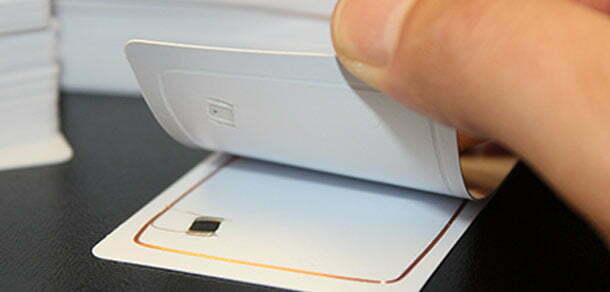
The key component in a contactless card is an embedded integrated circuit (IC) chip that contains the applications and data that make the card functional. The chip is either a microprocessor with internal memory, or a memory chip with non-programmable logic. The components within the IC store, transmit and process data.
A contact smart card also has an IC chip but it is exposed on the card’s surface. In order to be read, it must be inserted into a card reader where physical contact enables the chip to power up and communicate.
In a contactless card, the chip resides completely within the card’s body. Because the chip isn’t exposed, it cannot be read via contact with a reader. Instead, the card only needs to come within proximity of the reader to be powered up.
Inside the card an antenna coil is connected to the chip, eliminating the need for an internal power source. “The major feature [of contactless] is that it has no battery … it’s powered by the field of the reader,” says Martin Gruber, segment director for the Transit Team at NXP.
An extra benefit is that the IC lasts longer because the plastic protects it, unlike the contact chip, which is exposed to the elements. “[The embedded chip] has a longer lifetime span of four to five years,” says Abu Ismail, senior engineer, Customer Application Support for NXP, adding that a contact chip’s lifespan is about two years.
The other part of the contactless system is the card reader. The card relies on the reader as both a power source and the means by which the card shares data. The reader has a primary coil and a secondary coil that generates a magnetic field, says Ismail. When the card enters the reader’s magnetic field, it accesses the power it needs to turn on.