Card, mobile credential, payment and security
Case Western Reserve University (CWRU) has implemented Apex food lockers in The Den, providing a fast and efficient option for student dining. The new system reflects a growing shift toward automation in campus dining, aimed at reducing wait times and accommodating high volumes of mobile orders. By integrating app-based ordering with quick, contactless pickup, the university hopes to improve convenience for students navigating busy class schedules.
The Den often receives more than 100 mobile orders per hour. Before the lockers, that volume created long lines and crowded waiting areas.
With the massive shift to students relying on mobile apps to order ahead, traditional counter service often creates bottlenecks. CWRU’s move to smart lockers reflects an effort to keep up with student expectations for speed and flexibility while easing pressure on dining staff.
According to Apex, these smart food lockers are designed to “streamline food order pickup, reduce congestion, and enhance the student experience.” The system at CWRU does exactly that. Students order at The Den’s through a mobile app, and when their food is ready, kitchen staff load it into a locked compartment. Students then receive a unique code via the app and simply scan it at the locker unit to access the compartment.
Students order through the Transact app and pickup at the locker. The whole retrieval process takes less than 10 seconds.
During peak lunch and dinner rushes, The Den typically sees 110 to 125 mobile orders per hour. Before the lockers, that volume created long lines and crowded waiting areas. Now, students can pick up their meals without interacting with staff, freeing up space and reducing chaos in high-traffic zones.
The solution integrates directly with the Transact mobile ordering app.
“Students place their order through the app, and when their order is complete and loaded into a compartment, they receive a code to scan at pickup,” says Ashley McNamara, Vice President, Global Marketing for Apex. “The whole retrieval process takes less than 10 seconds.”
The University specifically chose to implement the OrderHQ Flow-Thru model, which “allows The Den’s kitchen staff to load orders from the back of the unit while students pick up from the front. This keeps the order handoff clean and the counter clear, even during busy periods,” says McNamara.
With 23 individual compartments at CWRU, the system can handle multiple orders simultaneously without creating backups. Each compartment stays locked until the correct code is scanned, adding a layer of security that has already reduced incidents of stolen or misplaced orders. The Flow-Thru setup also improves hygiene and organization, as food never sits exposed on a counter.
For dining services staff, the lockers mean less time spent managing lines and more time focused on food preparation and quality.
The installation of the Apex smart lockers is more than just a convenience upgrade; it signals how campus dining is evolving to meet the needs of today’s students. For example, a recent survey from PYMNTS.com found that 45% of Gen Z restaurant customers placed their most recent food order for pickup rather than delivery. While delivery remains strong, this suggests pickup is crucial, especially among younger demographics.
Campuses are being asked to do more with access than ever before. What once centered primarily on opening doors has expanded into a broad ecosystem of physical and digital touchpoints that shape daily campus life. From dining and retail to printing, events, and administrative systems, access now plays a direct role in student experience, operational efficiency, and institutional security.
As campuses modernize, the question is no longer whether access should evolve, but how to do so in a way that balances innovation with flexibility. Institutions are discovering that long‑term success depends less on choosing one “right” credential and more on designing access strategies that can adapt over time to meet the needs of multiple stakeholder groups.
Historically, access conversations focused on physical entry points such as residence halls, classrooms, and campus facilities. Today, that definition has expanded.
Now the access infrastructure conversation must include logical access, the ability to securely interact with digital systems and services across campus.
For student’s, the distinction between physical and logical access is invisible. They simply expect their credential to work wherever they are.
From the student’s perspective, the distinction between physical and logical access is invisible. Students simply expect their credential, whether a magstripe card, mobile credential, or smartcard, to work wherever they are.
This broader view of access reflects how campus life actually functions. Students move fluidly between spaces and systems, often dozens of times a day. Modern access infrastructure must support that reality without introducing friction or confusion.
 Student expectations are accelerating mobile adoption
Mobile credentials are gaining momentum across higher education, and in many cases, student demand is the driving force. In discussions with institutions, they’ve reported that mobile initiatives are often sparked not by policy mandates, but by student advocacy.
One campus leader described their experience this way:
“It wasn’t the university or even me driving mobile credentials. The students drove the whole thing. The student government association went to the chancellor wanting a mobile solution.”
Beyond convenience, campuses cite tangible benefits. Mobile credentials can reduce reliance on plastic cards, lower fraud risk, and streamline card office operations during peak periods like orientation. From a security standpoint, phones are less likely to be shared than physical cards, and mobile credentials allow for remote provisioning and revocation when needed.
Despite growing interest in mobile access, it’s understandable that most campuses operate within complex credential environments. Many support a mix of magstripe, low frequency prox, high frequency smartcards, and mobile credentials simultaneously. Each option brings its own cost, infrastructure, and lifecycle considerations.
Magstripe and prox credentials may be economical but lack encryption. Smartcards provide stronger security but require compatible readers. Mobile credentials add new considerations related to device compatibility, provisioning workflows, and user support.
Rather than pursuing immediate, all‑or‑nothing mobile rollouts, institutions should adopt a phased migration strategy. This allows campuses to modernize while preserving stability.
Additionally, the higher ed environment produces its own set of challenges. Student populations turn over annually, which affects card production, replacement cycles, and administrative costs. At the same time, access control systems are among the most significant infrastructure investments on campus, often maintained over many years. These realities make a rapid, campus‑wide transition difficult for many institutions.
Rather than pursuing immediate, all‑or‑nothing mobile rollouts, it’s advised that institutions adopt a phased migration strategy. This approach allows campuses to modernize while preserving stability.
Your campus can support a phased migration by:
These are just a few guiding principles that give schools room to learn, adjust and scale at their pace. It also allows campuses to accommodate users who rely on physical credentials while gradually expanding mobile access where it delivers the most value.
One challenge campuses consistently encounter is discovering how many systems rely on the ID credential. Dining systems, printers, bookstores, event access, and administrative tools often surface during migration planning, reinforcing the need for flexibility.
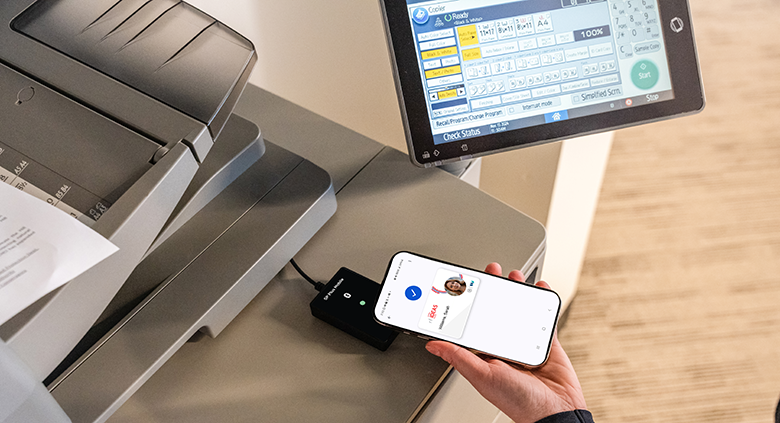 Interoperability and consistency build long‑term confidence
As credential ecosystems become more diverse, interoperability and consistency increasingly work hand in hand. Campuses need access solutions that can support multiple credential types, integrate across physical and logical systems, and behave predictably as they scale.
Interoperability allows institutions to introduce mobile credentials without abandoning existing investments or locking themselves into a single future path. At the same time, consistent access behavior across departments and systems reduces operational risk by limiting exceptions, workarounds, and one‑off integrations.
Rather than trying to forecast which credential technology will dominate next, campuses that prioritize interoperable access are ready for whatever comes.
When access works the same way across dining, academic systems, events, and administrative applications, IT and security teams gain confidence in the environment they manage. This predictability strengthens security, reduces technical debt, and makes it easier to extend access into new use cases without disruption. Rather than trying to forecast which credential technology will dominate next, campuses that prioritize interoperable and consistent access ensure today’s decisions leave room for whatever comes next.
When access systems work well, they fade into the background. Students move through campus without interruption. Staff focus on service rather than troubleshooting. IT teams gain confidence that their systems can scale and evolve.
This type of experience is the freedom to campus. The freedom to modernize without disruption. The freedom to support multiple credential strategies. The freedom to extend secure access beyond doors and into every corner of campus life.
Learn more about how flexible, interoperable access strategies are helping institutions create freedom to campus experiences at https://www.rfideas.com/industries/education
Share your story with colleagues and peer institutions by participating in a 3-5 minute video interview during the NACCU Annual Conference. The CampusIDNews team will be conducting interviews with campus representatives in our exhibit hall booth (#116). Brag about your program, share something interesting your team has done, describe a challenge you are facing, or think of another subject that would interest card office and auxiliary service professionals. And while you’re at it, grab your $50 Visa gift card.
Vendors – you are invited to join in as well. We will be conducting these interviews at your booth. It’s your opportunity to share thought leadership or show off a new product.
All interviews will take place during exhibit hall hours:
Reserve your 15-minute slot at the links below. If you know your topic, add it now. If not, grab a slot and we can coordinate topics before the event.
https://calendar.app.google/zAhRkcA9mp5Xjc8t6
https://calendar.app.google/4pru7puHQipkzaFC8
A security threat has breached the exterior doors of a campus building – what now?
In a modern security environment, electronic access control (EAC) can quickly, remotely close and lock doors to secure specific areas. This only works, however, at the enabled access points.
Interior doors strengthen campus defense if an exterior door has been left unlocked or been otherwise compromised. “Together, these layers can slow an intruder’s progress, protect evacuation paths and create more manageable zones for responders,” writes Ken Cook, director of National School Safety and Advocacy at Allegion, for Campus Security Today.
Compartmentalization, also known as compartmentation, refers to the creation of indoor zones designed to provide multiple layers of defense in emergency situations. Compartmentation is often used as a barrier to slow the spread of fire and smoke, but it can be helpful for any type of threat containment.
By replacing physical keys with modern credentials, facilities can be split into secure pockets, each with a different tier of access.
In the report, Compartmentalization for Life Safety - The Role of Fire Doors and Secured Access During Crisis Events, the Partner Alliance for Safer Schools (PASS) explains that institutions use doors for these purposes in many ways:
EAC is a key tool to enable compartmentation. By replacing physical keys with modern credentials, facilities can be split into secure pockets, each with a different tier of access to meet varying needs. This helps mitigate the spread of active threats.
Administrators can designate specific permissions allowing groups – students, faculty, staff, even temporary visitors – access to different zones. EAC systems also make it easy for campus security to override different protocols for emergency responders. Additionally, every access attempt is tracked, creating audit logs that can improve understanding of campus movement patterns that can be invaluable when building emergency response plans or investigating security incidents.
In addition to hardened interior door hardware and electronic access control techniques, special glass can withstand a brutal physical attack from an intruder for over four minutes, according to ASSA Abloy.
One concern with the adoption of compartmentation doors is the potential for delay in movement for emergency personnel during a crisis.
To prepare for operational challenges, the Partner Alliance for Safer Schools suggests integrating “dual-priority safety design using strategies like master access solutions, smart integration, clear way finding and mapping, and training and drills with responders.” Emergency overrides can be implemented, and administrators can coordinate credential solutions with first responders.
Electromagnetic hold-open devices use magnets to keep doors open during normal building occupancy but enable remote close and lock capability during emergencies.
If not implemented properly, multiple interior doors could potentially be an inconvenience during normal daily operations. To address this, Allegion’s Cook suggests that electromagnetic hold-open devices be installed to retain an ease of access.
“These devices use magnets to keep the doors open during normal building occupancy, allowing unobstructed movement through hallways,” he explains. After triggering an alarm, the magnets release automatically to close and lock the doors.
Students want to feel safe without feeling imprisoned, and tiered zones help restrict access to inner spaces while leaving public areas more freely accessible.
Ease of scalability keeps EAC relevant as campuses expand evolve – adding new doors, updating access levels, and remotely modifying user permissions. Interior compartmentation supports remote lockdowns and centralized monitoring by creating manageable zones. Combining the two – EAC and compartmentation – helps a campus create a comprehensive and intelligent security net.
April 29 marks Stop Food Waste Day, a global movement that highlights a simple but powerful truth: what gets measured gets reduced. For campus leaders, this day serves as more than an environmental reminder. It is a strategic call to address the "data gap" in auxiliary services. While universities have digitized almost every other facet of the student journey, campus dining remains a frontier where intuition often outpaces information.
The scale of the challenge is significant. According to the Natural Resources Defense Council (NRDC), the average college student generates 110 pounds of edible food waste annually, nearly double the rate of corporate environments. Collectively, campuses discard over 22 million pounds of food each year.
For too long, dining operations have relied on lagging indicators. Leaders can track what was purchased and what was served, but the real story happens at the tray. With roughly 70% of foodservice waste occurring after the meal is served, the lack of granular data makes it difficult to align production with actual consumption.
This is where AI and "Kitchen Intelligence" change the equation. By deploying computer vision and smart sensors, institutions can finally see the invisible. These systems track the lifecycle of food in real time, identifying exactly what is eaten and what is discarded. This is not about replacing the expertise of culinary staff, but about giving them the high-definition tools they need to make smarter, faster decisions.
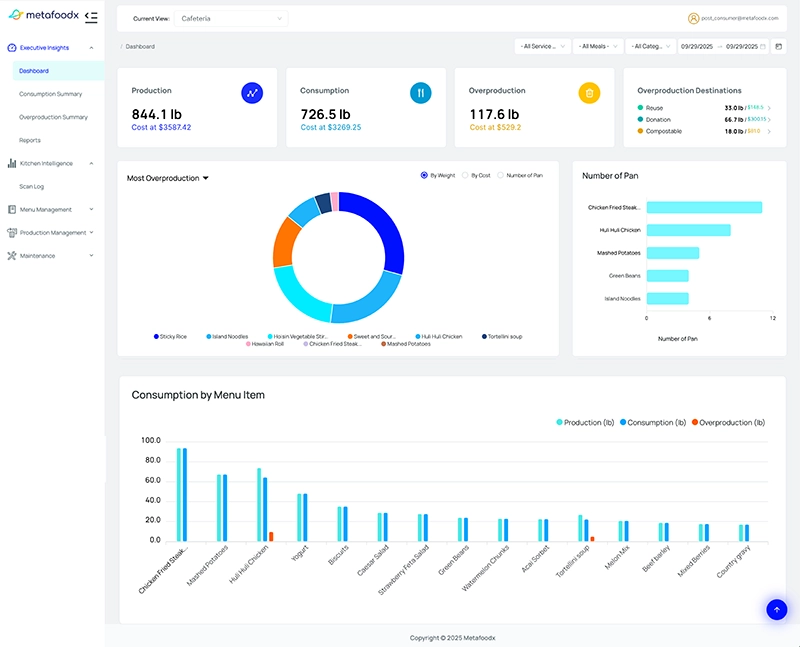
The accuracy of these new systems is redefining "best practices." Research published in 2025 by Dr. Gul Fatma Turker highlights that AI models, factoring in variables like student volume and weather, can predict demand with up to 99.9% accuracy. This level of precision has allowed early adopters to reduce food waste by 28% almost immediately.
The results are felt on the balance sheet as well as the environment. Leading institutions are already proving what is possible with data-driven foodservice operations. UMass Amherst halved its overproduction within a single semester. Pomona College saw a 54% reduction in waste, resulting in a first-year ROI of over 500%. For leadership, these are not just small wins; they are proof that operational intelligence can solve our most persistent sustainability challenges.
On this Stop Food Waste Day, the priority for campus leadership is clear. To reach the ambitious Environmental, Social, and Governance goals (ESG) set at the top, we must empower the teams at the point of execution with better data. Reducing overproduction lowers costs and slashes the carbon footprint of the institution, considering that food waste accounts for nearly five times the emissions of the entire aviation sector.
Reducing overproduction lowers costs and slashes the carbon footprint of the institution, considering that food waste accounts for nearly five times the emissions of the entire aviation sector.
By treating dining as a data-driven system rather than an unmonitored expense, we move from estimation to precision. Real-time data is the key to stopping food waste for good, transforming a traditional service into a model of modern, accountable stewardship.
Dining service professionals have been very diligent at improving their best practices in order to serve up the best food with affordable prices. The biggest hindrance to their effort has been the lack of actionable visibility to where exactly the wastes and inefficiencies lie. AI has come to the rescue to create a trustable and actionable ground-truth data layer with meaningful automation, marking the beginning of transformation for foodservice operations.
Dr. Fengmin Gong is the CEO and Co-Founder of Metafoodx, an AI-driven food operations platform focused on improving efficiency and reducing waste in large-scale foodservice environments. He has a background in technology and data systems, with a focus on applying computer vision and analytics to real-world operational challenges.
The Security Industry Association (SIA) released its Corporate Credential Design Guide, a new resource produced by their Credential Design Working Group. It specifies recommended practices for the design and implementation of credentials and badges by card issuers and security teams.
Though the document is geared toward corporate issuers, it is also highly relevant and beneficial for higher education issuers.
It covers key topics in physical credentials, identity verification, badge production, data security, counterfeiting protection, technology options, and more.
Modern attackers exploit human behavior, oversharing on social media, and advances in image replication to reproduce badges with alarming accuracy.
Identity credentials are key to modern enterprise security and operations, but the credential ecosystem is fragmented and increasingly vulnerable to new forms of attack. The guidelines shared in the report are intended to establish a vendor-neutral framework for designing secure, interoperable credentials.
In the section titled Security Awareness in Badge Design, it explains that design should not be viewed aesthetics, but rather as a core security effort to reduce exposure to social engineering, unauthorized access and credential misuse.
“Modern attackers increasingly exploit human behavior, oversharing on social media, and advances in image replication to reproduce corporate badges with alarming accuracy,” says the document. “As a result, the design of corporate credentials must include intentional and measurable security protections that help prevent forgery, misuse and unauthorized entry.”
Until now, no dedicated guidelines have existed to help organizations design IDs with both security and usability in mind.
The 72-page document is comprehensive but easy to navigate and digest. Users can skip between sections to focus on specific topics they need. As a whole, it defines a robust set of best practices covering the entire credential life cycle, including:
“Until now, no dedicated guidelines have existed to help organizations design corporate IDs with both security and usability in mind,” says Teresa Wu, vice president, head of Smart Credentials and Smart Integrate at IDEMIA Public Security. “The Corporate Credential Design Guide reflects SIA’s mission to lead with standards that shape the future of identity in the enterprise.”
The Corporate Credential Design Guide is available for free downloaded on the SIA website.
The bill that would enable students at virtually all Virginia universities to donate their unused meal plan credits fell just short of passing this year. State lawmakers voted to continue debating the proposal – supported by the nonprofit Swipe Out Hunger organization – in the 2027 session.
The bill was introduced by Senate Democrat Danica Roem and would have allowed students to voluntarily donate their unused meal swipes. The meals could then be distributed to other students for redemption at campus dining halls or on-campus food pantries.
The proposed legislation hoped to build on Roem’s 2025 legislative success that established the Hunger-Free Campus Food Pantry Grant Program. It provides funding to support campus food pantries at public and qualifying private higher education institutions in the state.
The new bill would have required universities to allow students to donate meal swipes in order to receive funding from the state's Food Pantry Grant Program
In both 2025 and 2026, the grant program distributed $500,000. In 2026, pantries at 48 different institutions received between $6,000 and $15,000 awards.
Had the new bill passed, it would have required universities to allow students to donate their swipes in order to remain in the Food Pantry Grant Program and receive funding.
The efforts were shaped and supported in part by the ongoing work of the nonprofit organization Swipe Out Hunger. Largely via student engagement, Swipe Out Hunger works with institutions and legislators to address student food insecurity. To date, they have facilitated the provision of more than 20 million meals at 900 campuses throughout the country.
Two thirds of Virginia’s public colleges report that 25% to 50% of their students experience food insecurity, but just 40% have any funding for resources and services.
On the advocacy front, they have helped a dozen states pass Hunger Free Campus legislation. These include:
According to the organization, two thirds of Virginia’s public colleges report that 25% to 50% of their students experience food insecurity. Still, just 40% have any funding allocated to student food security resources and services.
Despite passing unanimously in the Virginia Senate, the bill stalled in the House Appropriations Committee.
Roem attributes the setback primarily to political dynamics between the two legislative chambers rather than concerns over cost.
Students by and large are 18 years and older, they’re adults. Choosing what to do with their meal plans, that’s their choice.
In an article in the Commonwealth Times, she says some legislators took issue with the idea of students donating swipes paid for by their parents.
She dismisses that argument, however, suggesting it assumes all students come from traditional middle-and-upper class families. It ignores the fact that many students put themselves through college with alternative funding sources.
“Students by and large are 18 years and older, they’re adults,” she says. “Choosing what to do with their meal plans, that’s their choice – and if their parent happens to pay for the meal plan, then that’s a conversation they can have with their parent.”
Senator Roem remains committed to continue the effort in 2027 working to get both chambers on board.
The University of Texas at Austin is preparing to launch mobile student IDs beginning in the 2027–28 academic year. The initiative, driven by strong student demand and backed by university leadership, will allow students, faculty, and staff to access campus services using credentials stored in their mobile wallets.
Spearheaded by Student Government leadership, the effort marks the culmination of years of student advocacy. They first began pushing for mobile IDs back in 2018, but recent Student Government legislation formally set the project in motion.
Student Government says the project represents a long-standing student vision now becoming reality through collaboration with university administrators
When the program launches in fall 2027, digital IDs will be delivered through the MyUT platform and integrated into Apple Wallet and Android Wallet. Users will be able to tap their phones to enter buildings, access residence halls, check out library materials, attend events, and make purchases at campus dining and retail locations. Physical cards will remain available at least through a transition period.
On campus, surveys conducted by Student Government show overwhelming support for replacing physical IDs with mobile alternatives – particularly among residential students who rely on their credentials multiple times per day.
The road to digital ID
For student leaders, the initiative is about aligning campus infrastructure with modern expectations. In a statement, the Student Government president and vice president say that the project represents a long-standing student vision now becoming reality through collaboration with university administrators.
At its core, the Digital ID initiative is designed to create a more connected and frictionless campus experience. University officials describe two guiding pillars: improving campus connection and building a technology foundation that unlocks long-term value.
From a user perspective, the benefits are immediate. Mobile credentials reduce the everyday friction of forgotten or misplaced cards and eliminate lost card replacement fees. The system is also expected to improve residential life by minimizing dorm lockouts and strengthening access control.
Beyond convenience, the university says the initiative sets a foundation for broader digital transformation. By consolidating identity, access, and payments into a single mobile experience, UT Austin aims to create a more seamless user experience and technology ecosystem.
They also point to potential cost savings, with reduced spending on card production and fewer replacement fees for students.
The rollout will follow a phased approach. The initiative is currently in a feedback and discovery stage, with design and development scheduled for the 2026-27 academic year. A full student launch is planned for fall 2027, followed by expansion to faculty and staff in spring 2028.
We all know campus card programs generate a constant stream of data, and each interaction creates a digital record. Protecting this data and the individuals involved –our students, faculty, and staff – is a crucial responsibility.
How institutions can best respond to this challenge was the focus of a recent NACCU webinar and article featuring by Erin Williams, Manager of Access & Privacy at the University of Calgary. Her message was clear: protecting data requires more than security controls – it demands strong information governance.
Information governance (IG) is the overarching framework that connects people, processes, and technology across the entire lifecycle of data. It goes beyond security or compliance alone, encompassing how information is created, stored, used, shared, retained, and ultimately destroyed.
“It is how we manage information and data in a way that complies with required regulations and best practices,” says Williams. “Think of it as like the rules of the road or the guardrails.”
Technology evolves faster than legislation, and campuses that lead with strong governance will be better positioned to meet both current and future requirements.
One part of that framework, data governance, focuses on structure and standards that protect individual privacy.
“Data governance is a subset of information governance that focuses on specifics like data quality and access,” she explains. “This role is often housed often in IT because they're usually the ones that manage the infrastructure, architecture, and data warehouses.”
Another part, security, provides the technical and administrative safeguards. While these disciplines are often discussed separately, Williams suggests that they must function together to build trust and reduce risk.
A key takeaway from the webinar was the need for a proactive mindset. Rather than waiting for regulations to dictate action, institutions should adopt best practices early. Technology evolves faster than legislation, and campuses that lead with strong governance will be better positioned to meet both current and future requirements.
Campus card environments are particularly challenging to govern due to their complexity. Both their reach and data are often decentralized, involving multiple departments with varying practices. At the same time, they are highly integrated, relying on third-party vendors and APIs that can introduce vulnerabilities.
Card offices frequently store data for extended periods “just in case,” which expands the potential impact of a breach.
Long data retention practices further increase risk. Card offices frequently store data for extended periods “just in case,” which expands the potential impact of a breach. The combination of decentralized ownership, deep integrations, and large data stores makes campus card systems attractive targets.
The article outlines a pragmatic approach that campus card programs can implement without significant new resources. It begins with creating a simple system and data map that identifies key systems, the types of data they hold, and access controls. This foundational step enables better decision-making across the organization.
Many breaches originate from third-party vendors, so it essential to have clear requirements around data handling and security.
Next, institutions should strengthen procurement and integration processes. Many data incidents originate from third-party vendors, making it essential to establish clear requirements around data handling, security, and breach response.
Reducing unnecessary data retention is another high-impact step. Routine cleanup of exported reports and files, along with defined retention schedules, can significantly limit exposure.
Preparation is equally important. Conducting regular tabletop exercises helps teams understand how to respond to incidents before they occur. These simulations clarify roles, communication pathways, and technical responses in a controlled setting.
To learn more about information governance for your card program and explore a detailed 90-day step-by-step plan to improve information governance, check out the article and webinar.
For years, campus technology leaders have discussed the coming shift to cloud-based systems, flexible credential options, and non-proprietary hardware and solutions. According to Danny Smith, owner of ColorID, that transformation is no longer theoretical – it’s happening now, and it is fundamentally changing how universities think about identity infrastructure.
“Even before the pandemic, when we were hosting identity summits, we talked about how cloud-based solutions and mobile credentials were going to reshape the industry,” Smith says. “We knew it would happen, but we also knew it would take time.”
Today, many campuses are reaching the point where those predictions are becoming reality.
Over the past several years, IT departments have become far more involved in campus identity ecosystems. As institutions evaluate long-term technology strategies, Smith says many are beginning to move beyond the traditional one-card model that centralized multiple campus services under a single vendor platform.
Identity becomes the foundation, and everything else connects to it.
He describes the emerging approach as independent identity infrastructure, where identity serves as the central layer connecting multiple specialized systems.
Applications that rely on credentials – housing, dining, recreation, visitor management, and access control – can operate independently rather than being tied to a single vendor ecosystem.
Historically, campus one-card systems functioned as the hub for a wide range of services, from dining and vending to building access and campus payments. Vendors built platforms designed to manage these services through centralized infrastructure.
While that model served campuses well for many years, Smith says it also created a level of technological lock-in that many institutions are now trying to avoid.
“Most one-card providers are fundamentally financial platforms – they’re payment processors,” he says. “There’s really no reason for a third-party payment platform to control a university’s entire identity infrastructure.”
In the architecture Smith describes, identity becomes the core and service providers connect to it as needed.
Universities want the freedom to choose the best solution for each service instead of being tied to one ecosystem.
“In a modern architecture, the one-card provider becomes just another consumer of identity,” he says. “Universities can still use those platforms for dining or payments, but they’re no longer locked into them.”
This approach allows institutions to select specialized best-of-breed vendors for specific services, link them to the university-owned identity layer, and replace them, if necessary, with minimal disruption.
According to Smith, this is where ColorID’s CardExchange platform fits in.
“With CardExchange, we provide the identity infrastructure layer that connects everything together,” he explains. “Key to this is that the institution controls it and owns their identity data.”
ColorID has worked in higher education for more than 25 years, helping campuses deploy ID systems and integrate technologies across their environments. He believes that experience positions the company to help institutions transition from legacy card systems to a more modern campus identity infrastructure.
The credential itself isn’t the breakthrough. The breakthrough is how identity connects every system on campus.
One part of that evolution involves mobile credentials. ColorID has certified integrations with Apple Wallet and Google Wallet, enabling them to help campuses issue digital credentials directly to smartphones.
But Smith cautions that mobile credentials alone are not the real transformation.
“Sometimes the industry focuses too much on the fact that the credential sits inside a phone,” he says. “The real value is what you can do with that credential – how it connects to systems and enables new services.”
Mobile credentials, he believes, are simply another form factor. The real innovation lies in the identity ecosystem surrounding them.
Roughly 50 campuses currently use CardExchange as part of their identity infrastructure, and adoption is accelerating as institutions begin evaluating modernization strategies.
“Many universities are still operating within older architectures,” he says. “The longer they wait to modernize, the more complicated and expensive that transition becomes.”
At the same time, the identity technology landscape is becoming more competitive as new vendors enter the higher education market. Smith sees this as a positive development.
“Competition validates the model,” he says. “It pushes all of us to improve our solutions and ultimately gives institutions more options.”
He believes identity is no longer a supporting technology, but rather, the core platform that connects campus systems.
“I think the identity-first architecture will become the standard model in higher ed and across large organizations,” he says. “Identity is the common denominator, and as institutions recognize that, it becomes the foundation that everything else builds around.”