Card, mobile credential, payment and security
Focus shifting from high security to convenience, speed
A wide variety of identification and authentication technologies are well entrenched at universities nationwide, and it seems biometrics is starting to make noise on campuses where speed and security are both needed.
Hand geometry readers have been fairly common on campus for years but more recent deployments are leveraging fingerprint and even iris biometrics to link students with transactions. Physical access is the hallmark biometric application but the technology has been gaining popularity in food service and other sectors to expedite transactions.
The social stigma attached to biometrics is also being lifted, as students are becoming more comfortable with the technology, says Brian Adoff, executive vice president at NuVision. The inclusion of a fingerprint scanner on the latest iPhone is just one indication that the younger generation is comfortable with biometrics.
“Administrators have a greater fear of the technology than students,” says Bob Lemley, director of software development at the CBORD Group. “Students are growing up with the technology so they don’t think about it as much as the older generations.”
Georgia Southern University can attest to that fact. The school deployed iris biometrics at its dining hall and only two students out of 5,400 refused to enroll, says Richard Wynn, director of the university’s Eagle Card Program.
The impetus for deploying iris at Georgia Southern was the construction of a new dining hall and the addition of a new meal plan structure, Wynn explains. When the new facility opened in the fall, the meal plans became all access, enabling students to go into the dining hall as many times as they wanted. The previous plan required students purchase a set number of meals per week, and cashiers swiped student IDs to grant or deny access.
“With the new meal plan, Georgia Southern wanted a self-service system for students that would also be hygienic,” Wynn says. Biometrics seemed an obvious solution, specifically the iris modality because students simply look at a specific spot and do not touch anything.
Wynn identified a number of solutions with the desired sub-second response time, but most were too expensive. Readers from Iris ID, however, were in line with campus expectations. It cost the school $35,000 to outfit five lanes in two facilities, where comparable solutions could have cost $40,000 per lane, Wynn says.
Next, Wynn had to figure out how to integrate the iris system with the Blackboard Transact campus card system. After different attempts at a workaround, the school decided to use the Wiegand output from the iris cameras to instruct a physical access door controller to signal a red light or green light.
The next issue Georgia Southern had to conquer was enrolling the students in the system without disrupting current processes, Wynn says. The school issues campus IDs during orientation, distributing as many as 350 cards in just two hours. That time frame was already tight so the iris enrollment had to be squeezed in to an already compressed period.
“After taking photos there’s a 20 to 30 second window while the card is printing and the student is waiting,” Wynn explains. “Now we use that time to enroll them into the iris system before the card falls into the hopper.”
As for using the system on a day-to-day basis, it’s gone well, Wynn says. Students walk up to the camera, look at a spot on the device from a foot or two away and are verified in less than two seconds. Since its deployment in August, the iris system has successfully processed more than 375,000 transactions.
For the most part the system has worked very well with one of the only issues being students with dirty glasses, Wynn says. “Spots on the glasses and strong prescriptions can interfere with authentication,” he adds.
Other campus entities are considering the iris system as well. The student rec center has a fingerprint system for access and is considering a switch so students won’t have to enroll in more than one system. The data center and other high-security facilities are also considering iris for physical access.
Georgia Southern’s ID card already supported prox and mag stripe so why didn’t the school use one of those existing technologies for access to the dining halls instead of adding another technology? The university wanted to tie the identifier to the student rather than simply to the card, Wynn says. “You know it’s that person with the biometric,” he adds.
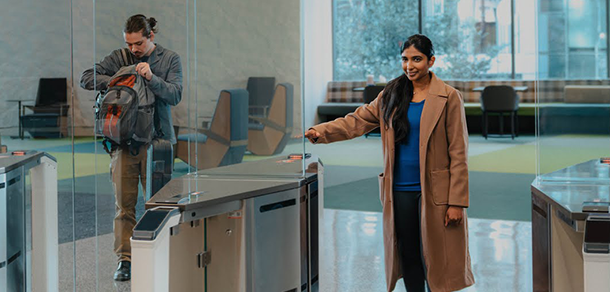
At Boston University’s Marciano Commons, fingerprint scanners are used in conjunction with the school’s contactless ID cards. Serving more than 5,000 meals daily, the new location’s six points of entry are controlled by turnstiles that combine the campus card and biometric fingerprint technologies.
University officials say that the inspiration behind the use of biometrics was the prevention of meal plan sharing between students. Boston University uses CBORD’s CS Gold campus card system and HID Global’s iCLASS contactless cards for functions including meal plan management, access control, payments and privilege verification.
The biometric data is stored exclusively on the cards and is never logged in a backend database. The use of the biometric is an opt-in function so students who wish to forgo the fingerprint capture–an uncommon choice thus far–can simply present their card to the cashier at the gate for further verification.
The new turnstiles are simple to operate. Students first present their card to the turnstile reader and are then prompted to present their finger for biometric authentication.
The bioCLASS reader from HID Global then interacts with CS Gold’s access control module to determine that the card’s biometric template matches the presented sample and that the user has enough meals remaining on their plan to complete the transaction. Provided the above conditions are met, the turnstile opens and grants access to the hungry student–a process that takes just seconds.