Card, mobile credential, payment and security
A program designed to increase the rate of matriculation from a local two-year college to a nearby California university is finding great success, thanks in part to a “future student” ID card.
According to an article in EdSource, the Long Beach Promise program guarantees admission to students from Long Beach City College to CSU Long Beach upon completion of their two-year degree. At the start of the program, each student receives a Future Student ID card for CSU Long Beach, granting access the campus library, athletic events, clubs and more.
A similar partnership between Northern Virginia Community College (NVCC) and George Mason University is also significantly increasing matriculation from the two-year institution to the university. Key to the program is a series of innovative approaches to make students feel a part of the George Mason community from the beginning of their NVCC studies.
At the start of the program, each student receives a Future Student ID card for CSU Long Beach, granting access the campus library, athletic events, clubs and more.
From their first community college class, they are welcome to use George Mason amenities like the libraries, clubs, and even health care.
The program was designed to streamline the process for transfer students and improve student success rates. Since its inception in 2018, more than 1,500 participants have successfully transferred to George Mason, including more than 400 this past fall.
The rate of continuation is significantly higher than normal rates from community colleges and other two-year programs. More than 90% of the participants graduate within two years of transferring to Mason.
To put that in perspective, a Califonia study found that as few as 2.5% of students intending to move on to a four-year institution upon completion of their two-year degree do so within two years. Just 23% do so within four years.
Working around campus cards, we all have stories about the sweet lady in the airport who showed you her student ID from 1963. She still carries it because it is a tangible representation of the affinity she feels for her school all these years later.
“A lot of research in higher education focused on why students complete or why they don’t complete has included this notion of belonging, feeling a part of the campus,” says Hans Johnson, a senior fellow at the Public Policy Institute of California’s higher education center. “And I think the more that you can do for community college students can only help that sense of belonging so that when you eventually do transfer, you feel like it’s your school.”
Our card office team understands better than anyone on campus the powerful affinity that a piece of plastic engenders in a student. The Future Student ID card issued to Long Beach City College students as a part of the Long Beach Promise 2.0 program is brilliant.
That piece of plastic helps students at the two-year college see themselves as part of the four-year institution to which they will matriculate. In both the Virginia and California examples, they are actively encouraged to use the future institution’s library, participate in intramurals, join clubs, and even visit the health center.
From the beginning, this makes them feel like they are part of the larger community. They make friends and they become comfortable on the campus. They form an internal expectation that their two-year experience is part of a fluid educational process.
Traditionally, transfer students have a hard break when they complete the first two years. This inevitably creates a decision point. Do they continue or do they stop? Eliminating that hard break makes transition easier and far more likely.
The Future Student ID seems to work great in these two formalized programs, but could it work in other situations? Could our card offices help transfer students in a less formalized environment, when an official program does not exist?
Beyond transfer students, what would happen to recruitment if high school seniors on an initial campus visit received a Future Student ID from our offices? I would expect that the simple piece of tangible plastic would increase affinity to the institution in the same way that it does for enrolled students.
What would happen to recruitment if high school seniors on an initial campus visit received a Future Student ID from our card offices? I would expect that the simple piece of tangible plastic would increase affinity to the institution in the same way that it does for enrolled students.
This could increase the close rate for admissions visits.
What if we issued a Future Student ID to college-bound local high school students from the local community. With distributed issuance, the card could be issued on site at the high school. To make the experience more persuasive, the ID could grant access to sporting events, libraries, and even things like student-led tutoring sessions.
In each of these examples, there are benefits for our card offices. We would have recent photos on file for the real IDs from the previously captured images.
In some cases, the enrollment process could include education on ID use cases like access control, dining, and flex accounts. This would ease the burden on our office personnel a during orientation.
Working around campus cards, we all have stories about the sweet lady in the airport who showed you her student ID from 1963. She still carries it because it is a tangible representation of the affinity she feels for her school all these years later.
A campus card is a powerful tool. If we keep an open mind, we may find ways to extend its impact to new areas that can benefit both future students and our institution.
If you are issuing Future Student IDs or other unique cards from your office, let me know (chris at CampusIDNews.com) and we can share it with the CampusIDNews community.
To attract and retain modern students in on-campus housing, institutions need to invest in advanced technology such as mobile access, secure credentials, wifi, and apps. In the multi-family housing world, such technologies are called ‘proptech’ (property technology).
In this episode of CampusIDChats, we speak with Jeff Koziol, Allegion’s higher education specialist, and Robert Gaulden, the company’s go-to-market lead for multi-family access.
60% of respondents say they would be more likely to select a new residence that offered mobile access control as an amenity. More than one-third would even pay more
Gaulden’s group at Allegion recently release a study exploring what tenants want from multi-family housing/apartments. The report titled “2023 Multifamily Living Trends: A Study on What Multifamily Renters Desire, Expect and Will Pay More For in Their Residences,” is available for free download.
Important findings include significant increases in the adoption of smart home technology, mobile access control, re-prioritization of amenities, as well as online access for tours, leasing, and communication.
Key to campus card programs and other administrators is the similarity between multi-family and on-campus student housing. Resident preferences and expectations for apartment life likely crossover to on-campus housing.
Among the many proptech topics covered, the group discusses findings related to mobile credentials. Impressively, 60% of respondents say they would be more likely to select a new residence that offered mobile access control as an amenity. More than one-third would even pay more.
To learn more about how proptech can improve campus residences and how campus card programs can play a key role, click on the video image at the top of this page.
Universities are expensive entities to operate and maintain. They are also constantly fighting the need to remain at the cutting edge of technology, student experience, and quality of education.
Meeting all these needs requires significant investment, and the universities that get creative with their funding acquisition can set themselves apart from the rest of the field.
With fewer state dollars, universities are having to get creative. If you're a public institution and you receive 10% of your operating costs from the state, you need to make up the other 90% somehow.
CampusIDNews recently caught up with ASSA ABLOY’s Tyler Webb, Director of Sales, Campus EAC, and Jim Primovic, General Manager Electronic Door Security Sales Group, to discuss infrastructure trends and ways institutions are finding the financial support to undertake new projects.
We explored three key trends in campus infrastructure funding: creative financing for mobile credential programs, public private partnerships for residence halls, and donor involvement for facility builds.
One of the most popular projects universities are looking to deliver – and find funding for – is mobile credentials. Campuses are increasingly making the move to mobile, but it can be a costly endeavor.
Since the launch of Student ID in Apple Wallet, there has been a push for something known as the 100% use case. This requires that mobile credentials can be used everywhere traditional plastic cards can be used.
Some are offering financing to fund a university’s migration to mobile. Zero-percent interest can help an institution reach the 100% use case requirement for mobile credential programs.
The big catalyst for movement was door access, but to achieve 100% ubiquity between mobile credentials and the plastic card, all touchpoints need to be brought in line. This can be a lengthy and expensive undertaking, but Webb points to some new methods for getting this over the line.
“We've seen some credential providers begin to offer financing to fund a university’s migration to mobile,” Webb says. “Zero-percent interest rate financing can help an institution reach the 100% use case requirement without an upfront capital expenditure. I don't think we’ve ever seen this before in this space.”
Campuses are also finding creative ways that provide more flexibility to meet the 100% use case.
“There are, for example, academic spaces that students wouldn't require access to in their freshman year, but they would need to access as upperclassmen,” explains Webb. “We're seeing a phased approach to access privileges that folds in the necessary mobile credential access over time as opposed to all at once.”
By rolling out mobile credentials on a phased approach starting with new students, a campus could meet the 100% use case requirement by outfitting only the locations that these new students must access. Deployment of reader infrastructure at locations not used by first-year students could be delayed until a future date.
Another area where campuses are finding new avenues to fund major infrastructure projects is the public-private partnership, often called a P3.
An increasing number of institutions are turning to P3s to erect new campus housing projects. In essence, a private company agrees to fund the construction of the new facility, easing the budgetary burden and expediting the timeline of traditional residence hall builds.
If you're trying to maintain a one-card experience, the P3 may need security system access, but traditionally, you must be a university employee with sufficient privileges and a .edu email address before you can even log into a system
“Ultimately, what these P3s are trying to do is create the same user experience that already exists on campus,” Primovic says. “But it takes a lot of planning, even in the design and build phases of the project, to get this experience right.”
These properties can either be operated by university staff or by a third-party entity, creating complexities with regard to the management of the access control platform.
“If you're trying to maintain a one-card or one-credential experience, the private entity may need security system access,” says Primovic. “But traditionally, you must be a university employee with sufficient privileges and a .edu email address before you can even log into a system.”
In a P3, who will manage the day-to-day administration of the system as it relates to the new facility? And who owns the data and controls the workflow?
“We’re also seeing campuses that want mobile credentials, but the P3’s may not fully understand what that entails,” says Primovic. “That’s when our team can step in and help guide both the campus and the private entity through the process.”
P3 agreements are growing in popularity, making it a more viable avenue for universities to embark on costly campus infrastructure projects.
“We're seeing P3s more and more frequently across the board,” says Webb. “If the university has an on-campus living component, I think we’re now to the point that a P3 can be in play.”
 The prospect of a P3 can be very compelling for a university, considering that somebody else can foot the bill for a project.
“Granted, that entity does make the money for the length of the contract,” says Webb. “But it does alleviate a need in the here and now.”
“It’s all about speed,” says Primovic. “It can take four or five years for the campus to do it themselves, but a P3 can have the same project up and running in two years from start to finish.
There’s also an undeniable premium being assessed for on-campus housing. There’s no doubt that this is the result of convenience and a list of amenities once considered luxury by college living standards.
“Campus housing, regardless of who's footing the bill – the university or a private company – is expensive and costs are almost certain to rise,” says Webb. “The companies in the business of P3 developments know the market really, really well. They know how to set pricing effectively to maximize occupancy and profitability.”
Another tried-and-true method for campuses to acquire funding for security and infrastructure upgrades is through donors.
“Institutions are seeing fewer state dollars, so universities are having to go outside of traditional means for funding acquisition,” says Webb. “If you're a public institution and you receive 10% of your operating costs from the state, you need to make up the other 90% somehow.”
Donors remain an invaluable funding source for universities embarking on larger projects, like residence hall upgrades or new builds. Naming an on-campus building after a major donor isn’t a new concept, but Webb believes the practice will increase as state-allocated funds constrict.
“Campuses don’t necessarily think ‘we want to name new buildings after someone,’ but this is a perfect opportunity, where you have a donor or several donors, and they want their legacy on campus,” explains Webb. “Building something with their name on it is a great opportunity for the university to accept a large donor gift for something that will last.”
This idea of building things that will last is crucial to the future of higher education.
“The need for infrastructure doesn’t go away just because traditional funding sources decrease,” concludes Primovic. “We need creative approaches to obtain funding for these projects, whether they be technology such as access control or mobile credentials or facilities like residence halls and buildings.”
In April the campus card, mobile credential, and transaction system world will converge on Covington, Kentucky for NACCU’s 2024 Annual Conference. Last year’s event included more than 550 attendees and this year that number is expected to grow. The highlight of the event is always the 70-plus outstanding educational sessions, and members are the key to this success.
The deadline for proposals is Monday, Dec. 11 so this is truly your last opportunity to submit a proposal to speak. The good news is that it only takes a few minutes, and you can do it online.
The info needed to submit is easy. Just create a short session title, a 100-word description, and a few discussion questions you'll use to engage the audience
Institutional members make up the bulk of the speakers, but corporate members exhibiting at the event are also welcome to contribute.
There are four types of education sessions from which you can choose:
The information needed to submit a proposal is easy. Just create a short session title, a 100-word session description, and a few discussion questions you will use to engage the audience. Then click submit.
I have presented at many NACCU conferences over the past 20 years, and it is always a rewarding experience. Attendees are, or soon will be, your colleagues and friends. Like Planet Fitness says, it is a judgement free zone. People are not there to critique your public speaking abilities but to learn from your experiences. Take the leap, submit your proposal today.
Prior to her role with HID Global, Amy Surprenant helped lead two of the most innovative card programs in the country – the University of Vermont and Vanderbilt. At Vandy, she was instrumental in the launch of their mobile credential program. Now as HID’s End User Business Development Rep for Higher Ed, she is guiding other campuses through their mobile launches.
Surprenant says the HID CBORD partnership offers a complete mobile solution that works seamlessly for the end user.
CBORD has an intense 24-week implementation phase and your campus project leaders will have HID, CBORD, and Apple available throughout
During her Vanderbilt experience, she was well-supported with both HID and CBORD on every call from initiation to launch.
Recently she provided that same level of service as she helped the University of Kentucky go through their mobile ID launch.
She explains that CBORD has an intense 24-week implementation project phase and campus project leaders will have HID, CBORD, and Apple available throughout this process.
Learn how to determine what access control hardware you can continue to use and what you will need to upgrade. Also hear how to plan for mobile by prepping your infrastructure with a mobile key unique to your institution.
Click the image at the top of this page to check out the video.
Northern Arizona University’s JacksCard went mobile two years ago and never looked back. The mobile credential was initially released to students in Apple Wallet, but one year later in August 2022, Android availability was added to the mix.
With the help of their transaction system partner TouchNet, they accomplished the initial launch of the mobile ID in just eight months, explains Patty Allenbaugh, Senior User Experience Analyst for NAU.
The JacksCard and mobile credential serve as general identification, building access, health services, university transit, meal plans, as well as JacksDebit Express payments for vending, bookstore, postal services, and dining locations.
Provisioning of the credential is done through the institution’s mobile app, NAUgo. The app preexisted the mobile ID project, so students were accustomed to using it. Thus, integrating credential provisioning in NAUgo helped expedite adoption.
iPhones account for about 90% of users on the NAU campus while the remaining 10% use Android devices, says Allenbaugh.
“We have slight differences for Android and iPhone,” she explains. “For the iPhone user, they go through the provisioning process and add the card to the Apple Wallet on the iPhone and Apple Watch.”
For Android users, the credential is held in the NAUgo app rather than Google Wallet.
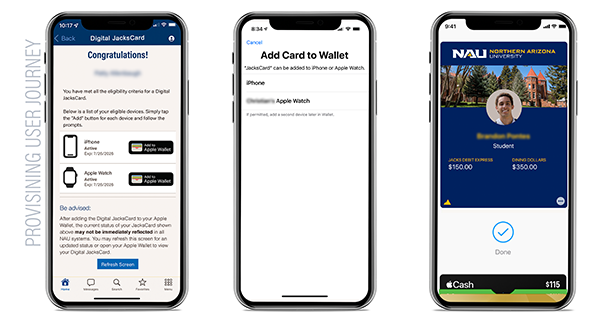 “Our security protocols on campus determined that the Google Wallet was not secure enough for our JacksCard to live there,” she says.
To solve this situation, NAU’s app provider, Modo Labs, developed a solution to enable the credential to be stored in the NAUgo app.
With the iOS version, students simply hover the handset or watch over a reader and all their access privileges are provided.
With Android, however, they must actively wake the phone to use it. Additionally, they must stay logged into the app, and because the mobile ID is stored in the app rather than natively in Google Wallet, when the phone’s battery dies the student ID cannot be accessed.
The app has been key to the mobile ID’s success, and in turn the mobile ID has proven key to the app’s success.
In the year before the launch with Apple Wallet, NAUgo had 60,000 visitor sessions. Today, the app draws nearly three times as many sessions. According to Allenbaugh, “students who would not have necessarily downloaded the app now had to download it to get their card and were delighted by some of the other features and services that were in the app.”
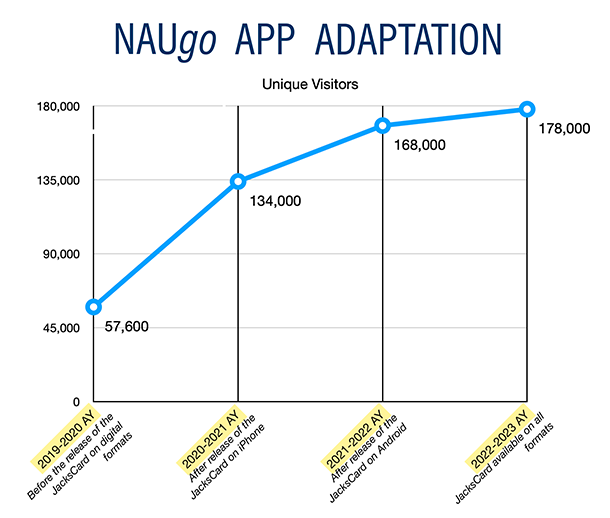 The app is extremely robust and even award-winning.
For the second year in a row, NAUgo won Modo Labs’ Best Campus Mobile App award. In 2023, the array of integrations, including PeopleSoft, TouchNet, HID, and Apple was cited as a determining factor.
The announcement of the award also noted features that enable students, “to see their class schedule, grades, and advisors; use their phone as their digital ID; track campus shuttles in real-time; use the dining module to see menus, order food, and check dining balance; access maps to find parking, printers, restrooms, etc.; reserve study rooms and much more.”
Nearly 20,000 people in the NAU community have a plastic or mobile JacksCard. Roughly 70% have opted for the mobile ID. Of those with mobile ID, more than 90% use the iPhone.
Graduate students have taken to the mobile ID as well with 65% provisioned across the campus.
As you would expect, the highest level of usage comes from on-campus students with more than 90% using the digital version.
Multi-factor authentication (MFA) is an Apple requirement for provisioning a mobile ID to Apple Wallet.
“One of the hang-ups we had in our first year of the release was at that time, students were not required to use MFA enrollment like DUO to access their student data,” says Allenbaugh. “But it was required to provision the card, so we had to work with students to get them enrolled in DUO and provision the card. It was two very large steps.”
Now students start using DUO when they are accepted to NAU, so the card team doesn’t have to worry about that side of the implementation and education process with incoming students. They can focus solely on student ID provisioning.
She recommends that other campuses consider this, and if they are not already providing MFA for students, consider getting it in place before launching mobile ID provisioning.
She says that thanks to key partners like TouchNet and Modo Labs, the project has been a success, driving strong adoption of the new digital ID with a bonus benefit of boosting usage of the NAUgo mobile app.
This fall, York University launched its new mobile YU-card that can be stored in Apple or Google Wallet. The mobile credential, launched with partner Transact, can be used anywhere the physical YU-card can be used.
Applications include photo identification, payments, dining plans, access control, as well as authentication for library, recreation facilities, exams, events, and discounts. It will also provide new capabilities, such as directly loading flex funds through the eAccounts application.
New students getting their first credential from the institution are not required to pay, but York does charge existing cardholders a $20 fee to upgrade to new mobile ID.
According to a university announcement, it is estimated that the digital ID will cut 400 kilograms of plastic and PVC each year.
“Mobile YU-cards create an important sense of identity and pride as a member of the York community, while being more efficient and cost effective,” says Tom Watt, interim assistant vice-president, Ancillary Service. “Issuing mobile credentials saves an incoming class from approximately 12,000 hours of wait time every year and eliminates the replacement fee for lost cards, as mobile cards can be transferred to a new device for free.”
New students getting their first credential from the institution are not required to pay, but York does charge existing cardholders a $20 fee to upgrade to new mobile ID.
According the YU-card website, “Mobile YU-cards are available to all new students, faculty, instructors and staff. Mobile cards are available to current community members as their physical YU-cards become due for renewal. If you wish to replace your card before the expiration date, please note that there is a $20 transition fee to mobile when your current card is returned to the YU-card Office.”
This fee could help offset some of the financial impact that campuses often experience when the mobile credential reduces or eliminates their lost card revenue. At least until the existing students matriculate or leave campus, the $20 fee should provide some buffer.
For those without a compatible smartphone, plastic cards will remain available at no cost, but the mobile YU-card will have additional features including access increased security through two-factor authentication and the ability to immediately revoke lost credentials.
Higher education campuses are getting back to pre-pandemic levels in areas such as on-campus populations and utilization of auxiliary services. Campus cards, dining and physical access control are once again in high demand. But will the supply chain issues and the slowdown in new construction and renovations have a longterm impact?
In this edition of CampusIDChats, publisher Chris Corum talks with Tyler Webb, Assa Abloy's Director of Sales for Campus Electronic Access Control about higher ed's new normal.
To check out the video interview, click the image above.
In this episode of the IDk 15-minute webinar series, CampusIDNews Publisher Chris Corum is joined by Rawldon Weekes, Campus Lead for reader and software developer ELATEC. The discussion focuses on how campuses can solve for all those "other" one-off and unique applications that need the campus card or mobile credential to function.
When a campus migrates to a new ID technology is when all the under-the-radar use cases for the card surface. A move to contactless and mobile credential is no exception. Campuses tend to focus on access control, payments, and mealplans, but one-off applications created by departments and other entities go unnoticed. That is until they stop working.
USB readers can pull data from contactless cards and mobile credentials and present it in the format needed for unique, specific applications
How can we support these legacy applications and enable our contactless or mobile credential to power new applications from scooter rentals to lockers and printing to computer access?
Many campuses have found the solution using ELATEC's USB readers to pull data from contactless cards and mobile credentials and present it in the format needed for specific applications. ELATEC readers support access control and payment functions, but they also are ideal for the unique, one-off use cases campuses struggle to support.
Join us as we learn about something IDk.
Click on the image at the top of this page to check out the video.
Electronic lockers are coming to campus, and they are seeing a growing number of use cases. For years higher ed has used lockers to automate mailroom parcel delivery, but today these advanced lockers are loaning laptops in libraries, keeping food warm in dining pickup locations, and more. Campus cards and mobile devices control the check-out/check-in process in a convenient and secure manner. In this edition of CampusIDChats, publisher Chris Corum gets the lowdown, talking with Jessica Martinez from locker provider Luxer One and Assa Abloy's Tyler Webb.
Lockers are a way to securely exchange goods on campus, whether those be parcels, food, laptops, lab equipment, or convenience items.
Sample use cases include:
Check out the interview and product demo by clicking on the video at the top of this page.