Card, mobile credential, payment and security
Yale students are visualizing their on-campus dining history in a unique way thanks to a new service called Yale Hospitality Wrapped. It was created by an undergraduate computer science major and based on the incredibly popular Spotify service of the same name.
Spotify launched its Spotify Wrapped in 2016 as a tool to let users see a visual representation of their music preferences over the course of the year. It became a viral marketing phenomenon as millions shared their personal Wrapped on social media. In the years that followed, virtually every streaming service has jumped on the bandwagon and even learning sites like Duolingo have added their own annual wrap-up.
Now it’s campus dining’s turn.
He “reverse engineered” the Transact API to access the HTML data from the user’s account, synthesize the swipe data, and compute the individual account holder’s statistics.
For Yale Hospitality Wrapped, the concept is similar. Show the student when they dined, where they dined, and how often they dined.
Yale undergraduate Anish Lakkapragada created the Chrome extension that – after just one semester – is already used by more than 10% of his classmates.
“Everyone likes to compare and categorize,” he says. “We have things like chicken tender Tuesday and all these traditions, so people want to see how much they go.”
Lakkapragada uses the meal swipe data from Yale’s Transact Campus system to build the users’ dining hall wraps.
He “reverse engineered” the Transact API to access the HTML data from the user’s account, so it grabs the HTML pages, synthesizes the swipe data, and computes the individual account holder’s statistics.
When a student installs the Yale Hospitality Wrapped Chrome Extension, they click the button saying add to Chrome, and it automatically takes them to Yale’s central authentication page where they enter their NetID and password. Once signed in, the extension does the rest.

Campus card and transaction systems hold many more data points beyond meal swipes, and Lakkapragada is eager to explore other areas. Stored value, access control, and rec center transactions are of specific interest.
Currently, Wrapped is available for the fall 2024 semester, but it will be changed to analyze spring 2025 meal swipes at the end of the semester. Though it would not be true to the year-end concept of a typical wrapped, he says the extension could be modified to allow users to set their own timelines.
Lakkapragada has already expanded the dining hall wrapped to another major university, and he emphatically says he’d welcome others to get on board.
Until he built Wrapped, he says he really did not know about his dining usage.
He found he used 156 meals wipes during the semester, averaging 1.5 meals per day. He believes that he, like so many students, under-utilize their meal plans, and Yale Hospitality Wrapped could help them better take advantage of it.
“I pay for three meals wipes per day, but obviously, I'm a student and I’m not waking up for breakfast,” he jokes.

Yale Hospitality Wrapped screenshot
One of the extension’s most popular data points is the diversity score. It is calculated based on the number of dining locations a student visits during the term. If you frequented every location, you’d attain the maximum scored of 100, but if you ate at the closest dining hall for every meal, you score would be zero.
Student are using social media to share and compare diversity scores. Lakkapragada hopes this aspect will encourage students to explore other dining options on campus.
This could be a great benefit to dining services as well.
“We actually did speak with Yale Hospitality about the project, and they were excited and supportive,” he says. “They were surprised and receptive to it.”
Today, the data is disparate and tied only to each unique user. Anonymously aggregating the results across all the participants, however, could give a very different and interesting perspective.

Anish Lakkapragada, Developer of Yale Hospitality Wrapped
Lakkapragada says that is one of the reasons he would like to advance the project from a Chrome extension to a web app. As a website, there would be more flexibility to aggregate data, expand functionality, and include other campuses.
“If any other university that uses Transact is interested – a student, an administrator, a Transact Campus developer – I'm more than receptive to sharing code,” he says.
Why did he do it?
“Creating software is one of my favorite pastimes, and I like seeing my stuff being used on someone else's computer,” he says. “I always feel really happy.”
Anish Lakkapragada is a first-year undergraduate at Yale University double majoring in computer science and mathematics. He encourages anyone interested in contributing to the project or bringing a dining hall wrapped to their campus, to contact him at [email protected].
In this episode of CampusIDNews Chats, Danny Smith, co-founder and co-owner of Color D, announces the company’s acquisition of CardExchange, a long-time partner in identity and credential management solutions. Smith describes that the move is intended to increase ColorID’s ability to offer more integrated and flexible identity management systems for higher ed and other markets.
For more than 20 years, CardExchange has been a key partner in developing sophisticated, custom identity solutions, helping ColorID implement complex credentialing projects. The acquisition cements their long-standing collaboration, enabling a more seamless approach to providing cloud-based identity solutions.
A major focus of the acquisition is CardExchange’s cloud platform, which has been in development for the past four to five years. This system allows institutions to manage credentials across different modalities—physical, mobile, and biometric—while integrating with multiple third-party applications and access control systems.
With the acquisition, Smith says ColorID will be able to provide universities with greater control over their identity infrastructure. Traditionally, identity management has been tied to one-card system or physical access control (PAC) platforms. He argues, however, that universities should own and manage their own identity ecosystems.
This would allow them to switch service providers or integrate new technologies without being locked into a single vendor. The CardExchange acquisition, Smith says, enables ColorID to deliver an agnostic integration platform, helping institutions centralize identity management while maintaining interoperability with existing systems.
One of the most notable applications of CardExchange’s solutions is the NYU project, where the platform was used to unify credentialing across 14 global campuses. The success of this implementation demonstrates the scalability and adaptability of CardExchange’s technology.
Listen to the full interview, by clicking the image at the top of this page.
In this episode of CampusIDNews chat, Jeff Bransfield discusses how campuses are looking at biometrics to replace traditional access control methods like ID cards or mobile credentials.
Biometrics, such as face and palm recognition, are becoming popular in gyms, athletic centers, and other areas because of the convenience they offer. Bransfield explains that managing physical credentials has always been challenging, and using the human body as a credential makes things simpler.
Traditionally, biometrics were used in highly secure labs and areas requiring two-factor authentication, but now they’re expanding into everyday spaces like rec centers and student facilities. The idea is to streamline access and make it easier for students and faculty to move around campus without worrying about carrying a card or phone.
The fingerprint was a little more invasive and you had to touch the reader, so it took longer than some credential-based access controls. Facial identification changes that by reading as you're walking.
There are various types of biometrics—fingerprint, face, iris, and even gait recognition—but Bransfield points out that face and palm recognition are becoming more popular. These modalities are less invasive and easier to deploy than fingerprint systems, which used to be the most common but required more effort to enroll users and manage templates.
As the technology has improved, face and palm recognition have gained traction because they allow for a more frictionless experience. For instance, facial recognition works passively, identifying a user as they approach, making it quicker and easier than older systems.
Privacy concerns have been a longstanding issue with biometrics. People worry about how their data, especially facial images, might be used or stored. Bransfield stresses that biometric systems don’t store actual images of faces or fingerprints. Instead, they create a binary representation—a string of ones and zeros used for identification. This means there’s no photo stored, and the data is secure. Most systems discard the image immediately after creating the template, offering even more privacy protection.
It's becoming more of a convenience layer. It is less for added security than that individuals want to use biometrics to access everyday openings throughout the campus.
Another important distinction Bransfield makes is between facial recognition and facial identification. Facial recognition is often associated with video surveillance and used to pick people out of a crowd, like in airports or large events. This technology is used for security purposes like criminal investigations. On the other hand, facial identification is a more intentional and opt-in process. Users willingly register their face as a credential and use it for specific access, such as entering a building or room. This is more about convenience and less about surveillance.
ASSA ABLOY acquired Control iD, a biometric technology leader in South and Central America, and is now bringing their solutions to the U.S. and Canadian markets. Control iD’s products are particularly useful for higher education and other institutional settings where managing physical credentials is a challenge.
In contrast to facial recognition, facial identification is very much an intentional act of me opting in to use my face as my credential to access a certain area within my facility.
What makes Control iD’s biometric readers stand out is that they function as both readers and controllers. This means they can make access decisions directly at the door, without needing to communicate with a central control panel. They can be deployed as standalone devices or connected to an access control panel, depending on the campus’s needs.
Check out the full interview by clicking the image at the top of this page.
To learn more about Control iD readers, click here.
TRANSCRIPT
Credentials on campus are not always plastic cards or mobile phones anymore.
In a growing number of use cases, biometrics seem to offer a preferred mode of identification and on campus rec centers and athletic facilities and locker rooms and highly secure labs are frequently turning to biometrics to increase security and convenience.
But there may be more to it on campus than even just that. With me today to talk about this is Jeff Bransfield. He's regional director for digital access with ASSA ABLOY. Jeff, thanks for joining us. Yeah, thanks for having me.
Let's start off by saying or talking about where do you see biometrics heading specifically in the campus market? What's on the horizon?
Yeah, the conversations are evolving every single day. I think the use of biometrics is really becoming more of a common discussion to really bring that convenience layer into security, which doesn't include convenience for so long, right?
So the challenge of the credential and managing the credential, managing that identity has really evolved over time and the technology has increased in capability and availability to really give some more options to use the human being as the credential.
It’s become more of an everyday discussion of how can we leverage the things that we already are to bring us into that security layer.
Okay, and do you see it moving into other applications on campus? I mentioned in the opening that it's not maybe just secure labs anymore.
Yeah, for a long time it was really that conditional layer. It was that two-factor authentication, leveraging biometrics to those ultra secure facilities.
It's becoming more of a convenience layer. It is less for added security than that individuals want to use biometrics to access everyday openings throughout the campus.
Now it's becoming more of a convenience layer that I want to use my finger or face or palm or whatever I'm using for biometrics to access my everyday openings that I'm getting into throughout the campus.
So the rec centers, the athletic facilities, the things that you think about which is difficult to carry a credential to are becoming our everyday topics of discussion on campus, yes?
Lots of modalities out there. We've fingerprint, face, iris, crazy things like Gates, which I guess maybe is not crazy anymore. But with all these biometric modalities, are you starting to see one or a couple kind of become the main ones that campuses are interested in?
Yeah, I think the technology of biometric devices has evolved massively over the last few years.
So in the past, the entry-level price point was always kind of leaning towards fingerprint just because it was less intensive to deploy. But it was also one of the more difficult to manage because the templates needed to be very, very much enrolled on the device.
They needed to be very good capture at the time. So it took a lot of logistical pain to get the fingerprint template involved.
So we're seeing the technology has definitely increased to take things like palm or take things like face or iris. Those are easier to grab, maybe face and palm more than iris as far as the templates.
But yeah, we're seeing some evolution there to start leveraging some of the more automatic parts.
The fingerprint was a little more invasive. You still had to touch and do those things. So it actually took longer than some of the credential-based access controls versus facial identification. It's just getting it as you're walking.
So it's really that frictionless deployment that we're seeing that people are grasping.
As an industry, I know we've worked hard for a long time to get people past the fear of biometric technologies. By trying to push the message that your images aren't stored. You're not storing a picture of my face in the system that can be used for other purposes. It's really just a string of zeros and ones that form a template that's created from the measurements and the certain parts of my face or my fingerprint or whatever the modality might be. Been fighting it for decades, maybe even at this point. Are you still seeing that concern on campus? Are you having to fight that battle every time you step on a campus still?
I have that conversation every day. And that's good because people are learning the process. But yes, to your point, technically it is. It's storing a binary representation of my face. It's not storing a photo of my face.
It's all ones and zeros. It's just the algorithm that it's processing all of those data points.
We even have devices that can go so far to say, just discard a photo, don't keep a photo.
When I walk up, it doesn't even show my cardholder photo in the system.
In contrast to facial recognition, facial identification is very much an intentional act of me opting in to use my face as my credential to access a certain area within my facility.
So you can really go to that layer of conserving that privacy.
From the other side of the spectrum, the conversation of the human understanding of what biometrics really is, in regard to face, for example, we're having a lot of conversations around facial identification and facial recognition.
They're completely different technologies and different use cases.
Facial recognition is typically applied to a video surveillance layer to where it's identifying a face from a crowd in general surveillance for use for forensic find, criminal investigation, et cetera.
These are used in high traffic environments. You see them in airports, sporting events, malls, et cetera.
Facial identification, though, is very much an intentional act of me opting in to using my face as my credential to access a certain area within my facility.
So they're different conversations and it's very intentional.
I'm opting in to registering my face as my credential and I'm knowingly doing that act as I approach the opening, versus just walking into a general population area and being picked out of the crowd.
So they're two different processes and two conversations that we're having.
And it's very important for people to understand when deploying facial identification that it's very much an intentional use for frictionless access control leveraging biometrics.
A couple of years ago, late in 2022, Asa Abloy acquired a company called Control iD that has some pretty cool looking biometric readers. Can you give us a little update on that? And let me know where that might fit in the campus setting.
Absolutely. In October, 2022, it's been almost two years ago, the acquisition was complete with Control iD. Control iD has been doing business in access control, biometrics, process automation, time and attendance in South and Central America for years.
We just this year have been bringing these products to the United States, Canada, and we're really excited about the opportunities that it's granting our teams as we're going out and providing these solutions to our customers, especially our institutional customers like higher education.
A lot of the market's been asking for this. Control iD has been a fantastic partner. It's been a fantastic add to our portfolio.
The total cost per opening really, really starts going down at that point with a panel-less deployment.
It's revolutionary in what it can do and all of the different aspects in higher education, but also, we're having a conversation with K through 12, commercial, you name it, where people are really getting into that convenience of the credential, because that's the hard part of access control is managing that piece of plastic or managing that mobile credential or even better securing those credentials.
We're really, really excited about Control iD being part of our brand. You can see over my shoulder has really been fun to have as an option.
All right, so I've got one more question about the Control iD readers. You've talked about them being kind of unique and even maybe revolutionary. Tell us why, what's different about that reader than other devices?
Yeah, so we're working really well with a lot of our OEM software, OEM partners to develop native integrations to the product.
What that means is that we can actually deploy the Control iD, so ID face that you see over my shoulder, it actually is a reader controller.
It's got an external access module built into it that actually allows for you to process all of those yes and no decisions at the opening.
I can wire all of my peripheral devices to the access module itself. So I can deploy, especially with either standalone or with some of our OEM integrations, a panel-less integration.
I don't need to rely on an access control panel to make those decisions. I can actually deploy it with a panel-less deployment.
Our total cost per opening really, really starts going down at that point.
I assume too it's great for really remote locations too and things like an area where it might be the athletic locker room where it's a very fixed number of people and you know where they are.
Yeah, so you can deploy standalone. We can do it connected to a panel if you so choose. We can do our OSTP out or we can actually do a native integration as I spoke earlier.
Awesome. Okay, well it's a great update. They really are cool looking. I hope to check them out at a show or something like that.
Anytime. I know more about biometrics now than I ever thought I would, so.
Well, Jeff, thank you. We've been talking with Jeff Bransfield, Regional Director for Digital Access with Asa Abloy and I appreciate you joining us.
Thanks Chris.
Just off the University of Minnesota campus, the neighborhood of Dinkytown has seen an uptick in violent crime in recent years. The issue is important to the institution because it is an where many students reside in both apartments and even dorms.
In an attempt to make the area safer for students, the university and city police departments are cooperating on a new campus safety center. Locating the center in Dinkeytown is important because the university’s main police station is more than one-half mile away.
Anyone with a UCard can scan at the main entrance to access the facility to study, receive self-defense training, file police reports, and get legal advice.
“The Off-Campus Safety Center, operated by the Department of Public Safety, brings resources and community to the heart of Dinkytown,” explains the University on its Safe Campus site. “Along with opportunities to connect with UMPD, the safety center will offer community engagement, safety classes, and student space to its visitors.”
As they describe, this isn’t a normal police station. The safety center brings law enforcement to the community, but it also provides a place for students to gather, learn, and feel safe.
There are dedicated study areas and student meeting rooms, and even an area for self-defense training. In the part of the center dedicated for law enforcement use, students can file police reports and get legal advice.
As reported by NBC-affiliate KARE11, Minneapolis Police Chief Brian O’Hara said, “We've heard the concerns … both from parents and students on campus about safety [in] this part of town, and this safety center is an example that we are listening, that those concerns are being heard.”
Anyone with a UCard can scan at the main entrance to access the facility.
The center is open Monday through Friday from 9 a.m. until 11 p.m.
Topanga provides software to drive reusable container programs in on-campus dining using the institution's existing mobile ordering app and ID card. Working with campus apps and transaction systems, it lets students check-out and return containers, cutting waste and saving money for the institution.
The software is live at 59 campuses across North America and has experienced significant growth in the past two years. Strong partnerships with food service providers including Aramark and Sodexo, continues to help drive adoption.
We have other exciting integrations that we're working on with Transact and other mobile ordering solutions going live in the next few weeks
“We do not manufacture the packaging ourselves,” says Page Schult, the company’s co-founder and CEO. “We're completely agnostic, which allows you to use what you already have on hand, or we can help you procure new packaging for our manufacturing partners.”
Building the option to request reusable to go containers into existing mobile ordering apps is a great addition to the offering. The Topanga Grubhub integration is a popular option, and others are on their way.
“We have a couple other exciting payment card integrations that we're working on with Transact and other order ahead and mobile ordering solutions that are going live in the next few weeks,” adds Schult.
TRANSCRIPT:
Hello and welcome to another installment of Campus ID News Chats. I am your host Chris Corum, publisher and editor of Campus ID News. I'll be asking the questions today about an issue that I care a lot about. It's sustainability and environmental protections and issues on campus and how we can affect that, and specifically how our campus card programs, our apps on campus, can help dining services to redirect some waste from landfills.
To get to this topic and answer some questions is my guest, Page Schult. She's co-founder and CEO of Topanga, and her company helps campuses reduce and replace disposable to-go containers with reusable ones. So Page, thanks for joining us today.
Yeah, thanks for having me.
So let's start. Tell us about the importance of reusables and why specifically in campus dining environments this can make a big difference.
So campus environments and campus dining specifically are really interesting for reuse, and that there's kind of a lot of pressures driving towards sustainability.
For example, students are increasingly choosing campuses and schools that have sustainable practices, presidents and major stakeholders at universities are increasingly kind of pushing for more sustainable practices for impact reporting and to really show off these stats to incoming students.
And dining is where a lot of that waste and sustainability is so tangible.
Like it's very, very apparent when food is being wasted or when all the single use to-go packaging is filling up the trash cans across campus.
It's a lot less visible if your science building is running on renewable energy.
I think because of that, sustainability and dining gets a lot of attention because it's really easy to see the shifts.
And reuse specifically is awesome for campus environments because it's really high reuse rates in terms of it's a semi-closed environment.
So the students who are getting to go every day on campus are typically getting to go and then going within a mile radius from where they got that food packaging.
They're going back to their dorm, they're going back to the library to study, and then they're in a position where in the next day or two, they can drop that container off, it can be reused and sanitized just like any other dish, and then it can be ready for another student to get to go.
So that kind of turnover and that kind of built-in client base that's going to keep coming back for more really helps reuse thriving campus environments.
Okay, so what inspired you to start the company? Why this topic and then a few details like how long you've been around, how's it grown, how many campuses are you serving, those kinds of things?
So me and my two co-founders, we started this company in 2020 and it was actually very different.
Today we are a software company, but prior to being a software company, we actually ran a commercial kitchen in Los Angeles where we were packaging food in reusable containers and delivering it to customers like a milkman-style market.
This was an amazing experience because we had to go through the full kitchen certification process.
We were working day in and day out with dishwashing machines and three-compartment sinks and really understanding what it means firsthand to kind of reuse in a fast-paced commercial kitchen.
It was through this that we actually built our software. So we first built our software for ourselves.
That business was going really well, but we said, hey, if our goal is to make as big of an impact globally on reducing unnecessary waste from kitchens, we can do so a lot more effectively by taking the software that we've built and delivering it to other environments versus just continuing to do this ourselves.
So that's really when we made the shift to say what other types of kitchens and kitchen environments and dining programs can we support with this technology?
And through that is when we got connected to two of our earliest clients, Ohio State University and Boston University, and we had some great conversations where we understood that the problems that we had solved for ourselves through our software were problems they were experiencing, and huge pain points they were experiencing, and trying to launch reuse.
So that's been how we got into the campus space. It was accidental, but now it's amazing. It's been a wonderful space to work in.
We're live at 59 campuses across North America and really excited about kind of the growth we've seen in the past one to two years since we've been here.
I have seen some stats about putting in perspective the amount of savings and things that that's been across the campuses. They're pretty impressive to me. Any comes to the top of your mind, I'm sure you know them by heart.
Yeah, there's a lot of different stats that I could throw at you, but I think one that's probably particularly interesting to focus on is one of our campuses like Boston University, where we've been able to show there that this program, the Reuse Pass program, has reached over 90% of the undergrad campus, so it has huge reach across the types of students who are using this.
They've seen in the past year over 78% reduction in disposables, so not just our people trying this program, but they're truly using it day in and day out, and they've seen about $274,000 in program margins versus like just if they were going with single use as they had before or a reused solution without this kind of track and trace system of accountability that Topanga's Reuse Pass program provides.
So that's obviously like a huge school with a huge retail footprint, but the reality is that those kind of stats on how broad of reach we can get on campus and how many kind of single use transactions we can replace with reuse, those are really kind of the crux of what goes into understanding the ROI opportunity for your program, and I will say throughout our sales process, it's really important to us that we're working with schools that believe that there is an environmental and an economic opportunity for reuse, and we'll walk through all of that math and all of that modeling from the get go to make sure we're setting these programs up for success.
Can you walk us through in detail the student experience with the system? You know, I'm going in to get my food in the dining hall and then I can …
So there's actually a few different ways that this can come to life kind of depending on the campus setup, the environment, and what kind of card and mobile ordering providers that they're using on campus.
The simplest form is, you know, it's a non-integrated experience.
Students go to the web app, app.reusepass.com, they sign up using their cell phone number, and then in their Apple Wallet, they kind of get their reuse pass QR code.
And this is a lot like checking out a library book.
Every time they go to, you know, get takeout from their residential dining hall, they show their Apple Wallet QR code, the operator will scan that QR code, scan the QR RFID code on the container, and that kind of completes the checkout experience.
So that's like the most straightforward just out of the box.
That could be live within a few weeks on a campus.
And then we also have a few different layers that we can add on to support more complex and more diverse dining environments.
So for example, like the Boston University school example that I mentioned, they're a huge Grubhub school. We've integrated with Grubhub mobile ordering systems to create an even more like seamless student experience that allows you to kind of order ahead.
You as a student, you go through the Grubhub ordering flow like you normally would, you select that you'd like a reuse pass container at checkout.
At that point, our system is connected with Grubhub, and we kind of get your student ordering data, and we process that so we can see what your reuse pass QR code is.
That same QR code that you see in the Apple Wallet, Grubhub passes us back of house.
And then the team that's fulfilling your order sees that QR code on the chip that prints out, they scan the QR code, scan the QR code on the container, and your order is ready at the pickup shelf where it's already been checked out to you.
So we have a couple other kind of exciting payment card integrations that we're working on with Transact and other order ahead and mobile ordering solutions that are going live in the next few weeks.
So I would say that integrating within the systems that campus are already using is really important to us to ensure that it's a seamless student experience, but also a seamless operator experience.
I was curious, like, you know, we get that level of app fatigue where, you know, do you want to have, you know, the more that can be integrated and partner offerings so that we're not having to download specific apps for a million different things, I think for everybody, even students can be a benefit. So those partnerships are great. I suppose it makes it easy to work with a Grubhub campus or down the road Transact or whatever others it might be, the work's already been done. So the deployment then for that, for a campus that partners with them, you know, the hard work was done on the first one and now the rollout goes more quickly.
Yeah, absolutely.
Having these kind of channel partners and being able to work in a space like the College of University dining space where everybody is really keen on like peer-to-peer learning and just like spreading learning from each other makes it so much easier to kind of continue to iterate and improve our programs as we build.
So that's the student side of things. How about the campus side of things? So I'm watching this, I'm a campus, I've wanted to do this for a long time or I like the idea of it. What do they do?
So from a kind of like, you know, getting in touch and how we could start a perspective, again, like we, we love working within the campus space, we have great partners with Aramark and Sodexo and all of the great service providers.
And so like kind of getting in the weeds and figuring out what type of program you're likely have is really important to us.
We're really keen on setting up potential new clients with existing client partners and having them do like site visits and tour our campuses environment as is possible.
So you can see firsthand what this program looks like and what type of program you want to build.
And I say that because exactly like, if you're just you want to launch a reusable to go program at like one of your residential dining halls, it's like medium to low volume and you really just want to get live and see what's happening.
That's great.
We can get you live in a few weeks and we can start small, really figure out what works and build from there.
Or there's other schools that they'll come to us and they'll say, hey, by 2025, we wanted to be completely zero waste campus.
We have like 10 residential dining halls, like 30 different retail environments, two different mobile ordering and card payment providers.
Like, can you help us get started? And that's where again, the answer is yes, but there's going to be a bit more lead time because you have to navigate those integrations.
What are the shifts in operator and student experiences across dining locations?
How are we going to operationalize like collections and returns these containers?
So it really is designed to be flexible and support you wherever you're at.
I would say the main kind of considerations are one, do you already have packaging or to procure packaging?
We do not manufacture the packaging ourselves. We're completely agnostic, which allows you to use what you already have on hand or we can help you procure new packaging for our manufacturing partners.
That's kind of like one of the big physical sides to getting a program live that will typically start in on right when we're working with a new partner and get those wheels turning.
From there, it's really kind of, again, the scope and the scale that you want to start with versus what you want to grow into.
Typically for some of our larger implementations, we'll come on site, we'll do a site visit.
Like I mentioned, a lot of our team has spent time working in kitchens and restaurants in the past and we're truly passionate, not just about the sustainability side, but also the dining side.
So we'll come on site and we'll help you kind of map out to a tee what this program is going to look like and what the flows are going to look like in your system to make it as streamlined as possible.
So you did mention this at the beginning, but I think that the point came up there when you were talking about you're really the app provider and the software provider, the intelligence and the reporting logistics, all the pieces like that, pardon me, rather than, you know, we sell bowls and lids and things like that.
So give us a little more detail on what's the beauty of the app? What more is happening there? What does the kid get out of it, but also what does the university get out of it or the campus get out of that from reporting and things like that?
I did kind of say this before, but kind of at its core, how the system works is it's like checking out a library book. So it's a one-to-one system of accountability. Each time a container is checked out, it's checked out to a specific student or a specific diner.
That diner then has a full record of kind of their transactions, so to speak, in their ReusePass app. So they can see how many containers they've checked out, from which locations, when and where they're due back, what happens if they're not returned on time.
Some of our schools will charge a late fee.
If a container isn't returned within a specific amount of time, that's where some of these payment card integrations like what we're working on with Transact really come into play to make that charging process seamless, and the student sees that real-time in their app.
In addition to the more fun stuff, such as what has their impact been and how many people are participating at their campus and kind of what is that gamification element that makes you feel good by taking this action to reuse instead of choosing single use.
So it's really kind of the crux of accountability.
Again, it's a web app.
So our goal is not just to have you download an app and have you glued to your phone, but we also have systems in place to kind of send you those proactive nudges and bring the program to life.
So for example, we have an SMS-based nudging program.
So first time you check out a container, you'll get a welcome text explaining the roles of the road, and then each time you have a container that's late or overdue, we'll send you a quick nudge saying, hey, don't forget to return this, click here to find your closest return location.
So in a perfect world, nobody's ever charged a late fee and everything's burned on time.
But we also know not everything's a perfect world.
So that's kind of why we have these systems built.
And then beyond the app, we also have a really robust campus ambassador program, which I think is something that we're really proud of because it allows us to like bring the dining organization's mission of sustainability, like they're doing this for a reason.
It allows us to kind of bring that to life through the students and they'll do tabling activations or they'll paint murals or they'll pick up trash in a local park.
All of these really cool ways to kind of build community around this great cause in real life and kind of bring reuse past to your campus in a way that's not just, hey, I'm checking out a container because the school says I have to, I have to, but it's really like, hey, this is an amazing initiative that campus is doing and it's great to be a part of it.
Awesome. I'm on board with anything we can do to help those kinds of kinds of issues. It was great, Page. I appreciate you joining us. Thanks for the great info and, and I, you know, we'll talk soon again.
Thank you so much.
And of course, thanks to all of you for listening in. If you have an idea for a future episode of Campus ID News Chats, shoot me a note at chris at campusidnews.com and we'll see you next time.
Several weeks ago, we learned Roper Industries, the parent company of CBORD, was acquiring Transact in a deal that surprised the industry. Together with NACCU, CampusIDNews is seeking input from our subscribers and members. While information regarding the purchase is still forthcoming, we are wondering what questions or thoughts you may have.
Responses from NACCU members and CampusIDNews subscribers will be anonymized and used to guide the information gathering process.
We will anonymize and compile the responses we receive into categories, creating a series of overarching questions. It is our intention to use these questions to help guide our discussions, as we seek information on how this may impact our industry and how we can best support the higher ed community.
Please take a moment and send me an email with your thoughts.
Thank you,
Chris Corum, Publisher
CampusIDNews
[email protected]
Xavier University recognized that students were experiencing food insecurity, too often having to choose between eating and paying for other essentials.
“It's not just a Xavier problem, it's everywhere,” says Jennifer Paiotti, Associate Director of Business and Operations for Auxiliary Services. “Some have to choose between books and food – or are they going to be able to drive to campus or will they have to eat a bag of chips at night?”
Auxiliary Services collaborated with multiple campus departments and utilized the Mobile Ordering App, Mobile Credential, and Transact System Enterprise to create the meal share donation platform.
“As higher education, it's unacceptable,” she says.
To address the issue, Xavier created their Food Insecurity Meal Share Program, enabling meal plan holders to donate a meal to a student in need. In just the first few months of the pilot, more than 15% of meal plan holders donated a meal helping nearly 10% of students facing food insecurity.
For campus card programs and auxiliary services, the best part is Xavier launched the program using only existing technology.
Xavier Auxiliary Services collaborated with multiple campus departments and utilized the Mobile Ordering App, Mobile Credential, and Transact System Enterprise to create the meal share donation platform.
Paiotti stresses that any campus card office can take simple steps to help fight hunger on campus.
Click the image at the top of this page to check out the full video.
---------
TRANSCRIPT:
Hi. My name is Jennifer Paiotti. I am the Associate Director of Business and Operations for Auxiliary Services at Xavier University in Cincinnati, Ohio.
My presentation this week is Hungry to Learn, our food insecurity program that we developed at Xavier University.
We found in 2016 that many people on campus – and it's not just a Xavier problem, it's everywhere – have to choose between books and food or are they going to be able to drive to campus or are they going to have to eat a bag of chips at night.
And as higher education, it's unacceptable.
So at Xavier University, we launched a pilot program this year where we utilized our transaction system through our campus ID services, we utilized our mobile ordering app, and we utilized our mobile ID or mobile credential to create an autonomous food insecurity program.
Students have an opportunity, meal plan holders, to donate one meal utilizing the mobile ordering app and that gets placed into a meal plan donation pool.
We call it meal sharing.
And then students that are battling food insecurity, maybe they were able to purchase a small meal plan, but it's ran out, or they had some dining dollars, or things like that, and they just don't have it anymore.
They're able to go out to the mobile ordering app.
They can request a meal from the meal plan pool.
It is then brought into the system.
A meal plan is added to their mobile ID and they walk in and tap in just like every student.
So there's no kind of peer pressure.
There's no ability to know who's hungry and who's not.
Everybody looks the same and that's why it works for us because we are all for one.
The mobile ordering app, it works exactly like you would ordering a burger.
So you go to the meal share location, you select share a meal, the tender is share a meal so it automatically adds, and then you check it out with your ID.
That's it.
So we have had 16% of students who have a meal plan, we have 16% of them have donated just in this pilot phase from November to now.
And then we have been able to help 9% of students that are facing food insecurity in just this time with many of them repeats.
And the great part about it is that some of these are multiple students who request it so we're able to actually work and collaborate with student success on retention or issues that may be happening outside of the classroom to help further the student success at Xavier.
Starting a process would be relatively seamless on your campus, especially if you're able to collaborate with your transaction partner.
You can create a meal plan that's inside of your system already.
If you have a mobile ordering app that's with your on campus, then you can actually then transfer that data in.
If you are an ID campus, you can easily with an actual still physical ID, you're able to get that meal plan onto that ID or if you are a campus with a mobile credential because it is basically just a meal plan, you're easily able to transfer that to the student.
In the summer of 2023, students at the University of Pittsburgh began grabbing items from an on-campus convenience store and walking right out the door. Amazon’s Just Walk Out technology powers the store and makes this frictionless experience possible. Using artificial intelligence, sensors, and cameras, it identifies the patron upon entry, tracks selected items, and charges the preferred method of payment as the shopper leaves the store.
The Market at Towers – in Pitt’s multimillion-dollar renovated dining facility – was the university’s first autonomous market deployment in partnership with Pitt, Chartwells, Transact and Amazon.
“While we have two other markets on campus, the Market at Towers sits in the center of our campus and is part of our main dining facility footprint,” says Julie Michelle Bannister, Assistant Vice Chancellor for Auxiliary Services, University of Pittsburgh. “It was important to have this first location included with our state-of-the-art renovation of The Eatery complex.”
Just Walk Out has allowed us to reallocate our staffing matrix, removing the traditional cashier and creating Customer Ambassadors. Our staff is now more mobile to stock the store and interact with patrons.
Pitt evaluated different unattended retail vendors before selecting Amazon, but they determined Just Walk Out would work best with their existing infrastructure and partners.
Transact already provided the widely-used mobile ordering app that enables the campus population to place orders from any of the on-campus dining locations.
“Because Amazon was able to seamlessly integrate with our Transact mobile app and accept our declining balance, we felt that their solution was the best fit,” says Bannister.
To enter the market, the user opens their Transact mobile ordering app and scans the QR code on the turnstile’s reader. As they choose their items, the Just Walk Out system uses an array of AI-driven cameras and sensors to detect what is taken from and returned to the shelves. When the shopping trip is complete, the customer simply leaves the store without waiting in line, visiting a cashier, or using a self-checkout station. The app automatically deducts the purchase amount from the shopper’s Dining Dollars, Panther Funds, or Pitt Cash accounts.
Bannister explains that the Transact mobile app currently accepts the stored value tenders, but they are working with their partners to add the meal swap as an option in future semesters.
Transact’s core role was to empower the Amazon technology to process the student campus card as a form of payment.
“Our Mobile Ordering platform not only provides the student with the ability to present their campus credential, but also handles complex sales scenarios, such as specific taxation, coupons and discounts associated with the item basket,” says Keith Kellermeyer, Product Manager, Campus Commerce. “We built a sophisticated way to synchronize menus from Cloud POS to Just Walk Out and certified the entire process with Amazon to ensure reliability and quality.”
To enable the Mobile Ordering app to display the QR code required to enter the store, Transact added additional screens to both the iOS and Android apps, as well as fields to the database and administrative dashboard.
Dining service provider Chartwells was also key to the enabling payments.
Transact’s Mobile Ordering platform enables administrators to set a minimum balance threshold for entry to the store, thus reducing the opportunity for a student to overspend their account.
“We worked directly with Transact and Pitt to build the operational functionality of the store set up and integration with our payment processing,” says Steve Schurr, Resident District Manager, Chartwells.
As a part of this core functionality, there is a minimum balance check to ensure that students have sufficient funds before they enter the store. This reduces the opportunity for a patron to overspend their account and depart the store with a negative balance. To accomplish this, students with less than $20 on their stored value balances – including meal plans, PittCash or Panther Funds – are prompted for another form of payment.
To accomplish this, Transact’s Mobile Ordering platform was modified to enable administrators to set a ‘minimum balance threshold’ for entry to a Just Walk Out location.
In the field, the Mobile Ordering app performs a balance inquiry against one or more of the customer’s campus card accounts. Once the balances of all accounts are returned, the system checks against the minimum balance threshold. If the customer has sufficient funds, the QR code is generated and displayed in the app.
“Stepping through each scenario of processing a payment after the transaction had occurred helped us carefully craft the business rules around when to allow and deny entrance and how to reconcile transactions between systems,” says Kellermeyer.
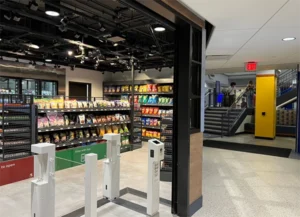
University of Pittsburgh's Market at Towers
In the past, the Market required four cashiers plus two team members stocking shelves during high trafficked hours.
Because the technology eliminates checkout lines and expedites shopping, the location now serves students 24 hours a day in an even more effective and efficient way. At times it can be staffed as usual, but it can also operate virtually unattended at night and on weekends.
Chartwells manages the operations and restocking for the store. They also serve as the direct liaison with Amazon. Pitt supports the ongoing maintenance and IT support, but day-to-day operations fall mainly to the Chartwells’ team.
“Just Walk Out has allowed us to reallocate our staffing matrix to be more customer focused, removing the traditional cashier and creating Customer Ambassadors,” says Schurr. “Our staff is now more mobile to stock the store and interact with patrons.”
Since the opening week, daily sales have risen steadily. The team credits this in part to the utilization of Amazon's data insights to optimize the product mix. Also key is the staff’s continued education of first-time customers.
“Through team member training and customer education we are seeing a continuous increase in sales since the store opened,” says Schurr. “As we continue to adapt and analyze our business, we are finding more opportunities to grow and engage students.”
In the future, Bannister says they plan to expand offerings to include full grab-and-go combo meal options, which should drive sales even higher.
Just Walk Out’s analytics portal provides insight into customer behavior and shopping habits, enabling a next-gen approach to store programming.
The early success has already brought on the addition of a second location. At Pitt’s Petersen Events Center, an Amazon-powered market enables attendees to purchase concessions without waiting in lengthy lines.
When asked what advice she would have for other campus administrators considering a similar project, Bannister advises to take your time.
“We were faced with a construction project that had additional challenges, and having more time for testing with our staff would have been helpful,” she says. “I also would recommend having a solid communication plan because engaging students early for adoption is important.”
Chartwells’ Schurr agrees that communication is crucial.
He says the student population was somewhat hesitant initially, but they became comfortable as his team engaged and educated them on the process.
The biggest piece of advice he can offer, however, is to leverage the tools available through Just Walk Out’s analytics portal.
“It provides insight into customer behavior and shopping habits, enabling a next-gen approach to store programming,” he explains. “You need to understand that this technology will shift the sales matrix and so you have to stay agile with your offerings.”
In a recent NACCU video interview, Allegion’s Jeff Koziol shared his vision for migrating campuses from brass keys to electronic locks. This will be the subject of his conference presentation at the upcoming NACCU Annual Conference.
“Many students have never held a physical key,” says Koziol. “Yet while some institutions are moving to mobile credentials, there’s many that are still providing students with brass keys for dorm room access.”
Many students have never held a physical key, yet many institutions are still providing brass keys for dorm room access.
Allegion is both a credential provider, and they manufacture readers that address the access control needs on a campus. This includes readers that go on interior doors to enable electronic access via card or mobile credential, effectively eliminating the brass key.
Koziol explains that they do not manufacture readers for vending machines, copy print stations, laundry, or other campus use cases.
“What we have done is filled in with different partner companies like rfIDEAS, Metramodo Smart Lockers, Castles Vending, and a whole host of others to build out that ecosystem and address all those cases,” he says.
In addition to their own credentials, Allegion readers also support both Transact and HID mobile credentials.
“I don’t think a lot of people realize it because they may see us and HID as competitors, but we are also a business partner,” says Koziol. “So if a campus is leaning more in the HID direction with wallet credentials, iClass, or Seos, we have devices that will work with that credential and preserve the investment they have already laid out for their institution.”
For institutions still using legacy ID technology, he says contactless cards can be a good intermediate path to mobile.
To find out why, click the image at the top of this page to check out the video interview. Or learn more about migrating your campus from brass keys to electronic access control here.
The migration from cards to mobile devices continues to heat up in higher education. While it is clear that students hold their phones up to door readers for access control, there are a lot of other applications across campus that rely on the credential. Many applications are obvious – like payments in dining facilities and patron identification in libraries – but there are host of others that are often not so obvious. CampusIDNews publisher Chris Corum catches up with HID's Rick Winter and Tim Nyblom to explore ways to power transactions from payments to privileges. Using HID's standalone and embedded Omnikey readers, all types of non-access transaction can be powered via the mobile credential.
Topics include: