Card, mobile credential, payment and security
 While it’s still called CardTech/SecurTech, the show’s promoter is pushing separate identities for the two sides of the name, more so this year then in the past. In fact, it’s being billed as “one event, two technology sectors.”
“The show has been saddled with an EMV reputation. A lot of people think it’s a credit card event when it’s about identity tokens and how they’re applied,” said Bill Rutledge, CTST’s conference program manager for Thomson Media Conferences & Expositions.
“What’s different (this year) is there is a much larger focus on security and the fact that we’re defining what CardTech and SecurTech mean,” he said.
Some 4,000 attendees are expected at the event on April 12-14 at the Mandalay Bay Convention Center, Las Vegas, Nevada. That’s slightly more than last year, but considerably more than the 400-500 who attended the first CardTech. “We usually get more attendance in Las Vegas,” he said. “About a third of our attendance is from outside the U.S.”
Up, down attendance
“Like most shows, since 2000 we saw a dip (in attendance) but we saw an uptick last year for the first time,” said Mr. Rutledge. Some 200 exhibitors are expected.
When CardTech was first started in 1990 by industry veteran Ben Miller, smart cards were starting to make inroads in North America, said Mr. Rutledge. “Then they were saying that in five or six years every credit card would be a smart card.”
While that never came to pass, CardTech did pick up its reputation as being the show for the financial side of the industry. Even when SecurTech was added about four years later, “attendance was 70% from the financial side,” said Mr. Rutledge. “But that has really flipped,” he added. “We’ve seen the security side grow over the last three years.”
The CardTech side is designed “to serve transaction-oriented audiences. We’re the oldest and largest show with transactions tied to identity tokens,” said Mr. Rutledge. “While it used to be just smart cards, it has expanded to online transactions and biometrics. There is really no place to get all those things other than at our show.”
With SecurTech, it is aimed at physical and logical access. “It is the only event that looks at this from the perspective of convergence, using one card for both, one password for both, a single sign-on universe,” he said.
‘We’re about applications…’
What Mr. Rutledge wants to make clear is that “technology is not what we’re about. We’re about applications for the end user,” he said.
“For example, we’re doing biometrics on the security side by the International Biometric Group (IBG), which is supporting us very heavily. The group will debut an extensive research project it has done on iris recognition technology which could be used in the Registered Traveler and Transportation Worker Identification Card programs.”.
But biometrics will also show up on the CardTech side too, he said, such as Biometrics in Transaction Technology by the IBG.
“We have an extensive day on contactless transactions. There’s a lot going on there with ExpressPay (from American Express) and PayPass (from MasterCard). And a lot of other organizations are doing contactless transaction stuff,” he said.
The Department of Defense, which is driving much of the secure identification technology, will naturally be out in force at the show. “Government ID: New Mandates, Specs and Deadlines,” will be led by Mary Dixon, director, access card office, Department of Defense. “Mary Dixon is very popular and she has helped us a lot with that panel,” said Mr. Rutledge.
On the CardTech side, Avisian’s publisher, Jeff Staples, will moderate a panel: “The Wave: RFID and Contactless Security Technology.”
The Tech Pavilion
“One cool thing we’re doing is the tech pavilion,” said Mr. Rutledge. “It includes 30 to 40 cutting edge products that will be on the exhibit floor.”
AVISIAN is helping out with the contactless pavilion at this year’s show. “We’re looking forward to this pavilion experience as it will help showcase the latest trends in the use of contactless technology,” said Mr. Staples. Included in the pavilion will be TechTours that will highlight innovative biometric, contactless/RFID and POS terminal technology.
The “tours once a day will focus on different technologies. We’ll will take them around to the vendors who specialize in these technologies, such as biometrics, contactless and terminal technology,” said Mr. Rutledge.
Bruce Schneier, author of Thinking Sensibly About Security in an Uncertain World “will kick off our convergence workshop,” added Mr. Rutledge.
All told, there will be about 60-70 speakers on both sides of the aisle (CardTech and SecurTech). Keynote speaker will be Richard Clarke, former cyber security advisor to the president of the United States, who will provide an “insider’s look” at how the current administration is tackling the potential for terrorist attacks through initiatives such as Homeland Security Presidential Directive 12.
Attendees will be able to choose one, day-long workshop for each of the three days from among eight offered.
CardTech Workshops
SecurTech Workshops
As many as six speakers/panelists will participate in each of the above workshops.
For a complete CardTech/SecurTech agenda, or registration information, visit:
http://www.tmconferences.com/conferences/CTST05/
 The selection of a campus card banking partner nearly always involves a consideration of fees. Financial institutions charge fees to customers and non-customer users of their services in order to stay in business and build value for their shareholders. Campus decision makers typically want to minimize fees charged to their student cardholders and/or share in the fees collected. So the potential partners often find themselves at cross purposes.
A ubiquitous fee that has received almost constant attention and debate nationwide is the ATM usage fee. It has been the subject of industry regulation, consumer upheaval, and legislative action. In the end, it comes down to economics … and an understanding of the basic economics of the ATM market can help the campus card administrator better evaluate banking partnerships.
The first thing to consider are the parties involved in an ATM transaction: the cardholder’s bank, the ATM network, and the ATM owner. Each of these parties incurs costs when a cardholder uses an ATM. It is only logical that each of these parties levies fees to cover their costs and make money.
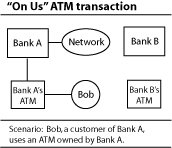
When a cardholder uses an ATM that is owned by their bank, the transaction is called an “on us” transaction. No other bank or ATM owner is involved in the transaction so only the ATM network and the cardholder’s bank are entitled to fees.
When a cardholder uses an ATM that is owned by another bank or private ATM owner, the transaction is called a “foreign” transaction. In such a case, all three parties incur costs and thus levy fees. The ATM owner has the costs associated with deploying and maintaining the machine, the network uses its infrastructure to route the transaction, and the cardholder’s bank must approve and moderate it.
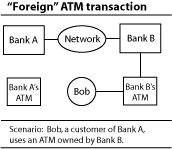
With “on us” transactions, the costs are most often absorbed by the cardholder’s bank as a service to their customer. Foreign transactions, however, typically result in two separate fees to the cardholder.
First, a fee called a surcharge is levied at the time of the transaction. This fee is detailed on-screen at the ATM, usually taking a form such as, “the owner of this ATM charges a $1.50 fee for use of the device.” The cardholder is asked to accept or decline the fee and, subsequently, the transaction. This fee is shared between the ATM owner and the network.
A foreign transaction also commonly results in a second fee assessed by the cardholder’s bank. This fee appears in the monthly statement and is designed to cover the expenses that the cardholder’s bank incurs during the transaction. This fee is set by the cardholder’s bank though a portion of it is shared with the ATM owner.
For years there have been consumer complaints that ATM owners were, in essence, double-dipping by surcharging and sharing in the foreign fee collected by the cardholder’s bank. There were pushes to ban surcharging brought from many levels (in fact, surcharging was not allowed in the early days of ATMs).
The reality, however, is that this it is the surcharge that has enabled ATM deployment to proceed to the extent it has occurred. Without surcharges, it would be difficult to make money deploying and operating the devices. The surcharge has changed this and created a major business in ATM operation. This has led to significant convenience–with an ATM on almost every corner. Consumers can avoid fees by using devices deployed by their bank, but they can also benefit from the convenience of ready access if they are willing to pay the additional fees.
The campus card perspective
For campus card programs, understanding on us and foreign ATM transactions can help us to better serve our customers when it comes to banking partnerships. For our customers to take advantage of “fee-free” transactions, their should be partner-owned ATMs available for student use. And you should understand the fees that the prospective partner charges for both types of transactions. Only with this understanding can you evaluate the true cost to the student of the banking services.
The e-Suds laundry system that enables advanced features including monitoring of washer and dryer availability online and notification via email when laundry cycles are complete has been implemented alongside Blackboard’s campus card payment system at Goucher College in Baltimore.
USA TECHNOLOGIES AND BLACKBOARD JOIN FORCES TO STREAMLINE STUDENT ACCESS TO E-SUDS LAUNDRY SERVICES
MALVERN, PA, February xx, 2005– USA Technologies, Inc. (OTCBB: USTT) today announced the successful integration with Blackboard Inc. (Nasdaq: BBBB), a leading provider of transaction processing systems to colleges and universities throughout America.
USA Technologies and Blackboard have integrated their technologies to allow students to use the Blackboard Transaction System™ cards to activate and pay for using USA Technologies’ e-Suds™ electronic online laundry services on campus. The first installation of e-Suds integrated with Blackboard was installed earlier this year at Goucher College in Baltimore Maryland.
“Students who took part in the Goucher College program enjoyed the convenience and simplicity of being able to use their Blackboard Transaction card to have the cost of doing their laundry deducted online directly from their Blackboard account,” said Wendy Jenkins, Vice president of Marketing, USA Technologies. “The relationship with Blackboard gives USA Technologies access to more than 450 universities, colleges and corporate accounts, and tens of thousands of users,” she said.
Students already use the Blackboard Transaction System to make payments at the cafeteria, bookstore, and even at neighboring retailers and restaurants. Now they use the same card to pay for laundry and receive all of the amenities for the e-Suds system including being able to see availability of washer and dryers online and get notified via email when their laundry cycles are complete.
“We believe the e-Suds is a terrific enhancement to our laundry service and plan to bring this to many of our partner schools,” said John Gregory, President of Caldwell and Gregory, Inc. “Now that e-Suds can integrate with Blackboard, there is the opportunity for the e-Suds service to grow. Many of our partners have been waiting for this.”
Blackboard is recognized as a leading provider of enterprise software and services to the Education Industry and has more than 450 schools using its transaction services. In a recent Forbes.com survey of the most connected campuses in the US, 18 of the 25 schools relied on the Blackboard Learning System™ for their e-learning needs.
USA Technologies’ e-Suds online laundry system has already been installed at a growing number of campuses, including Carnegie Melon, Cedarville College, Bluffton College and more have been targeted for deployment.
USA Technologies also manufactures the e-Port® cashless transaction device for vending machines and unattended kiosks, and an expanding line of energy management products, specifically aimed at the vending and cooler markets.
About USA Technologies:
USA Technologies is a leader in the networking of distributed assets, wireless non-cash transactions, associated financial/network services and energy management. USA Technologies provides networked credit card and other non-cash systems in the vending, commercial laundry, hospitality and digital imaging industries. USA Technologies is an IBM Business Partner. The Company has marketing agreements with AT&T, Honeywell, MEI, Unilever and ZiLOG Corporation. http://www.usatech.com
About Blackboard Inc.
Blackboard is a leading provider of enterprise software and services to the education industry. The Company’s product line consists of five software applications bundled in two suites, the Blackboard Academic Suite TM and the Blackboard Commerce Suite TM. Blackboard’s clients include colleges, universities, schools and other education providers, as well as textbook publishers and student-focused merchants that serve education providers and their students. Blackboard is headquartered in Washington, D.C., with offices and staff in North America, Europe and Asia.
 by Lauren Lowrey, Contributing Editor
College and university ID card programs are used to secure access to dorms and buildings, as banking vehicles for students … even to enable discounts at the local movie theatre. Imagine if the same program was made available for students in fraternities and sororities. The Office of Greek Life at Pennsylvania State University is working with the campus card office to make this a reality for Greek students for Fall 2005.
Pennsylvania State University has a large Greek community with 95 national and local chapters represented. The Greek ID card program is planned to help monitor the almost 5,000 Greek students. The need for such a system catered specifically to Greeks came from the desire to control attendance at all-Greek events.
The current event attendance system is paper-based with the named organization at the top of each page and numbered lines for attendee’s signatures. Though simplistic, the method inaccurate and non-electronic – and thus not capable of generating reports. An independent student could sign in under the name of another member student if checking the ID is not required. And there is virtually no means to discern anything relevant from the collected lists. This problem is what the Office of Greek Life and its four main chapter councils are trying to combat.
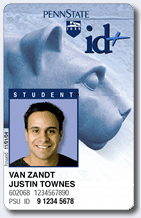
 With the new Greek IDs, fraternity and sorority members will not only be identified as Penn State students but also as members of their respective chapters. The plan for the cards is to retain the Penn State colors, yet have information pertinent to Greek students: name, affiliation, birth date, initiation date, and expected graduation date.
The current plan is to have the PSU campus card office produce the IDs for the Office of Greek Life. A fee of $2.30 per card is anticipated from the card office with the cost to be incurred by each chapter member who will pay an extra $3 in dues. Once a new member is initiated into the organization, he or she will receive the GreekID with their name, affiliation, etc. However, the Greek Life Office and the Card Office have not decided upon a method for cancelling a card when a member drops from the organization without graduating.
Jared Brown, the Assistant Director for Greek Life at Penn State, said that until they decide to utilize the magnetic stripe (or other technology), they will “provide a paper list of all active card holders” to double-check that the person who is on the card is still an active member of the Greek organization. The cards, for now, will serve as a “flash badge” until the begin using hand-held card readers.
This Greek ID venture may lay the groundwork for more applications at PSU and on campuses around the country. The presence of a card with a magnetic stripe, barcode, or contactless chip could open up new possibilities for all of users. This card could be the first step towards card readers at fraternity and sorority parking lot entrances, buildings, and meeting locations. It could serve as an attendance tracking tool enabling members to manually swipe their card before the meeting began. And it could develop into a Greek-only discount card at local merchants.
As more accountability and security is required of and desired by campus organizations including fraternities and sororities, the opportunities for the utilization of card technology increases. And the campus card offices are in a unique position to understand both the needs of the campus organizations and the capabilities of advanced ID technology. We will keep an eye on the PSU Greek ID program as it continues to develop.
Additional resources:
To visit the PSU campus card office on the web, click here.
To read more about Penn State Greek Life, click here.
Findings from a recent study sponsored by the Better Business Bureau offer significant – and somewhat surprising – insight into the current situation of identity theft in the U.S. It also outlines a great array of practices that can help individuals guard against falling victim. For campus card leaders, it provides a good foundation for creating a card program that is identity theft resistant and for educating your constituencies.
Identity theft is certainly high on the list of concerns among both institutions and individuals. In the campus card world, it is a very real issue that must be faced on multiple fronts. We issue credentials with identification numbers that are subject to loss or theft, we maintain databases that compile personal information on our campus populations, and we frequently cooperate and share data with peripheral service providers such as telecoms and financial institutions. All these aspects of day-to-day operations have significant identity theft implications.
Identity theft in America
The study suggests that 9.3 million American adults were victims of identity theft during 2004. How were these average people victimized? We read constantly of packet sniffing, phishing, spyware, hacking, and other electronic schemes and scams. But in reality, the vast majority of identity theft occurs in the physical world. The study suggests that less than 12% of all theft occurs online. Additionally, online theft tends to be detected more quickly and results in significantly lower dollar losses per incident.
The number one source of stolen identity information is lost or stolen wallets and purses. Nearly 30% of all cases occur in this manner.
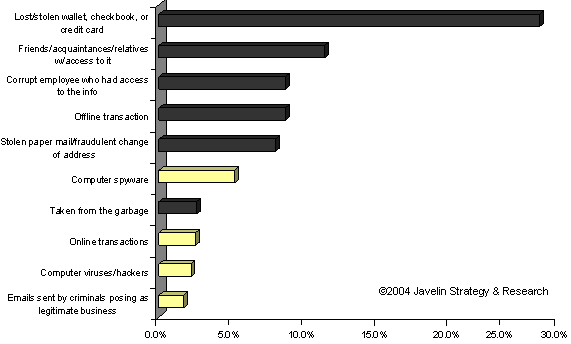
In cases where the perpetrator is known, more than half the time is it a family member, friend, or neighbor of the victim.

What does this mean to campus populations?
Though not specifically studied among student populations, these findings would suggest the following:
The most likely means of identity theft on campus is from a lost or stolen wallet or by friend, roommate, or neighbor that steals paper documents. This is the first place that students should take action. But this is by no means the only area of concern, and although the study suggests that online theft is less common than many believe, it is still a viable threat.
Taking action
Here are some terrific suggestions presented in the study that can help students and the rest of us protect ourselves from identity theft.
Additional resources:
To access this study online,click here
 Phoenix Card Scores Big at Duke Basketball Game
by Matthew Drummond, DukeCard Office and Janet Cooper, Manager Phoenix Card Services
Elon University’s Phoenix Card Office and Duke University’s DukeCard Office partnered to provide a unique service in an effort to promote the convenient and secure method of payment of both schools’ one cards. Elon students and staff were invited to attend a Duke basketball game where they were able to use their Phoenix Card at Cameron Indoor Stadium. Elon students were validated into the game as currently enrolled and were able to use their Phoenix Cash Account to purchase items at the concession stand.
Using a Wireless Campus Card Terminal from Sequoia Retail Systems, Inc., the DukeCard Office was able to program the device to process real-time transactions against the Phoenix Card Office’s Blackboard Transaction System server via the Duke University wireless network. All transactions between the Wireless Campus Card Terminal and Elon’s campus card system were encrypted ensuring that cardholder numbers and other data were protected.
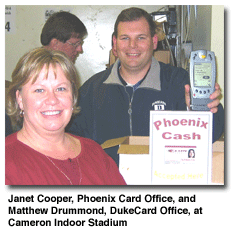 Though the pilot program was small, the event was a big success. Mike Vivenzio, a sophomore at Elon, said, “The experience was great. Being an Elon student and a Duke fan, this really helps me a lot. It offers me an easier and more convenient way to pay for things at a sporting event or on the Duke campus.” Andrew High, also a sophomore at Elon, had a positive experience as well and is excited about the possibility of being able to use his Phoenix Card at other schools in the area.
This partnership was easily formed because the schools are approximately 30 miles apart, both use the Blackboard Transaction System – Unix Edition and both have established, successful card programs.
Once all parties involved from both universities were on board with the project, Phoenix Card transactions were successfully being processed via the Duke wireless network in less than an hour. The Wireless Campus Card Terminal was also programmed with profiles that allowed the user to switch between processing transactions for Duke patrons and Elon patrons on the same device.
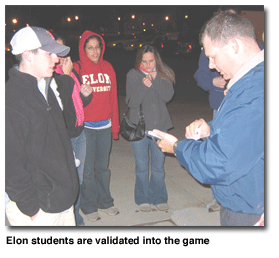 Duke Stores Concessions was pleased with how the pilot project went and is excited about the future possibilities with other North Carolina institutions, Atlantic Coast Conference members and any other schools with close ties to Duke University. They believe the ability for the other schools to use their campus card at Duke will increase their revenues.
Both universities hope this pilot project marks the beginning of providing this service to other schools that visit their campuses for co-sponsored university activities such as athletic events and academic programs. They envision this type of service being very useful to those schools who are not only geographically close but also have collaborative efforts through other programs that closely intertwine their community members.
Additional resources:
To visit the DukeCard Office on the web, click here.
To visit Elon University’s Phoenix Card Office on the web, click here.
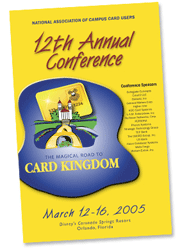 Lowell Adkins, executive director of the National Association of Campus Card Users, has just one word for those attending–or thinking of attending–the organization’s annual meeting in March: Disney.
But he’s not talking about the Magic Kingdom, or EPCOT, or MGM, although those certainly provide nice incentives for bringing the family. No, it’s Disney as in Disney Innovation and the Disney Institute. At no extra cost – and no increase in the conference registration fee over last year–those attending the NACCU conference March 12-16 at Disney’s Coronado Springs Resort in Orlando will get three 90-minute Disney Institute sessions. Complete all three and you end up with a certificate. But, more importantly, you’ll have received training from the company that practically invented customer – and employee – satisfaction.
And for an extra $125, there’s the pre-conference workshop on March 12 – a three-hour behind-the-scenes tour of Walt Disney World. “This is not only a fun thing to do but it will be a great professional development program,” said Mr. Adkins. “Folks who attend this pre-conference will get insight on how to manage a complex operation. It will be a good learning experience.”

Disney icing
But Mr. Adkins considers Disney “icing on an already very rich cake. There is so much going on in the industry … We’ve got educational breakout sessions, plus Disney.” Even the conference theme, “The Magical Road to Card Kingdom,” is tied to Disney.
The goal is to have 350 to 400 attend this year’s conference. Last year’s event in San Antonio drew 325, he said. “We already expect that a destination like Orlando will draw more. Conference chair is Dianna Norwood, Florida State University and co-chair is Kathleen Kelly, Carlton University, Ottawa, Canada.
There will also be some 55 exhibitors composed of major system integrators, financial institutions, accessory providers, and more, added Mr. Adkins.
“Every year, we have an excellent conference because of incredible networking opportunities. We’ll have six breakout sessions. Each will have five tracks. That’s 30 education opportunities. Plus there’s always those networking opportunities, talking to folks in the hallways,” he said.
“Learning from the experiences of others is the keystone to the success of this association and its members’ card programs,” commented Ms. Norwood. “Ask anyone why they attend the annual NACCU conference year after year, and they will quickly point out the advantages of networking with others who are experiencing the same day-to-day challenges on their campuses. Many of our veteran members take advantage of the face-to-face opportunity to exchange ideas with our corporate members in the exhibit hall.”
Conference attendees will “get the best of what we’ve always done, plus an extra added attraction – the Disney Institute, a great professional development opportunity,” added Mr. Adkins.
“We are very excited to be able to include three premier Disney Institute sessions in this year’s strong educational line-up,” said Ms. Norwood. “This is another perfect example of NACCU’s commitment to its educational mission for our membership.”
Wireless and more
Some of the other key sessions will cover wireless, security, access control, and even how to set up a card program. “There are still people who are doing that,” said Mr. Adkins, “particularly in community colleges where a lot of the new installations are happening now. That’s a real growth place for the campus card industry.”
Marketing will also be there. “It’s so important that it will be part of every one of the six breakouts. Disaster recovery is another important topic. That can be a natural disaster (Florida’s four hurricanes, for example), or what do you do when your system fails or you’ve been hit by a hacker,” added Mr. Adkins.
There will also be award presentations, such as the NACCU PERSONA Professional Development winner, “which we’ll be announcing in late January or early February,” said Mr. Adkins. Also, the winners of the best card and best marketing contests will be announced. Attendees will get to vote for their favorites at the conference.
Not to be forgotten is Sales Pitch Sunday. “As always, that’s a win-win opportunity for folks to see what’s going on and it’s a great chance for vendors to toot their own horns,” said Mr. Adkins.
The three 90-minute Disney Institute sessions Monday through Wednesday, will cover Leadership, quality service, and people management.
The NACCU conference in brief
While the complete agenda and other info is available at: www.naccu.org/conferences/2005/2005conferenceindex.html, here are some educational session highlights:
Saturday, March 12:
Pre-Conference Disney Institute Workshop, “Innovation in Action.”
Sunday, March 13:
Sales Pitch Sunday, and opening of exhibit hall.
Monday, March 14:
Educational Breakout Sessions #1:
Educational Breakout Sessions #2
Tuesday, March 15, 2005:
Educational Breakout Sessions #3
Educational Breakout Sessions #4:
Educational Breakout Sessions #5
Wednesday, March 16
Educational Breakout Sessions #6
“And by the way, it’s Orlando, a family opportunity,” added Mr. Adkins. “It ought to be a wonderful week in Orlando.”
 Like the old Greyhound bus slogan, “Leave the driving to us,” many universities offering campus card payments at off-campus merchants are finding it more cost effective and efficient to let someone else handle that side of the business. Universities, after all, aren’t merchant acquirers or payment processing companies.
And when they have a company like Blackboard already entrenched on their campus, an expansion move is a natural. Evidence of this trend – at least from Blackboard’s perspective – can be found in the company’s recent announcement that 12 more universities have opted to have Blackboard manage their off-campus card businesses.
Blackboard has more than 300 clients using its Transaction System, which is part of the Blackboard Commerce Suite, said Dan Gretz, senior director of operations for BbOne, the company’s on- and off-campus university card management program.
The newest BbOne additions include:
“BbOne is designed as a complete outsourcing system. We extend the functionality of their ID card to off campus merchants. As part of that outsource, we work with the university to design a target list (of possible merchants),” said Mr. Gretz.
“To maximize the success of off-campus services it is important to have a well established flexible spending account that has become a popular service option with the student population,” added Tom Bell, vice president for industry relations for the Blackboard Transaction System.
 Clemson grows a successful off-campus program with BbOne
Clemson University, South Carolina, went with BbOne last August. “Our goal was to have it fully operational by the end of the semester, but it was operational by mid-semester,” said Steve Robbins, director of information technology services for Clemson’s Division of Student Affairs.
“Things have gone exceptionally well. The response from students has been very positive,” he added. By letting Blackboard handle the off-campus program, it allowed the university “to focus on our resources. Blackboard recruits the merchants, supports the merchants, and make sure they are settled.”
While Clemson went directly to BbOne when it started its off-campus program, some universities initially tried to manage it themselves.
“In the case of George Washington University, the campus had a thriving program that (was becoming) too big for them to manage,” said Mr. Gretz. “They had 50 merchants and a waiting list of 75 merchants who wanted to join the program.”
At Clemson, “we currently have 21 merchants but we are always looking for more. We probably have five or six in negotiations right now,” said Bill McGee, associate director for the university’s card program, Tiger 1.
With Blackboard handling most merchant dealings, it does relieve the university of extra work. Explained Mr. Gretz: “We meet with the merchants to execute a card processing agreement. We then deploy the hardware to those merchants and we provide 24-hour support. Like Clemson and other clients, when a school contracts with us to run their off campus program, it’s a turnkey solution. They’re not involved in supporting that hardware or reimbursing the merchant, another time consuming step. We automate that for them and settle with merchants on a daily basis.”
“We really mimic the bank card world, concerning settlement, reconciliation, the detailed record,” added Mr. Gretz.
He said that universities can settle with merchants themselves if they want. Merchants can also purchase the needed hardware, if they so desire. Though he would not disclose the fee amount, he noted, “it is similar to what merchants are already used to (paying for debit and credit card acceptance).” And, “the university shares in the fee; it is a revenue generating opportunity so they get a percentage of the discount rate which varies by the size of the community.”
More about Clemson’s Tiger 1 Card
Clemson’s 16,500-plus students and more than 4,000 employees have access to Tiger 1. The university’s “declining balance” program, known as the TigerStripe account, carries pre-deposited funds that can be used on and off-campus, said Mr. McGee.
“Clemson houses 6,500 students which means a lot of students commute daily, so we’re now strengthening the program to allow them to do off campus what they can do on campus,” said Mr. Robbins.
Since the Tiger 1 with the TigerStripe option isn’t an actual credit card–students can only spend what they or their parents have deposited into their account–the declining balance account protects both groups against “overzealous spending” by students, said Mr. Gretz. “We’ve all seen articles on student spending. With this discretionary spending account, it creates a budgeting tool. Parents depositing funds have the option of setting up regular deposits. Anything the student might need for daily living expenses can be purchased using their card.”
There is a $500 per day deposit limit. “We’re not a bank,” said Mr. McGee. “Once funds are deposited they are only refundable on graduation or on transfer from the university.”
Students or parents can also make deposits online, call the college office or mail a check to Clemson, enabling cardholders to deposit funds in many ways.
“The (TigerStripe account) funds reside online,” said Mr. McGee, “not on the card. This promotes more security. If the student loses his card, we can deactivate it.”
One of the main reasons the college went off-campus was the same reason that many universities cite: “Each year, during orientation, we had many requests from parents and students to take the card off campus,” said Mr. McGee. When the university finally took that step last fall, students and parents were notified in a variety of ways–e-mails, flyers, a brochure.
BbOne makes the grade at Clemson
The college’s short-term goal for the program “is to see 50-60 merchants participating. With the interest we have, that will be achievable in the coming year,” he explained.
Some of the merchants now accepting Tiger 1 include a grocery store, pizza places, sandwich shops, clothing stores, a graphics/printing operation, a sushi restaurant, ice cream shop dry cleaners. “We have a broad range of offerings,” said Mr. McGee. “Most of them are close (to the campus), the farthest one is 10 miles out.”
BbOne has been “very well received by our students, student government, and parents since our launch in October. We’ve only had positive responses and now community merchants have more of a connection to the university,” concludes Mr. McGee.
Additional resources:
To visit Clemson’s Tiger 1 Card Office on the web, click here.
To learn more about BbOne on the web click here.
When it comes to predicting what’s in store for the campus card market, our expert panel is certainly well-equipped. From ‘top ten’ lists to the future of security, applications, and more … the panel had something to say about all facets of the campus card indsutry.
Industry veteran Tom Bell’s “top 10” campus card predictions for ‘05
by Tom Bell, Vice President of Industry Relations, Blackboard
Read the full story
Securing campus card transactions is key in ‘05
by William Adoff, President, NuVision Networks, Corp
Read the full story
Web-based ordering, wireless, and integration dominate ‘05
by Read Winkelman, National Sales Manager – Colleges and Universities
Transaction Processing Systems, The CBORD Group, Inc.
Read the full story
Campus card legislation, mature systems, and new technology at OSU in ‘05
by Jon Gear, Director, BuckID, The Ohio State University
Read the full story
Ten predictions for campus card programs in ‘05 and beyond
by Bob Huber, President, Robert Huber Associates
Read the full story
 A panel of ID industry experts provided predictions for 2005. One of these glimpses into the future will appear here each day during December.
by Bob Huber, President, Robert Huber Associates
Prediction #1 – Off-Campus Merchants
In just five years (2010), 50% of all campus card systems will include at least several off-campus merchant applications; Off-campus “marketing partners” will surpass all banking relationships within three years, secondly only to “self-op” management of off-campus merchant applications.
Prediction #2 – IP Readers
Individual “IP-addressable” card readers will compose 90% of card system vendor reader sales within two years, as institutions move away from traditional dedicated networks to connect readers to host systems.
Prediction #3 – Smart Cards Lose
Smart cards have lost their “window of opportunity” for acceptance in the U.S. due to fledgling promises and failed pilots over the past 20 years, and will be surpassed by more customer friendly technologies (i.e. magnetic stripes, biometrics, etc.).
Prediction #4 – Magnetic Stripe Reigns
Nearly 90% of campus cards will still retain a magnetic stripe in the next five years, while bar codes will quickly disappear off campus cards.
Prediction #5 – Proximity
The family of proximity technologies will continue to “seduce” many campuses with their single application and often expensive proprietary technology (i.e. usually only in security applications), and will compose the secondary technology on many “combi” campus cards.
Prediction #6 – Web Tools
Demand for increased customer services, more restrictive budgets, and higher debit account deposits will drive the acquisition of third-party web tools to accept financial deposits via the Internet by both students and their families, and therefore transitioning the traditional card office into a Virtual Customer Service Center.
Prediction #7 – Hosting Evolves
Although the majority of schools in the past have dedicated one card system host per campus, there will be an increased variety of host options and configurations (i.e. satellite/regional campus sharing, neighboring institution sharing, business/institution sharing, centralized vendor host leasing, etc.).
Prediction #8 – Vendor Partnerships
Vendors in the campus card industry will form more alliances with each other for expertise, integration, and demand by expansive All-Campus Card programs, both on and off campus.
Prediction #9 – Door Access Communications
If industry security and communication issues are rectified, “wireless” door access readers (on-line) will eventually secure 25% of the market, while off-line door access readers (standalone) will retain 50%, and the remaining 25% will utilize on-line communications (wired).
Prediction #10 – Pay-for-Print
Increased attention to printing consumable costs will eliminate free printing, necessitate central control and management of computer labs, and integration of Pay-for-Print subsystems linked (debited) to the campus card system.
“What’s Hot and What’s Not”
HOT —– COLD
Biometrics —– Smart Cards
Wireless Readers —– Off-Line Readers
IP Card Readers —– Private Networks
Shared System Hosts —– Single System Host
Off-Campus Applications —– On-Campus Applications
Marketing Partners —– Exclusive Banks
Pay-for-Print —– Copy Machines
Deposits (via Web) —– Deposits (via USPS)
Virtual Service Centers —– ID Offices
Strategic Marketing —– Periodic Promotions
About the author:
Mr. Robert Huber is President of Robert Huber Associates, a “vendor independent” management consultancy, based in Scottsdale, Arizona. His firm specializes in assisting colleges, universities, community colleges, boarding schools, healthcare facilities, and corporations with campus card programs.
He earned a Bachelor of Science degree (B.S.) in Business Administration, an Associate of Science degree (A.S.) in Restaurant Management, and has been certified by the Arizona Department of Education, the Arizona Community College Board, the Institute of Management Consultants, and the National Bureau of Certified Consultants.
Mr. Huber has an extensive management, operations, and marketing background. During the past 35 years, he implemented over 200 management systems – including point-of-sale, debit, food service, meal plan, vending, door access, mainframe, and food production systems. In addition, he was responsible for the startup and management of 50 Burger King ® restaurants, 3 hotels, 2 campus radio stations, and has trained over 2,000 employees.
Mr. Huber has been a pioneer in the development and implementation of campus card programs for over 20 years. In 1985, he co-developed and implemented the first campus-wide multi-application card system at Duke University, providing students with pre-approved access to hundreds of services – using a single card. During his career in higher education, he has worked with over 150 colleges and universities throughout the United States and Canada.
Mr. Huber has no financial ties with any vendors (e.g. card system, banks, credit unions, or financial consortiums) and does not recommend specific companies or systems. Instead, he educates and guides his clients through strategic processes and provides impartial professional advice so they may better define and more efficiently achieve their organizational goals.
Robert Huber, C.M.C., C.P.C.M., is an author, media resource, industry analyst, and frequent speaker at industry meetings, workshops, and conferences.
Visit Robert Huber Associates on the web at www.allcampuscard.com.