Card, mobile credential, payment and security
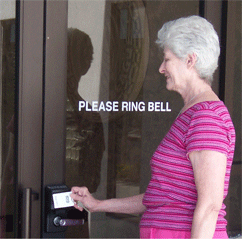 For more than 20 years, Assistance League® of Las Vegas has promoted volunteerism, dedicated to meeting the needs of its community. Part of the National Assistance League®, the organization’s 292 volunteer members logged over 32,000 volunteer hours last year in support of philanthropic projects.
Access Control Needed
Access control, in support of the large volunteer staff and on-site retail facilities, is a constant and vital requirement for the organization. The League’s headquarters, the Donald W. Reynolds Chapter Facility, had existed since its completion in October 1998 with traditional mechanical locks.
After experiencing several break-ins due to faulty locks at the facility, League management was desperate for a new access control solution. The organization went to a group organized by the Associated Locksmiths of America (ALOA) to research the cost of new locks for their facility. In conjunction with the ALOA Convention in Las Vegas, a cooperative organization comprising representatives from three concerns (Associated Locksmiths of America, OSI Security Devices and ACE Locksmiths) was able to respond by donating a state-of-the-art access control solution for the Assistance League.
State-of-the-Art Keyless Solution
With a goal of providing greater security and access control to the Assistance League facility, 13 doors were installed with the high-tech Omnilock Wireless Access Management System. Donated by OSI Security Devices, Inc., the installed system replaced the League’s old lock system. The system uses HID Global’s proximity technology and incorporates programmed access cards, donated by HID Global. Additionally, several Von Duprin exit devices and associated installation time were donated by Security Lock Distributors and ACE Locksmiths of Las Vegas, providing additional resources for the installation. Hardware for the new system is valued at $15,000 - $18,000, with twice that amount given by locksmith installers, in labor and installation costs.
The Assistance League facility is one of the nation’s first non-government commercial installations with Omnilock door locks. The lock system includes a battery-operated mechanism that can be used with HID proximity cards, a touch pad system, or both together, customized for each volunteer for heightened access control. In addition, a log of entrants into the building, forced entries, outages and battery power is recorded by the software component of the system, providing increased access control intelligence to the League’s management. The entire system enables end users to log on to the system and run their access control application remotely.
The installers, many with their first chance to work with the keyless, wireless, battery-operated Omnilock system, gained valuable training and experience with the new system while providing a valuable service to this community center.
“With a very worthy cause, and an opportunity to advance the training of ALOA members, it was not difficult step-up to the plate and donate the WAMS system for this project,” said Ron Siess, OSI Security Devices Vice President of Business Development. “It was a very instructive day and The Assistance League of Las Vegas was very grateful to all who contributed to the project.”
“This looked like a perfect opportunity to launch off a new access control system,” said Jerry Newton, Ace Locksmiths’ CEO. “I like what they do and it’s great to see somebody trying to do some good.”
Touching Lives through Cooperation
The ALOA-sponsored group helped to provide valuable assistance and an innovative security approach to this critical community organization. League funds that would have been spent on an access control system will now be reallocated to assist initiatives like Operation School Bell, providing clothing and school supplies to underprivileged 5- to 15-year-olds, increasing their incentive for attendance, academic performance and self-esteem.
“To us, this is such a boon because the money we need is for the children,” Assistance League’s Margy Purdue-Johnson said.
About OSI Security Devices
OSI Security Devices, shortly after it’s founding in 1986, introduced one of the world’s first battery-operated stand-alone electro-mechanical locks. Built to stringent military and industrial specifications, Omnilocks have been successful in meeting the demands of government, university and industrial customers throughout the United States. Stand-alone reader/locks programmed by PDAs have solved difficult access control challenges in some of the toughest environments imaginable. OSI has now introduced WAMS, which stands for Wireless Access Management Solution. This system allows easy upgrades for their stand-alone systems and provides a full featured, software based system, which is totally wireless end to end. OSI is headquartered in Chula Vista, California. To learn more, please visit www.omnilock.com.
About HID Global
HID Global is a leading manufacturer in the access control industry, serving customers worldwide with proximity and contactless smart card technologies; central station managed access controllers; secure and custom card solutions; digital identity and photo card management software solutions; secure card issuance solutions; and RFID electromechanical cylinders. Headquartered in Irvine, California, HID Global operates international offices that support more than 100 countries and is an ASSA ABLOY Group company. To learn more, please visit www.hidcorp.com.
 By Andy Williams, Contributing Editor
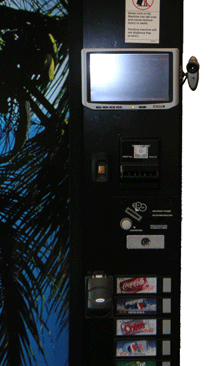
A group of grad students at the University of California, San Diego (UCSD) are in the process of creating what one of the students calls the “most over-designed soda machine in the world.”
Right now, the machine has attached to it a barcode scanner, a fingerprint reader, and a web cam for facial recognition. Want a Coke? Stick your thumb on the reader so the machine recognizes you as having an account, take out the drink, then walk way, never having had to reach into your pocket for change.
The project, called SodaVision (sodavision.com), is the brainchild of UCSD engineering associate professor Stefan Savage.
“I came up with the idea in June, 2005, but we didn’t get the soda machine until later that year. I had some discretionary money, so I bought a generic machine,” he said. “The biggest problem was putting through a purchase order for a ‘biometric soda machine.’ I got a few weird looks. I never actually gave the project the name. That came from the students.”
 He said the computer science department at UCSD has had a soda and snack cooperative, nicknamed Chez Bob by the students, for some 20 years. “You would put in 50 cents and take out a coke. About 10 years ago, someone came up with the idea that you could log into a computer, list the amount of money you’re depositing into the (Chez Bob) account; then when you buy a coke, log that in against your account,” said Dr. Savage. “I thought, ‘Here we are a leading computer science program, we should have something better.’ So, I offered it as a project for the grad students.”
What SodaVision ended up becoming–and it’s still a work in progress–is what second year computer science grad student Tom Duerig calls “the most over-designed soda machine in the world.”
“I wanted it to be incredibly easy to use,” said Dr. Savage. “I bought the soda machine and a touch screen and the fingerprint reader, a Fujitsu MBF 200. We looked for a fingerprint reader that would work with our software and with Linux. Now they (about 10 students) have actually torn (the fingerprint reader) apart and rewired it to work with the machine.”
The students built the interface. “I had one guy design a touchscreen that looks like the one used in Star Trek. Somewhere along the way they added a camera and another group added a 2D laser barcode scanner,” said Dr. Savage.
The camera, a web cam, is for facial recognition, the next big step in the technology-heavy machine. “The students even wrote the software to recognize the images,” he added.
“Our goal is to have the soda machine simply recognize who is standing in front of it when a soda is vended or money is inserted to charge or deposit into the appropriate account. And thus was born SodaVision,” wrote Mr. Duerig in a paper explaining the project.
As he further pointed out in the same paper: The camera “is trained on users faces, which are added to the repository. Recognition requires detecting a face, morphing the face, running preprocessing on the face, looking up the face in the repository, running an election over many frames, and finally logging in the user with the most votes in the election.”
The brain inside SodaVision is a small computer designed for cars. It is stored inside the soda machine and is equipped with an Intel Celeron 2GHz processor with 512MB of RAM. The computer fit the students’ needs in that “it was very small, slow, quiet, and didn’t produce a lot of heat,” explained the 23-year-old Mr. Duerig. “We briefly considered putting a quad CPU 1U server in there as that would have fit, but we decided against it for heat reasons.”
“The students have been entirely cooperative in this project. It has created a tremendous esprit de corps, a lot of energy and excitement,” said Dr. Savage.
The machine is available to grad students, faculty and staff in a locked room accessible via a card reader on the door.
While the team of grad students concentrate on increasing the accuracy of the facial recognition software, Dr. Savage still utilizes just the fingerprint reader. “I use it every day, because I’m used to using the reader.”
“The only way to purchase soda is when you’re logged in (currently via the fingerprint reader). You can also deposit money into your account (through a slot attached to the machine),” said Mr. Duerig. When a user vends a soda, his/her account is automatically debited. A candy bar or other snack item is scanned with the barcode reader and charged against the user’s account.
Right now, the facial recognition part of SodaVision is carrying an 80% accuracy rate. “We’re shooting for 95% accuracy.” Eventually, the plan is for “dual recognition,” added Mr. Duerig. You sign in with your thumbprint, and then go for facial recognition. But until we hit the magic 95% accuracy, it isn’t integrated with the payment/purchase system,” he added. “I suspect we’ll hit that mark at the end of this summer for the unveiling of the project.”
While the camera is there primarily for humans, it can be used for other things as well. For example, said Mr. Duerig, “We’re looking at ‘facial’ recognition for bananas because they don’t have barcodes.”
During the summer, SodaVision sees 20 to 50 users a day, but during the fall usage picks up. “In the fall I get about 10 emails for every five minutes the system is acting weird,” said Mr. Duerig.
 Even in a post 9-11 world, college campuses remain fairly open. Anyone can enter the campus itself with barely a nod from security. Corporations are a different matter and many have hardened building access in recent years. So, too, have K-12 schools. But with more options and lower costs, is it now time for colleges to take another look at better controlling visitors to their campuses? Supporters of visitor management solutions think so.
“Colleges are watching ingress and egress better than they used to do,” said Steve Blake, director of secure systems for Fargo Electronics, whose printer/encoders are used in visitor ID management systems. “But adoption has been better for visitor management in K-12 than in post secondary schools.”
Had some kind of visitor management program been in effect at the University of Cape Town in South Africa, a university professor might have avoided being beaten up by people who easily gained access to the building housing the professor’s office, as recently reported by a Cape Town online news service.
It’s one of the tradeoffs for having an open campus, a quality in which most colleges take pride. But are those days numbered?
 “(People are) implementing both unattended and attended visitor management systems,” explains Mr. Blake. “However, if you’re concerned about security, there is no reality to using an unattended system. I’ve been to several schools where you print out your own badge. It’s based on the honor system and it will work only for those who are honorable.”
Visitor management systems were in use even before 9-11. “They’ve been available for about seven years,” said Mr. Blake. “But there was a low level of adoption until the last couple of years. What has changed is that prices have come down to where they’re more affordable. New technology also makes it much easier to go through the registration and badging process.”
But it took “9-11 for visitor management (and other security systems) to skyrocket,” added Mr. Blake.
Some of the more popular visitor management programs are the ones that allow a visitor’s driver license to be swiped or scanned, thus providing a visitor’s critical information along with his picture. Then a temporary badge can be produced, usually in less than a minute, complete with photo.
“Driver license scanners can be tied to the software. A school clerk will take your driver license, run it through a scanner and be able to print a card with a Fargo printer in color or black and white, within 30 seconds,” said Mr. Blake. “This is what’s really driving the growth in visitor management. If anything happens, the school has the front and back of the visitor’s driver license.”
Despite the ease of creating visitor IDs, it could still be difficult for colleges to implement. “The issue is that with colleges, they tend to be an open environment with a lot of public access,” said Mr. Blake. “If you’re going to have attended locations for visitors you might have multiple points of issuance. Some (colleges) do use ID cards for visitors, but there hasn’t been a high level of adoption here.”
To date, the real adoption of visitor security has been in the corporate arena, Mr. Blake added.
Selecting a visitor management system from the host of options
Do a Google search on “visitor ID badge management” and nine different products show up on the first page alone.
Some of the bigger providers of visitor ID management software include Avery and Brady ID, plus “there are a lot of homegrown ones out there as well,” said Mr. Blake. Most work with ID card printers, but Avery’s for example also prints on paper labels.
Another aspect of visitor badge management is whether it will be standalone (located on a single computer) or tied to the network. Standalone architecture is obviously easier since all data resides on the PC at the front desk. But regardless of the system chosen, says Mr. Blake, implementation is simple. “You can be up and running in 30 minutes.”
Visitor management systems don’t require top-of-the-line printers to function adequately. “Our entry level printers tend to be the printer of choice for visitor management,” he said. “They contain just the features that are necessary. A visitor management solution typically doesn’t require high volume card production.”
Another consideration is how easy the visitor ID badge printer is to operate and maintain. “(Operators) need to be able to change ribbons and load the cards easily, so they can spend their time with people interaction, not printer interaction,” said Mr. Blake. “With our Persona C30 printer, for example, you can just pop the ribbon and cleaning cartridges in, unlike some printers where you have to deal with rolls of ribbons or cleaning rollers. Ease of use is extremely important. Operators can’t be afraid of what they’re about to use.”
Visitor management software has also evolved, said Mr. Blake. “They’ve migrated to include modules that are not only people-related, but will handle packages as well. For example, if UPS or FedEx delivers packages to the front desk, the software allows the packages to be logged in … right at the front door to create a history, an audit trail, of that package internally.”
With lower prices, more products from which to choose, and ease of use, “maybe it’s time for colleges to take another look at this,” said Mr. Blake. “There has been great adoption (and successes) elsewhere. This could be the time for colleges to examine how visitor ID management can benefit them.”
 By Andy Williams, Contributing Editor
More student choices, more options, and peace of mind for their parents are some of the ideas that went into the development of iMye, Sodexho’s new method of paying for food on or off campus. Oh yes, there’s also the “coolness” factor.
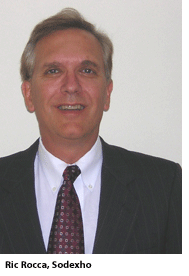
“You don’t need a card or cash, just your finger,” said Ric Rocca, senior vice president of strategy for Sodexho Education Services, of the company’s finger scan technology.
Even the name, “iMye” tracks the idea behind the program: In explaining the genesis of its name, the company explains “I Am Me…My Choices are Mine.”
Said Mr. Rocca: “The name was developed internally and reflects the Millennium Student. They’re individuals. It’s a combination of ‘me’ and ‘my,’ a reflection fo how they view music. They don’t buy albums anymore, just individual music and they want more variety and flexibility in terms of where they’re eating.”
The program - in a pilot stage right now - is at two colleges: Gonzaga University, Spokane, Wash., and the University of North Texas, Denton, Tex. It allows students and faculty to pay for their meals on campus and at select restaurants off-campus with a simple scan of their finger. Both Gonzaga and UNT were chosen for the pilot “because we have had great support from our clients there and from the Sodexho operational team,” said Mr. Rocca. Sodexho handles food service for an estimated 900 campuses across North America.
Dale Goodwin, PR director at Gonzaga, reported that early indications suggest that the system seems to be a success from the student perspective said the “students like it, from what I hear.”
Storing scans not fingerprints to protect privacy
First thing Sodexho wants to make clear is that it’s a “finger scan” not a “fingerprint.” In other words, the actual fingerprint is never stored in the centralized database, only algorithms that allow for simple identification.
 “It’s finger scan technology, not a fingerprint, so a record isn’t kept. It uses 16 points which converts the finger scan into algorithmic numbers, rather than the 64 points used for fingerprint comparisons,” said Charles Wesley, Sodexho general manager in Spokane.
“Essentially,” as the web page points out, the finger scan is simply “a batch of numbers, not your fingerprint” that’s kept on file.
Added Mr. Rocca: “The finger scan takes an image of the student’s finger, then we discard the actual fingerprint.” The later finger scan is compared with the algorithm. The finger scan database is stored centrally on a Sodexho computer and transmitted over the Internet.
How the system works: the student perspective
“Students can sign up online or on campus,” said Mr. Rocca. “They can even mail in an application, but to validate the account, they have to put their finger on a finger reader on campus. Everything else can be done online.” That includes loading, or reloading the student’s account.
It’s a prepaid meal plan type account, a debit system, added Mr. Rocca. “It allows them to go to participating retailers around campus and outlets (off-campus) which have finger scan technology right next to the cash register. Students (or parents) can set up the account for automatic reloads or buy a meal plan. They get dollar for dollar.” In other words, there is no cost to the students.
“This university (Gonzaga) was interested in being part of the pilot program, on the cutting edge,” said Mr. Wesley. “The school is pleased with the ability of the program to offer students a prepaid account to spend on and off campus.”
Mr. Rocca, who heads up iMye, said one of the main concepts that led to its development was that “we’re always looking for ways to better satisfy our clients, our customers. Students want choices and we always try to give them that.”
He said students “like the technology associated with biometrics. They’re comfortable with it, they like the fact they don’t have to carry a card. We’d been looking at the technology for a while. It’s a safe and convenient way to do the same thing that a card does.”
Sodexho has partnered with Biometric Access, a Texas company that produces the finger scan readers. “It’s a good, solid company,” said Mr. Rocca. “They’re growing and they fit the bill with what we needed for this program.”
How the system works: the merchant perspective
Since Sodexho operates a campus’s foodservice program, the readers cost the college nothing; they’re part of the contract. Off-campus, eventually merchants accepting finger scan technology will have to pay a fee. “There are a variety of ways to supply the readers,” said Mr. Rocca. “They can rent it, lease it or buy it outright, but since iMye is still in the test stage, we’re not charging the merchants right now.”
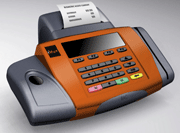
The finger scanner is about eight inches high, four inches wide and takes up about a 6-by-6-inch square space on the cash register table.
One glitch so far, if it can be called that, is transaction speed. Since the finger scan is compared with a database and is transmitted via the Internet, merchants with dial-up connections could experience longer transaction times. Normally, approval is almost instantaneous.
Merchants and the university also have to make sure their cashiers are properly trained. “Once the right amount of training is in place, you save time at the register,” said Mr. Rocca.
“You have to make sure cashiers know how to complete the transaction with somebody’s finger,” added Mr. Wesley. “With a trained cashier and a customer used to finger scanning, it can be faster than cash or credit card. While the cashier is ringing up the order, the customer has the capability to start the finger scan process.”
Moving from pilots to full-blown programs
The pilots at the two schools were initiated mid-term, in the middle of the normal school year. Just 350 students at Gonzaga (slightly more than five percent of its 6,000 students) signed up and about twice that number participated at UNT, said Mr. Wesley. The smaller numbers, however, gave Sodexho time to explore the feasibility of the program.
“We’re expecting a much higher penetration this fall,” said Mr. Rocca.
The program is also going to expand into other colleges in the Spokane area and possibly at UNT as well. “We’re not going to blow it out just yet. We’re trying to make sure it’s the right thing to do, we’re moving cautiously,” said Mr. Rocca. “We want to grow these test accounts first.”
He said some 20 merchants have signed up in Spokane and “a little less” at UNT. Merchant participation, too, is expected to increase this fall.
“The merchants that we are signing up now are predominately either restaurants or grocery stores,” he said. But that’s likely to change as other types of merchants become interested in the program. That could also lead to different types of purses in the student accounts.
“In the near future the money in the students’ accounts will be segmented into buckets of money … some that can be used only for food, some that can be used for anything, such as bookstores and other non food merchants,” said Mr. Rocca.
“Students seem happy with the program and our clients seem happy,” said Mr. Rocca. “The system works well, kids like the technology, the coolness of it. We’re really excited about it. Bottom line is it gives kids more options, more choices in where and how they eat. And it gives parents the peace of mind that their students are using the money they send them for food.”
Or, as Mr. Wesley pointed out, iMye “is about touching the future.”
Additional resources:
To learn more about iMye on the web, click here.
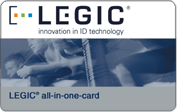 LEGIC provides robust suite of payment and security applications for students in Chur, Switzerland
By Andy Williams, Contributing Editor
While many U.S. colleges and universities have been hesitant to delve into the contactless world, European and Asian campuses have taken the opposite approach. So it is with the University of Technology and Economics (HTW Chur) in Chur, Switzerland. The college opted for a contactless campus card system based on chips supplied by LEGIC Identsystems Ltd., also based in Switzerland. The company specializes in the design and manufacture of 13.56 MHz contactless smart card technology, including ISO 15693 and ISO 14443 compliant read/write chip sets, security modules, and transponder chips.
HTW Chur specializes in high tech pursuits, so what better way to emphasize your philosophy than to offer your students and faculty a cutting edge, cashless … and contactless … environment?
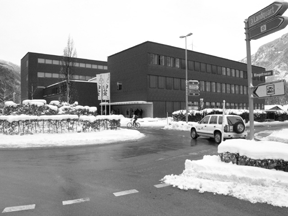 The range of courses offered by the HTW Chur covers six degree and three postgraduate courses, two Executive Masters of Business Administration and a wide-range of training courses. The college, according to LEGIC, specializes in the fields of tourism, entrepreneurship and commerce, telecommunications and electrical engineering, structural engineering and architecture design and computer science.
Two other Swiss companies, EVIS and Kaba, are also involved in the Chur project. EVIS, a LEGIC partner for more than 11 years, provides the project with vending solutions, access control systems, card personalization, hardware/software, cashless payment systems, POS terminals, and time and attendance solutions. Kaba specializes in security technology, such as locking cylinders, security locks, motorized cylinder locks and access control systems.
“We are a basic technology supplier,” said Stephen Neff, LEGIC’s vice president for sales and business development. “We supply transponder chips and people integrate our products into the finished product. Our technology products allow them to make the all-in-one-card system.”
Utilizing this multi-function technology, the university has already issued more than 2,000 cards to students, staff, faculty, and visitors at HTW Chur. The cards serve as the students’ ID, allow access to lockers (where student laptops are typically stored), provide cashless vending and copying, serve as the library card, and enable discounts at off-campus merchants. Museums and theaters also accept the contactless smart card, said Mr. Neff.
The college prints its own cards on site with a card printer from Zebra. This, said Mr. Neff, allows the school to personalize the cards and initialize the chip according to the area in which it will be used.
Payment applications are crucial to campus card success
Students are issued their cards when they enroll. Guests, visitors, and external users of HTW Chur facilities such as the library, can obtain a LEGIC smart card upon payment of a deposit. The student ID is used for payment transactions in the canteens, vending machines, and copiers and printers.
Charging stations - one in each of the two main buildings - allow students or faculty to add value to their card’s e-purse with up to 300 Swiss francs (about US$240). “The student simply presents his contactless smart card to the charging station,” says Mr. Neff, “inserts the money he/she wants to load on the card and after a few seconds the loading station confirms that the card has been recharged.”
“One of the main advantages of this system,” said Mr. Neff, ” is that students only have to bring cash to school if they plan to recharge their electronic purse. They don’t need cash for vending machines, the canteen, or copying machines.”
When funds are spent - via vending or in the canteen - the transaction is forwarded to a central server via the campus’ existing network. Thanks to the TCP/IP networking of all reading units, the card balances can be checked and (lost or stolen) cards can be blocked immediately if necessary.
“The balance is not stored in a back end system,” said Mr. Neff. “The money is in the possession of the cardholder only. This increases the security and the confidence in the system.”
 Physical security complements the financial offering …
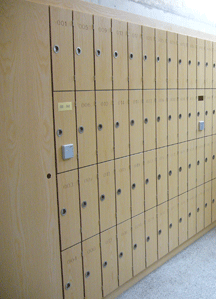
Kaba technology is used for access control and the locks on the 800 lockers. EVIS provides the vending solutions, added Mr. Neff. Since it is a contactless card, a student need only tap his card against the locker’s lock to open it.
While dormitory access is possible using the system, HTW Chur doesn’t need that capability because it is a commuter school, said Mr. Neff. But the campus does have plans to expand the access control capabilities of the system. In the near future, officials plan to deploy locking systems on individual laboratory doors to guarantee greater security and convenience for the user.
One of the benefits of this particular LEGIC technology, the all-in-one-card, is that more applications and functional areas can be added later as the college’s needs progress.
Mr. Neff provides the following example: “… a Chinese university, with more than100,000 LEGIC student cards, installed readers in dormitory showers that turn off the water automatically when the student takes his card away from the waterproof reader in order to save water and money. (Others have added) parking access or access to fitness centers.”
“(HTW Chur) is very satisfied with the new all-in-one-card solution,” said Mr. Neff. “The whole process is much easier and the students profit a lot from the increased comfort. Even the complexity for the card administration has been reduced significantly.” And, he added, thanks to the central data administration and the university using its own printers, it can easily administer and replace lost or stolen cards.
Evangelizing contactless technology in the U.S.
LEGIC has installed its campus card solution in many locations in addition to HTW Chur. “There are more then 50 universities in Europe and Asia using the LEGIC contactless smart card technology already and more are opting for this technology every year,” said Mr. Neff.
But, encouraging U.S. institutions to opt for contactless is a challenge. With offices in Chicago, and Dallas, LEGIC is doing what Mr. Neff calls “missionary work. We’re working with campuses, going to suppliers, trying to sell them on using contactless technology.”
In the U.S., LEGIC, which has offices in Chicago, Ill. and Dallas, Tex., is doing what Mr. Neff calls “missionary work. We’re working with campuses, going to suppliers, trying to sell them on using contactless technology.”
Of course, U.S. Government requirements, such as those included in FIPS 201 and the Department of Defense’s Common Access Card, are helping generate contactless demand, he adds. “Four or five years ago, it (contactless) was a non-issue. Now we’re at least getting invitations. It didn’t happen overnight in Europe, either.” Even so, LEGIC currently has some 70 million contactless cards in the field.
Contactless advantages for campus card systems …
He thinks contactless cards would be preferable at universities if, for nothing else, than for ease of maintenance. “Universities tend to incur quite a bit of vandalism (with items such as gum or coins) being stuffed into the slot designed for the contact card. In Canada’s (early) ATMs, the slot was exactly the thickness of a processed cheese slice, (and vandals stuck them in) so they had to make the slot smaller. Contactless is almost vandal-proof which, I think, is its biggest advantage over contact.”
Another big contactless advantage is, of course, its hands-free capability. “You can put your contactless ID badge into your pocket and walk by the reader. With a contact badge, you always have to take the card out of the holder and put it back again,” said Mr. Neff.
Concludes Mr. Neff: “The most important thing for universities is linking access control with vending, restaurant and other applications. They have to be able to run independently of each other so the card becomes the network … you can obtain IT access as well as physical access. The biggest stumbling block is that many people don’t believe it can be done.”
 Compare FIPS 201 Products
Ten campuses had already purchased the Webfood online dining solution from CBORD this summer, and now add Boston College to the list. The campus will use it to enable online ordering of meals for pickup and delivery and facilitate card-based payments using their CS Gold card system.
Boston College purchases Webfood®
Ithaca, NY—The CBORD Group, Inc. today announced that Boston College (Chestnut Hill, MA) has purchased Webfood®, the company’s online ordering system. The school plans to install the system later this month.
Using Webfood, Boston College faculty and staff members can view the campus’s “Eagle Express” online catering menu and place orders for both pickup and delivery. Patrons can also pay online using CBORD’s CS Gold® system.
Webfood will later be expanded to serve Boston College’s luxury box owners at Alumni Stadium, as well as BC’s Residential Assistants, who can use the system to order food for floor parties and other social activities.
The University of Colorado at Boulder, University of Maryland, University at Albany, University of Connecticut, East Carolina University, University of San Francisco, Western Washington University, Old Dominion University, Virginia Commonwealth University, and Johns Hopkins University have all purchased Webfood this summer as well—showing strong support for the system in the college and university market.
“We are very happy to see these institutions join the Webfood family,” said Peter Krebs, Webfood Product Manager at CBORD. He added, “Boston College’s innovative use of Webfood is a great example of how our customers work with CBORD to expand and improve our products.”
About The CBORD Group
The CBORD Group serves healthcare facilities, colleges and universities, corporations, chain restaurants, supermarkets, and a host of other market segments. CBORD’s products are used in foodservice, catering, nutrition services, campus ID card privilege control, access control and electronic security, housing services, cashless dining, online ordering, and other institution-wide activities. CBORD products and services are used by more than 5,000 organizations in the US, Canada, Europe, South Africa, New Zealand, Australia, and the Middle East.
The CBORD Group was founded in 1975. Today it employs more than 450 professionals. To learn more about CBORD or CBORD’s Webfood solution, visit us at www.cbord.com or www.webfood.com.
 Fee-free checking, online banking, and more have become standard fare
Students, like other customers, are expecting more and more services from their financial institution. And banks are working hard to find attractive offerings and competitive pricing to meet these new demands. Recent research and studies of student banking habits lend insight into this trend.
Don’t charge me for my checking account
Fee-free checking is one method that banks – those on campus or in a college community – are using to attract more student customers.
An article in last year’s Retail Banker International on student banking in the U.S. noted that banks “are turning to fee-free product offerings” to attract more student customers. Some of the larger banks provide free checking services to students only if their parents are already customers. Upon graduation, the student accounts often revert to standard accounts. For example, the article notes that one bank rolls a student’s account over to a basic banking account on the individual’s twenty-fourth birthday. Another, the article adds, automatically reverts its student account to a direct deposit account after five years.
Some banks have no minimum deposit requirements, others, $50 to $100; others have no minimum balance mandates either, according to the Retail Banker International article. One bank offers a fee-free checking account for the first five years as long as there is at least one monthly direct deposit or if the student’s parents have an account there.
Online banking is becoming a “must” for students
Brick and mortar campus branch banks aren’t necessarily the only option for students. Online banking is another viable choice and, according to a recent J.D. Power and Associates study, many bank customers prefer online banking to face-to-face interaction with a teller.
Quoting transaction times that are nearly three times faster than physically visiting a bank, the Power report, 2006 Retail Banking Satisfaction Study, concluded that online banking is the preferred transaction method among many customers.
This first-ever study by J.D. Power focused on performance among the nation’s largest banks, analyzing the retail banking experience from two points of view – customer satisfaction and customer commitment.
It’s no surprise that a customer’s interaction with a bank has the greatest impact on his satisfaction level. Comparing online and in-person transactions, the study found that the average online transaction takes just 2.8 minutes to complete, compared to 7.7 minutes of combined wait and transaction time with a branch teller. Online transactions received the highest marks in terms of satisfaction, even though this type of transaction is still conducted less frequently than the traditional in-person branch transactions.
Online banking also presents “a clear opportunity for banks to differentiate themselves from potential customers,” remarked Jeff Taylor, director of the banking practice at J.D. Power when the study was released. It used to be that free checking helped attract new customers, but 90% of the 12,904 households surveyed for the J.D. Power study reported already having that benefit. A significant majority, 94%, received free online banking and free debit cards.
The second part of the study, commitment, was designed to give banks a better picture of a customer’s revenue potential. Again, customer satisfaction was a major aspect influencing customer commitment to the bank, the study suggests. For example, customers with commitment levels in the top 25% use an average of 3.3 banking services, compared to 2.5 for those in the bottom 25%. Overall, the retail banking industry enjoys a commitment level of 28%, compared to 13%, on average, in other industries measured by J.D. Power.
A host of other services help differentiate one bank’s student offering from another …
There are other carrots banks are using to lure students.
One enticement is a fee-free credit card with low interest rates, which, according to the same article, many banks offer. However, the low APR is like an introductory rate, good for, say, the first six months. At least one bank rewards students with redeemable points on their credit card if they receive good grades. However, the same bank requires an annual student income of at least $8,000.
One bank used overdraft protection to reverse its declining student accounts. It offered an emergency use card good for a one-time refund of an insufficient funds charge, a stop payment fee or a charge for usage of a foreign ATM.
Banks are also getting quite creative in their attempts to attract students. Other programs include linking the bank’s web site to its scholarship program, offering free $1,000 financial aid drawings, tying debit cards to separate accounts for on- and off-campus use and even offering free downloads from iTunes if the student opens an account within a certain time period.
It seems that creativity may key to attracting student accounts but quality service and competitive pricing is still required to keep them as clients.
 Card systems at colleges and universities have typically centered around on-campus commerce and access. But today, they are extending their reach off-campus and opening their on-campus services to more commerce-savvy students, faculty, and staff. Credit card use has continually increased on college and university campuses, specifically in conjunction with their transaction systems. The companies provisioning campus card program technologies, as well as the universities, find themselves facing greater responsibilities and, more importantly, liabilities.
In Blackboard’s case, it meant assuring the 400-plus colleges utilizing the company’s Commerce Suite products that cashless transactions – campus card and credit card – are handled in a secure fashion.
That meant making sure Blackboard’s Payment Gateway has been certified as compliant with major card association security programs, such as Visa CISP (Cardholder Information Security Program), MasterCard SDP (Site Data Protection) program, Discover’s DISC (Discover Information Security and Compliance) program and American Express’ Data Security Operating Policies, said Blackboard’s Tom Bell, vice president, industry relations.
 “These programs utilize the Payment Card Industry (PCI) data security standard as the foundation to assess third-party processors,” he added. “This standard ensures that all third-party processes safely and securely store, process, and transmit sensitive credit card data across their network infrastructures. This is the second year that Blackboard has achieved this milestone in the payment card industry.”
In short, universities “want to make sure the partner they’re dealing with is compliant and understands the issues,” said Mr. Bell. “We’re very serious about this.”
As more campuses move to a system that deals with people when they’re on- or off-campus, and even online, “we see more issues with dealing with e-commerce or adding funds to accounts … different ways of paying for things. Blackboard has to provide a diverse choice. Years ago, we didn’t have to worry about this,” said Mr. Bell.
“While many third-party processors are not compliant with the PCI standard, Blackboard proactively met this challenge in early 2004 to ensure all credit card transactions originating from our Web Interfaced Card Management Applications were handled in the most secure way possible,” says Mr. Bell. “Our Payment Gateway is a powerful and flexible channel for conducting cardholder-not-present electronic transactions.”
What are the certification benefits?
“Every member along the electronic payment processing channel – from card association (Visa, MasterCard, American Express, Discover) to acquirer to processor to payment gateways down to the merchant level must comply with these standards in order to accept credit card transactions online,” said Mr. Bell. “Our clients must prove to their acquirers that any processor they are affiliated with is complying with the PCI standards. In short, university credit card acquirers must ensure that the university’s credit card processor(s) are complying with the PCI directives in order to maintain compliancy with their higher-ups, the card associations. In addition to embracing the required security standards, Blackboard provides our clients with a level of confidence when they negotiate discount rates with their Merchant Services Provider.”
 Added Russ Palay, Blackboard’s director of e-business and electronic payments: “Visa, MasterCard, etc. mandated it throughout the entire chain … and since we are a third party processor for credit card transactions, we have a responsibility to make sure the credit card data that is transmitted and processed adheres to the card association compliance programs that are bundled under PCI.”
“What’s driving this is customer demand,” said Ron Dinwiddie, senior director of product development for Blackboard. “Pubic and private colleges and Universities are issuing mandates requiring the highest levels of security when accepting credit cards as a form of tender. We will continue providing our clients with the highest levels of security to protect them and their constituents.”
 By Andy Williams, Contributing Editor
As the one-year anniversary of The CBORD Group’s acquisition of Diebold’s card systems division approaches, the Ithaca, NY-based company spans the range of colleges and universities – small, medium and now large campuses.
To Bruce Lane, CBORD’s executive vice president, the acquisition was a perfect fit with CBORD’s strategic direction. “Finally the stars aligned to make this happen,” explains Mr. Lane. “I’d been staying in contact with my competitors at Diebold for many years and I kept after them on it.”
“Prior to the acquisition, CBORD had the largest installed base of campus card users in the industry,” said Mr. Lane. “Diebold had larger university customers and that provided us with the need to meet any size campus.” Besides its 650 colleges, mostly in Canada and the U.S., but also in South Africa, New Zealand and Australia, CBORD also has about 200 corporate accounts, including hospitals and companies like Sprint and Daimler Chrysler. CBORD serves between 6 and 7 million cardholders. It is also delving into community colleges.
“We found some beginning synergies that benefited both customer bases,” says Mr. Lane. “Diebold had a very strong core competency in access control. The CS Gold access control product is highly optimized to meet the particular needs of colleges. The product has hundreds of access control installations in colleges. It’s a very powerful, defining product and we’re looking forward to bringing that to our Odyssey customers.”
The $38 million transaction addressed a gap in CBORD’s product line by adding Diebold’s access control and security expertise. The purchase also involved Diebold’s Card System employees migrating to CBORD. Most of them did, a couple didn’t, said Mr. Lane. “There were a lot of great people at Diebold that we are now happy to have as part of the CBORD family.”
Proving to the market that the acquisition makes sense …
CBORD has spent much of the past year proving that the acquisition was good for both companies. “Anytime there’s a change in the players or the marketplace, it’s always reasonable to assume that schools or employees or suppliers are going to get a little nervous. There’s no way to deal with that other than to show it was a good combination,” said Mr. Lane. “Our goal is to make the combined companies as successful as they can be, and to make it viable over the long haul. We’ve worked really hard and made the investment to show the marketplace that it was a logical move.”
For example, he said, CBORD has moved the CS Gold help desk into a new facility in Canton, Ohio. “We’ve also refurbished our training facility in Farmington, New York.”
CS Gold is optimized for large institutions while “Odyssey has a sweet spot among smaller and medium-sized schools,” said Mr. Lane.
“The Gold system is highly desired by institutions that have an IT staff and where the operators are looking for the ability to customize all levels of software for their use. These colleges have the time and resources to get into the system. The Odyssey system accomplishes most of that through user-set parameters where you don’t have to employ a programmer to do it,” he added. Another difference between the two: Odyssey can use a Sybase ASA or Oracle database, while CS Gold is Oracle-based.
“We found that when we were competitors there are customers who want a highly customizable system and others who want a very parameter-driven system,” Mr. Lane added. “(The two products) appeal to very different campus operations. They each have different system architectures. Now either type of customer can find a solution at CBORD.”
Building interfaces and finding shared components
Building an interface between CS Gold and CBORD’s signature Webfood online food ordering system, “was one of first things we did,” said Mr. Lane. Webfood, he said, is now installed in a number of CS Gold schools.
CBORD, he said, also pioneered its campus card users’ ability to use industry-standard POS terminals developed by MICROS Systems. “They’re the largest hospitality POS provider in the world,” said Mr. Lane. “When I started working with them 20 years ago, they were a small company. What’s nice is that now we’re one of MICROS’ largest resellers in the world. That gives our customers better access to service and product enhancements.”
He said Diebold had already begun to install MICROS as a better alternative to making POS terminals themselves. “So use of MICROS was a first, great similarity and point of synergy between the Gold and Odyssey systems.”
He added: “For off-campus programs, a school often takes CBORD card readers and sticks them at off-campus merchants. The readers work off the university’s host. We have hundreds of schools that do that, but we are evolving a new off-campus merchant program, a whole different paradigm to make off campus card use a lot more possible, particularly from a cost perspective.”
Integrating access control into the Odyssey platform
CBORD is also working on integrating Diebold’s access control system into campuses currently using the Odyssey platform. Before acquiring Diebold, CBORD had relied on third-party systems, such as Best, Synergistics and Sensormatic to provide access control solutions to campuses.
“Access control is different because you have to know how to deal with resident students, those on vacation, assigning students various levels of privilege,” said Mr. Lane. “Access control matrixes seem to be lot deeper for universities. They’re not a 9 to 5 operation. The matrix of privileges seems to be more complex for colleges and a lot of off-the-shelf access systems choke on that.”
CBORD is nearly complete with interfacing Diebold’s CS Access, the original native access control part of CS Gold, to the Odyssey platform. However, CBORD will still support third-party access control products if the school doesn’t want to change.
But with CS Access capability, CBORD will no longer have to pass on requests for a one-stop service that includes access control, as the company had to do in the past. “We now have the industry’s best access control system that’s highly tuned to the campus world,” said Mr. Lane. “Some (access control) companies build their systems to work well in a corporate or factory setting, but CS Access is very attuned to the particular needs of the college students and administrators.”
The CS Access portion is not being actively marketed yet. “The development work is done,” said Mr. Lane. “CS Access is battle-proven, Odyssey is battle- proven, so we hope to have it introduced within the next few months.”
The future …
Mr. Lane said he’s been very gratified with the acceptance of this transaction among CBORD’s university clients. “It seems to me the marketplace has accepted the work we’ve done and rewarded us with a number of new accounts,” he said. As to the future: “We have a lot of tricks up our sleeve and cool new things we’re going to be doing. We’ve doubled our development capability (and) we have no plans to do anything but grow. We’re very competitive and we’re very pleased our Gold and Odyssey products are widely accepted in the marketplace.”
Sure, students are a bank’s reason for its campus existence, but a more profitable client base includes the ones teaching the students … as well as the university administrators and staff. But attracting professors and staff that already have a banking relationship is no easy task.
Whitney Bright, vice president, Campus Banking, for U.S. Bank, said that while its programs are “tailored to the students rather than faculty and staff in terms of our ability to offer them services, they’re probably twice as profitable as a (typical) student account.” Put another way: “If we can grow faculty and staff, we don’t have to get as many students to justify the expense (of the branch),” she said.
But how do you attract faculty and staff away from their existing banks?
“We’re looking at how to (better) penetrate that market, but we haven’t yet had great success,” said Ms. Bright.
A method that works with new employees is to grab them before they have a chance to select another bank. “Employee orientation is a great way to get them,” says Ms. Bright. But the bank has to have a good in with the human resources department to make that happen. Ms. Bright reports that some universities have let U.S. Bank be part of the employee orientation program.
For existing employees, Ms. Bright suggests that direct deposit service can present an opportunity. “One of things we did with Marquette is help them with their direct deposit campaign,” said Ms. Bright. “Most schools have some kind of direct deposit. Of course, it does help to have a branch on campus. Then it’s more of a push to bank with us and to have direct deposit with us,” she adds.
At Milwaukee, Wisconsin-based Marquette, “everyone who signed up for direct deposit, received $10. The university appreciated our help in supporting (their effort to) increase number of faculty on direct deposit. If one signed up for a new account, the person got $5 and if he also signed up for direct deposit, the total was $15,” said Ms. Bright.
“(At the on campus branch), we can keep a supply of direct deposit authorization forms … which helps the university facilitate that process.”
Finally, there’s always the convenience factor to consider. In many, it’s easier to walk across campus to make that deposit, cash that check, or use an ATM than it is to leave campus to conduct routine banking business. And if the faculty or staff member has an account with the on-campus bank, he or she can save money as well as time by avoiding ATM fees.
The key to penetrating the faculty and staff market seems to a combination of patience, persistence, and creativity. Encourage your bank partner to keep the out in front of the audience and continually refine the message stressing a range of benefits. Not every benefit (e.g. convenience, cost savings, direct deposit) will resonate with every employee … but it is likely that at least one will. The trick is finding that sweet spot for each individual.