Card, mobile credential, payment and security
The notorious Conficker worm struck some 700 campus computers at the University of Utah, including those at the school’s three hospitals last week. The outbreak was first detected Thursday and by Friday had spread throughout the Salt Lake City school. While no patient data was affected, a university spokesperson said that log-in and password data, credit card numbers and banking information may have been at risk among the affected personal computers.
Internet access at some campus locations was shut down Friday for up to six hours so the virus could be isolated. University officials were expected to work through the weekend to eradicate it from the system. Directions for purging the virus from personal computers and equipment like thumb drives, digital cameras and smart phones has been distributed to staff and students.
Read more here.
Acxiom Corporation, a provider of interactive marketing services and identity management, has teamed with campus card provider Blackboard to handle online authentication needs of higher education institutions. As a partner in the Blackboard Alliance Program, Acxiom will make its Risk Identification Suite, used also in verifying online banking transactions, available to Blackboard clients to identify distance learning students.
The partnership offers colleges and universities the ability to improve student verification while complying with the federal Higher Education Act, which requires verification that individuals completing online assignments are actually the students registered for the distance learning classes.
“All higher education institutions with distance learning programs are looking for a simple, affordable solution that does not require hardware to meet evolving integrity policies in distance education,”
Acxiom’s identity verification does not require hardware, and institutions using Acxiom’s authentication solutions control when, where and how frequently students authenticate. Instructors and administrators are notified of results. The entire process is delivered through Blackboard software, enabling authentication during the learning process.
The student identity verification is performed over the Internet with no intrusion into the learning process. Acxiom’s authentication system asks verification questions that only the student enrolled in the course can answer.
Blackboard’s online learning application, Blackboard Learn is used by many U.S. colleges and universities.
Wells Fargo has launched a new debit card for students, faculty and staff of Texas A&M University, College Station. The new Aggie Bucks Unlimited Gold Card enables cardholders to access their linked Wells Fargo checking accounts and use their cards anywhere Visa debit cards are accepted, either on- or off-campus or via the Internet. The card features Texas A&M crest imagery and the university logo.
“As students’ purchasing patterns and new technologies have evolved, we determined it was time to update our existing Aggie Bucks program and provide our university community with new options and convenience to meet those needs,” said Texas A&M’s CFO Terry Pankratz.
The original Aggie Bucks program, first introduced in the 1980s, was used for dining on campus and was later expanded to include purchases at the campus book store. In 1998, Wells Fargo and Texas A&M teamed up to take the Aggie Bucks program off campus.
“The Aggie Bucks Unlimited Gold Card works just like a standard Wells Fargo Gold Check Card, with all of the same features and benefits,” said Carol Gravis, Wells Fargo Bryan-based Community Banking president. “We’ve already had more than 2,500 people sign up for the debit card.”
The new card also grants users access to Wells Fargo’s extensive ATM network.
Texas A&M students, faculty and staff may request the Aggie Bucks Unlimited Gold Card at any of Wells Fargo’s six banking locations in Bryan/College Station, including one in the General Services Complex on campus. Wells Fargo customers may order the card for existing accounts, while non-customers may order the card when they open a new Wells Fargo checking account.
New Rochelle, N.Y.-based Iona College has deployed a a security solution designed to protect against ID theft. The college has installed CampusWatch from Framingham, Mass.-based Identity Force, which is designed to eliminate the threat of data breaches while providing identity theft protection to students, faculty and staff.
CampusWatch protects against ID theft using prevention, detection, restoration and reimbursement tools to stop identity thieves. CampusWatch also helps colleges and universities comply with federal and state identity theft-related rules, laws and regulations.
The program also provides a financial literacy education program designed to help students become better able to manage financial matters, protect their personal information and eliminate threats caused by mishandling personal information.
CampusWatch provides on-line policies, training and education to eliminate the threat of data breaches. If an incident was to occur, a $50,000 safety net of notification and protection services would activate automatically.
Identity Force is a provider of proactive identity theft protection for individuals, businesses and government agencies.
Using their new contactless student ID card, called RamCard 2.0, students and faculty at Colorado State University, Fort Collins, Colo., will be able to gain entry to various campus buildings, including dorms, without keys.
The new keyless entry system costs $2,000 per building and includes contactless functionality that can also handle debit functions.
Read more here.
Just when a college thinks it has eliminated the ubiquitous Social Security number as a student identifier, those persistent nine digits have a nasty habit of cropping up again. Case in point is a community college in Binghamton, N.Y. that eliminated the social five years ago. Yet, in a recent mailing of its quarterly alumni magazine, the social was printed on the back cover of as many as 14,000 publications.
Broome Community College abandoned the use of Social Security numbers as student identification numbers in 2004, but the office of alumni affairs was utilizing a new system that used the old student identification numbers to verify addresses. The school has now crafted a new method to verify addresses.
The University of Georgia in Athens is joining the ticketless revolution, at least where football is concerned. A new system enables workers at the stadium to scan a student’s ID card, which will show whether he’s paid for his ticket beforehand. Scalpers won’t have tickets to sell and it is expected that more students will be able to get into football games.
The new system was adopted earlier this week and comes after many students complained they only were able to get tickets to three of the games last year.
Kansas State University, Manhattan, Kan., has notified 45 students who took an agricultural course eight-years ago that some of their personal information, including Social Security numbers, had been available via a K-State Web site since 2001.
Although there is no evidence that anyone’s personal information has been misused by identity thieves, the university is notifying the affected individuals. With the implementation of a new student system last fall, the university eliminated the Social Security number as the student ID.
Bucknell University students are now able to track online the availability of campus washers and driers and pay for their use with BU IDs with today’s launch of a new coinless laundry system.
Expanding on a list of campus services that can be accessed or purchased using the Bucknell identification card, the Lewisburg, Penn. school is also introducing an online payment system that allows students and their families to make electronic payments to their billing accounts as well as add funds to both Campus Dollars and Dining Dollars.
The BU ID is a multipurpose card that may be used for a variety of campus services including library borrowing, bookstore purchases, dining, copying, entrance to athletics events, campus box office purchases and now laundry. The card also serves as personal identification and allows entry to residential and other campus buildings.
Using the card, students will be able to pay for laundry at any of the campus laundry facilities, saving the need for coins.
The new service includes LaundryView, a Web site that displays the status of every laundry machine on campus. The system shows the amount of time remaining in the cycle for machines that are in use and allows students to reserve machines and receive text-message alerts when they become available.
The new Campus Dollars is a prepaid flexible spending account that serves as an alternative to cash or checks. These dollars may be used for dining, laundry and other campus purchases. Students may add Campus Dollars to their accounts using the online payment system or with cash or check.
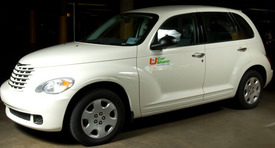 Car sharing services are starting to make their presences felt on college campuses and in cities throughout the U.S. The latest company to join the environmentally-friendly trend is U-Haul, best known for its truck and trailer rentals, which has launched U Car Share. It joins Zipcar, which already services more than 100 college campuses.
The latest school to sign up for U Car Share is the University of California at Berkeley, where four PT Cruisers and one van have been strategically placed around campus for students and faculty to use.
Of course, the cars aren’t free. Students or anyone else must sign up at the U Car Share Web site. They’ll then be issued a smart card which they can use to rent one of the vehicles by the hour or day. After reserving the car, you simply hold your card up to the reader located on the windshield. The doors will unlock and the keys are available inside the glove box. In addition, if the car is low on gasoline, U-Haul even provides a credit card to fill it up.
U Car Share vehicles can also be used in Portland, Maine; College Station, Tex.; Madison, Wisc.; and Portland, Ore.
Zipcar recently arrived at the University of Illinois at Champaign-Urbana, and while it, too, provides a contactless membership card that can open a reserved vehicle, it also allows members to reserve cars via mobile phone and locate cars via a GPS locator, according to its Web site.
Read more about Zipcar at the University of Illinois here.