Card, mobile credential, payment and security
As previously reported, the University of Georgia recently deployed new iris recognition scanners across its campus to facilitate entry to dining halls and the student rec center. The project has replaced the previous hand geometry scanners that UGA had used for years.
Now, in a new opinion piece in student publication, The Red & Black, the early signs are positive that the new iris biometric system will be a hit on campus. The piece acknowledges that there will be slight apprehensive with some students, but that the new scanners are a marked improvement over the previous hand scanners.
The piece goes on to cite specifically that the new iris scanners are not only faster than the previous hand scan, but are also more hygienic and easier to use than the previous system.
The author also makes note that the iris scanners, like with anything new, will require time and repetition for the students to grow acclimated to the new system. The system is set to be fully put to the test once students arrive back to campus int he coming weeks for the start of the fall semester.
Biometric entry is nothing new for the University of Georgia, where hand geometry scanners have long been used to increase efficiency on campus. Hand geometry was deployed as early as 2004 for dining hall access, and it wasn't until 2014, that the hand scanners were retired at residence hall entry points in favor of card and pin access.
As reported by the author, the reasoning behind phasing out hand geometry scanners was the need for greater speed and hygiene. It seems as though that same principle has been applied with the iris scanners.
HID Global has revealed that its Seos mobile access and advanced smart card platform has been deployed by Guadalajara, Mexico's Cervantes High School to help create a safer learning environment.
The implementation of HID solutions is expected to better protect the Cervantes school community from threats posed by unauthorized visitors, while turning the high school into a technology showcase where students, faculty and staff will now carry campus IDs on their mobile phones to securely access multiple entry points on campus. Students, teachers, administrative personnel and service employees are all being issued both the new Mobile ID and smart card credential.
Cervantes High School implemented the HID Mobile Access solution at school entrance turnstiles, complete with multiCLASS SE readers, to better protect what had previously been an open campus with uncontrolled access. The multiCLASS readers can verify both the Mobile ID housed on students' phones via Bluetooth Low Energy (BLE), in addition to the physical Seos smart cards.
The mobile access solution includes a web portal that facilitates device enrollment and Mobile ID provisioning. From this web portal, school administrators can quickly log batches of user and device information, and send tailored invitations and enrollment instructions to students via email.
The school has, to date, issued approximately 1,500 Mobile IDs, along with the same number of Seos cards to offer users the freedom of presenting either their phones or smart cards to access any campus entry point. Both options feature strong cryptographic security to minimize any possibilities of ID cloning or fraud.
Partnering with HID to install the new security features is system integrator, Amcorp Security Group México. “We wanted to offer Cervantes High School the latest technology and more choices to users by ensuring they had the freedom to use both Mobile IDs and traditional physical ID cards,” says Jorge Navarro, Commercial Director Amcorp Security Group Mexico.
“We are very pleased that innovative HID technology has made the Cervantes community feel safer and proud to be at the forefront of exciting new campus innovations,” says Harm Radstaak, Vice President and Managing Director of Physical Access Control Solutions with HID Global. “This is an outstanding example of how HID’s trusted identity solutions are creating convenient ways to help transform school campuses into model institutions where students can learn more freely.”
The HID Global deployment at Cervantes High School has proven to be highly effective and easy to use, prompting school officials to explore the expansion of HID Mobile Access and Seos smart cards to include secure access to classrooms in the future.
Mobile ID is being discussed in a number of settings, with corporate enterprises and government agencies of all shapes and sizes mulling the potential of the technology. But there's perhaps no vertical that's better suited for the jump to mobile ID than higher education.
With a cardholder base that lives on the very devices needed to make mobile ID a reality, adoption and use of mobile credential capabilities would be a natural progression for students. But this isn't exactly a revelation, as card offices across the country are already pondering the question, “Can I get that ID card on my mobile phone?”
But going whole hog with mobile ID isn't necessarily the answer near term. The debate over when to start issuing mobile credentials in place of plastic cards has raged on for nearly a decade, and this year we'll see more physical ID cards issued than any year prior.
So with the physical card remaining very much alive, many are now looking at strategies that see the capabilities of a mobile credential combined with the plastic card, rather than replace it outright, to enhance overall security and convenience for cardholders.
“The physical ID is not going away … its easy to deploy, its already in place, it’s the incumbent but at the same time, the whole world is going mobile,” says Dominic Tavassoli, VP Secure Issuance Solutions, HID Global. “There are many reasons behind the need for co-existence … citizens want choice as to whether they want a physical or mobile credential.”
In a new webinar with HID GLobal, SecureIDNews’ Gina Jordan talks with two leaders from the company about their experience working with hundreds of issuers who have been facing these questions.
Dominic Tavassoli is joined by Steve Warne from the HID’s Government ID Solutions unit to share insight into a third option that sees the card and mobile working together, rather than independent of one another. In addition to hailing it as the best option to meet the needs of government issuers around the globe, the combined approach could be the perfect way for universities to get their feet wet with mobile ID.
“Whenever you issue physical cards you should start thinking about issuing a mobile ID at the same time, because you are adding a lot of value and you are also helping prepare for that future change,” adds Tavassoli.
In the webinar, also learn about the HID Global’s goID solution that's helping issuers deliver mobile credentials in tandem with secure physical cards. Hear how one country is currently using the solution to improve security and better serve citizens, and gain insights on a future where ID cards can be complemented by a mobile credential.
Check out the webinar now.
An interconnected web of wireless access control locks weaves a thorough system of doorway security throughout Northwestern University. The common thread connecting these doorways is Wi-Fi locks from ASSA ABLOY Group brand Sargent.
Sargent IN120 locks form the base of the access control system along with Sargent 80 Series exit devices, 8200 Series mortise locks and a mix of access control components, hardware and a key system from HID Global, ASSA ABLOY Architectural Door Accessories and Group brand Medeco.
Installing an online access control system can be costly, requiring either labor-intensive hardwiring of doorways or a separate proprietary wireless network. But the IN120 Wi-Fi locks provided a cost savings for the university by leveraging the school’s existing IT infrastructure to deliver advanced access control to more locations.
Since the lock utilizes IEEE 802.11b/g/n Wi-Fi infrastructure, there is no need for a proprietary wireless network or equipment that is specific to a lock manufacturer. Doors can easily be connected to a centralized access control system without the need for costly wiring. This extends the range of access control systems to include doorways in remote or hard-to-wire locations.
“Wireless locks bring a significant reduction in infrastructure costs,” says Anthony Hicks, head locksmith for the Evanston and Chicago campuses. “With thousands of doors throughout the university, hardwiring would have been a huge cost. Plus we plan to install electronic access control on doorways that have traditionally been equipped with mechanical locks. The Sargent Wi-Fi locks give us security without the cost of hardwiring.”
From the perspective of residential services, the move to electromechanical locks and a campus-wide one card system created major improvements in efficiency.
“We used a security consulting firm to evaluate the building management systems we use and our network infrastructure and then determine which locking system provided the best fit,” says Roger Becks, director of administrative services for Northwestern University. “The most important factor was integration to a one card system. We didn’t want students to have separate cards for everything. We needed software that would provide a seamless experience. The ASSA ABLOY lock and its accompanying PERSONA Campus software made that a pretty easy decision for us.”
The locks feature multiclass SE technology from HID Global and seamlessly integrate with the university’s access control software. PERSONA Campus software enables the school to bridge multiple systems, including the RMS residential software and ID Works photo ID software. This allowed the school to use the same credentialing system for academic buildings and residence halls. Any time a student misplaces a credential, the card office can quickly and easily issue a new credential and remove the missing one from the system.
“That one ID makes it easy for everyone,” Becks says. “We have the ability to shut off access once we know a card is missing. Within 10 minutes, a new card can be activated and the old card is shut off from the system.”
“Our philosophy at Northwestern is to gain control of security,” explains Northwestern’s Hicks. “If you can’t control the credentials, then you have no true security.” This strict adherence to credential control is enhanced by the HID multiclass SE technology used for the campus card system and a Medeco high security key system for doors that require mechanical keys.
Sargent mechanical locks are also used throughout the campus, including in the newly constructed school of music and the newly opened Kellogg School of Management.
“We are a longstanding Sargent customer and believe in the quality and integrity of the ASSA ABLOY family of products,” Hicks says. “Thanks to our wireless access control system, we have a higher level of security on campus.”
The University of Nottingham is set to launch a biometric pilot using fingerprint technology to facilitate student registration and attendance at mandatory lectures and exams.
Beginning with the coming academic year, the university will install 40 fingerprint units and 15 USB enrollment readers from Swiss biometrics vendor, TBS. The fingerprint readers are developed by TBS and are fully integrated with Nedap’s AEOS platform -- the university’s current physical access control system. AEOS is a software-based security management platform that integrates and controls functionality for access control, intrusion detection, video surveillance and locker management.
“The high-end fingerprint identification technology developed by TBS is an excellent extension of our AEOS platform," says Jeroen Harmsen, Director of Product Management at Nedap Security Management. "The two systems can be seamlessly integrated, so our client - or its students - do not experience any inconvenience during or after the implementation process.”
Provided the pilot is deemed successful, a full-scale rollout will follow that will equip all 500 classrooms at the university's flagship UK campus with the fingerprint identification system.
The University of Nottingham expects that the new fingerprint system will provide 100% assurance that students have actually attended a lecture or participated in an exam. This is valuable information for the university, as it not only provides more thorough insight into student participation, but it will also help mitigate any fraud associated with false attendance and ID verification.
A recent access control study conducted by IFSEC Global has shed light on how trusted identities can serve as the backbone for smart buildings and today’s increasingly connected society. The study, sponsored by HID Global, hones in on the connected workplace, explores trends in smart buildings, and addresses the growing need for identity-aware building systems.
IFSEC's study focused on how the access control infrastructure combined with trusted identities can connect disparate systems for enhanced monitoring and a better user experience as people enter and move around buildings, as well as access various systems or leverage building services once inside. With advanced technology now commonplace for even basic, everyday tasks, the study's findings could be telling for a number of verticals.
“Most respondents want more integrated smart buildings and business applications that seamlessly work together. While many of them are realizing these benefits by using common management frameworks with centralized databases, this approach is generally quite expensive,” says Ashish Malpani, director of product marketing at HID Global. “The study reveals how trusted IDs offer a viable alternative for achieving a connected building at lower cost, better ROI and improved user experience--all by providing systems with knowledge of identities and their authorizations for access to elevators, parking garages, vending machines, printers and other systems.”
According to the report, 85% of respondents were aware that identities can be connected across multiple systems and devices, and more than 60% believe that having everything on one ID card or mobile device will provide operational efficiencies. More than half or respondents have already connected their building systems to access control applications, and stated that converging systems can be a factor in deciding to upgrade the access control infrastructure.
Top applications include integrated logical access, AV conferencing, elevators, secure print, locks for interior draws and racks and HVAC control. Other key findings include:
As we prepped for this year's National Association of Campus Card Users Conference, the vision was to construct an issue filled with articles highlighting the perpetual wave of technology. But in our pursuit of the latest industry advancements, an unintentional theme emerged: embracing change.
This issue is packed with new ways of thinking and operating. You’ll read about how contactless is making student lockers hip again. You’ll see a new means of card issuance via automated campus card kiosk We also detail a mobile-based verification tool that any campus – regardless of system vendor -- can leverage.
But the big fish in this issue is our look at the software-as-a-service (SaaS) hosting model that is taking campus card servers off premise. In interviewing for the story it quickly became clear that idea still split opinions – some applaud it as a godsend alleviating burdens from campus staff while others see it as a fetal position inducing worry.
This was a bit surprising to me. My experience with SaaS has been a highly positive one. At CR80News, we were able to move the server that powers our site from a closet in our offices to a series of secure, virtual servers dispersed around the globe in the public cloud. Instead of reliance on a single machine and one internal IT resource, we are now backed by the expertise and computing power of a global organization.
If you were to ask me if I wanted to move a software system to a SaaS environment, I’d ask, “When can we start?” But for others it will be a more calculated decision. In the near term, some campuses will change hosting models and many will not. Either decision is perfectly acceptable so long as the idea of change is embraced rather than feared.
Being agile enough to accept new ways of operation is crucial because change will come. With SaaS that change has already happened on a global level. Card systems are just another in the long line of applications considering off-premise hosting.
We each have our go-to’s, our defaults, our preferred practices. As creatures of habit, it’s only natural. But when those habits turn to routines, or worse yet ruts, it’s vital that we shock the system and start anew. It can be as simple as a small tweak in our day-to-day, or a wholesale change or hard reset.
In a sense, card offices work in a similar fashion. With all that the average card office has to juggle, it makes sense to lean on tried and true processes. But when something new comes along that can revamp the operation, it’s those that are willing to adapt and embrace change that will ultimately reap the benefits.
Embracing new ways of doing things is vital. Don’t jump blindly, but likewise don’t fear change.
The University of Georgia will be using iris biometrics to enable student access to its dining halls and rec center beginning with the coming fall semester.
The implementation of iris biometrics comes as part of an initiative that will replace the current hand geometry readers and card swipe access methods. As reported by The Red & Black, dining services officials believe the new iris biometrics system should be both faster and more sanitary than the current system.
“We’re just making it more efficient and easier to gain access to the dining commons,” said Brian Varin, executive director of dining services, in a Red And Black interview. “It’s really fast and very convenient. We’re really excited about it. We think it’s going to be a good enhancement.”
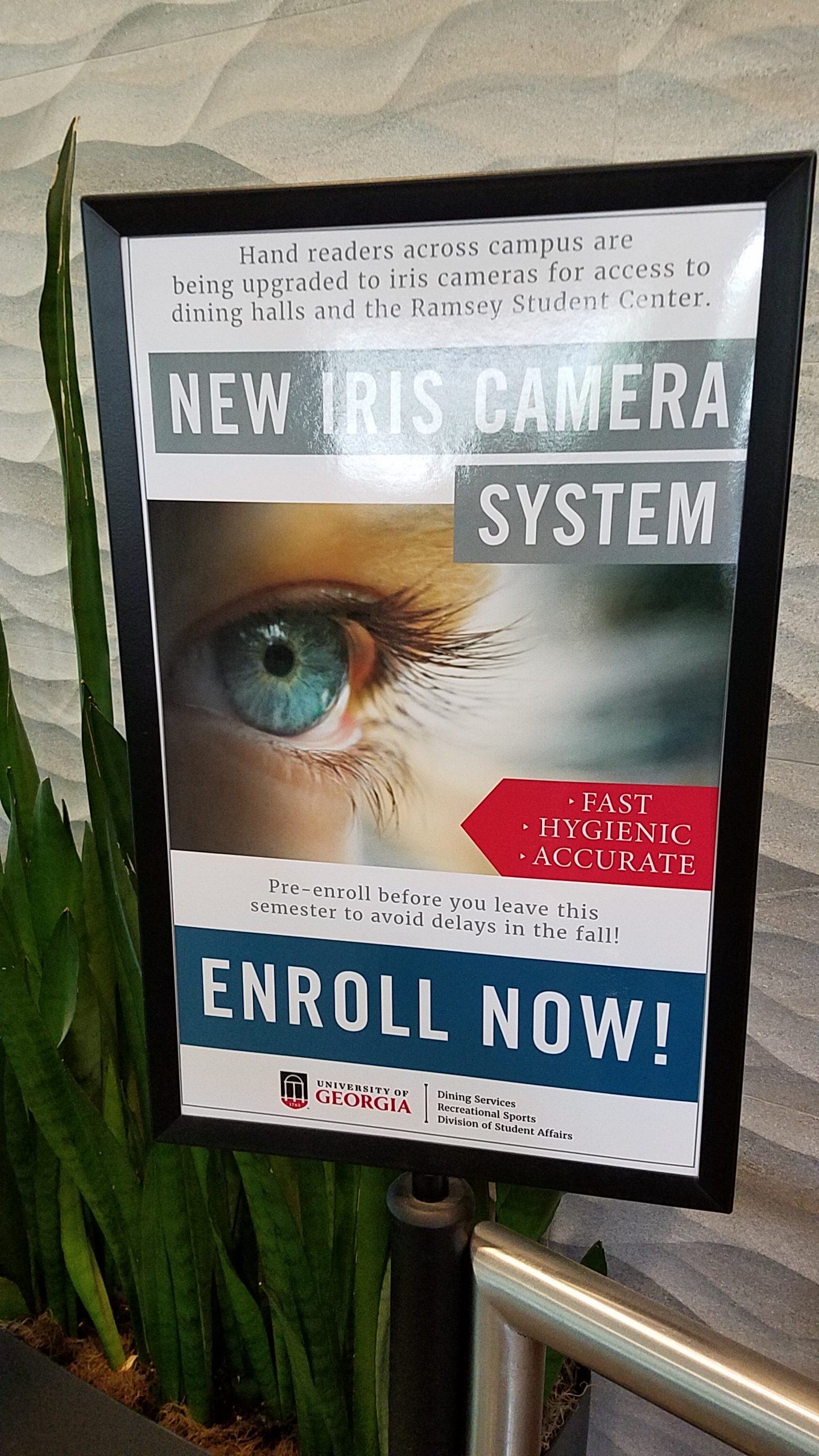
The University of Georgia is familiar with biometrics for access, having leveraged hand geometry biometrics at the dining hall since 2004. Iris biometrics, meanwhile, is no stranger to the state of Georgia, with Georgia Southern University having implemented the technology for dining hall ingress in 2014.
The new system at UGA will remove the need for students to enter their ID number, and unlike the previous hand geometry scanners, students on a commuter plan can for the first time leverage the biometric system.
Pre-enrollment began in mid April, with some 900 students registering in the first week alone. The iris program is also being incorporated into the orientation process, where it will be a part of student ID card issuance. University officials expect most of the student body to be enrolled in the system by 2021.
ColorID is the system vendor behind the iris project at UGA, and according to Mark Degan, the company's director of marketing, UGA opted for a database that will support up to 50,000 enrolled users. The program will also see 13 cameras deployed across all of the university's dining halls, as well as in the student rec center.
The first of the cameras will be installed in the university's card office prior to the first orientation, with the other cameras being installed in the rec center and campus dining halls throughout the course of the summer. University officials say the program’s 13 cameras and the software to operate them cost roughly $70,000.
"What's really great about this project is that we were able to implement biometric POS terminals at a new facility," says Mark Degan, director of corporate marketing, ColorID. "UGA wanted the latest technology and ease of use for its students, and iris was a natural fit."
It was also imperative for the university to supplant its long-used hand geometry system for a more advanced and reliable biometric. "With iris, the university is moving to something that's a lot more precise. Hand geometry is an older modality and the implementation at UGA had been in place for a long time," adds Degan. "With these types of installations, it sometimes seems like you have to ratchet down the reader threshold to effectively grab the unique points of a hand. Iris is more precise, quicker, and recognizes over 200 unique points for each scan."
Purdue University is the latest institution to join the parking app trend on campus, with the introduction of Passport to its West Lafayette campus. The university has launched the PassportParking app, making the services available at at all metered locations on Purdue's West Lafayette campus.
Students and visitors can take advantage of paying from their phones anywhere they see PassportParking signage. Via the app, students and campus visitors alike can pay for or extend their parking sessions directly from their phone, simplifying the process and reducing the need to visit a meter to pay or add time. Parking users just need to download the PassportParking app, create an account, select the desired parking duration, enter parking zone and space number from the decal on the meter and add payment information.
“Smartphone technology brings modern convenience in a variety of ways and parking is no exception. Passport was chosen to provide the app because of its proven track record in major cities and universities and its commitment to an ongoing partnership," says said Holly Buskirk, Parking Manager at Purdue University. "Students will love the ability to simply pay for parking from their phones and even extend their parking session.”
Purdue joins a growing number of universities leveraging the solution, including the University of Michigan, Michigan State, Nebraska, Oregon State University and the University of Florida.
“We’re excited to bring mobile payments to Purdue University and feel confident students and visitors will embrace the technology and find it a lot easier to use than visiting the meter to pay,” says Drew Myers, says Purdue alumnus and Director of Operations at Passport.
The president of Nigeria's University of Ibadan Student Union is standing firm on a promise that there will be no student exams taken until university authorities have issued student ID cards to the campus community.
According to reports in the region, university officials have failed to issue the ID cards to students for three consecutive semesters, despite already receiving payment for the job.
As university administrators see it, failing to issue the cards to students leaves the campus susceptible to the myriad of standard identification and vetting dangers, but perhaps more serious is that the cards were to be used for financial aid and scholarship disbursement.
According to university officials, there are students who are supposed to receive scholarships via the campus card, but with no card issued, accessing these funds has been problematic.
Another student experienced issues receiving a stipend for a university trip from Nigeria to Boston. The student was to represent the university on an institution-funded trip and be covered by an $8,000 stipend for travel expenses. The money was disbursed by event host Hult International Business School, but the student was reportedly unable to access it without an ID card.
The university has been closed since late May following a peaceful protest by students regarding the unissued ID cards and better student welfare.