Card, mobile credential, payment and security
One of the newer trends to emerge in campus dining has been the use of reusable takeout containers in dining halls. Reusable container programs are designed to eliminate unnecessary waste tied to student use of plastic, paper or styrofoam to-go boxes.
The latest to join the trend could be Vanderbilt University where, according to a report from the Vanderbilt Hustler, the current disposable containers in dining halls are contributing to a noticeable waste problem. In an effort to boost the campus' sustainability efforts in the dining facilities, some Vanderbilt students are calling for the OZZI system and reusable containers.
The university currently only offers standard, disposable containers, and according to estimates posted by the Hustler, some 1,813,500 disposable containers and plasticware were used last year at just two of the campus' dining locations, while a third dining facility used 609,675 disposable takeaway items.
The OZZI kiosk houses the returned reusable containers, and universities can choose to leverage student ID cards to checkout and return the to-go containers. Students can return their OZZI containers at their convenience by simply feeding the to-go boxes into the OZZI kiosk. Dining staff are then left to wash, sterilize and restock the containers for the dining hall cashier to checkout to students at the till.
To start with the program, each student can be issued on OZZI credit or “token.” With that credit, students receive a to-go container, and upon returning it, are given the credit back in exchange. The process then repeats itself for every subsequent to-go container used.
According to the report, the Vanderbilt Green Fund has, do date, stumped up $150,000 to implement a wide variety of student sustainability ideas. These funds, in turn, could be used to strategically deploy two OZZI machines at campus dining halls at an estimated cost of $34,370.
The report goes on to project the break-even dates for the deployed OZZI machines to be 13 months for one location and just four months for the second dining location. Ongoing cost for maintenance and staffing requirements for the initiative is projected to reach $19,500 annually.
As the report goes on to state, however, implementing OZZI could save the university as much as $170,500 annually across both participating dining locations. Were the university to move exclusively to reusable containers, it could eliminate some 2,423,175 disposable containers and plasticware annually. A proposal has reportedly been made to the Vanderbilt Green Fund to deploy OZZI as early as next year.
The National Association of College Auxiliary Services (NACAS) has named mobile ordering and commerce application, Tapingo, as the winner of its Outstanding Business Partner of the Year Award.
Each year, the NACAS Business Partner Advisory Group -- comprised of board members, auxiliary representatives and industry leaders -- evaluates business partners within the higher education community. The winning partner embodies the ideals of "outstanding customer service, supports the educational process at NACAS institutions, and is the one that contributes most significantly to the success of NACAS through creative and generous means."
“Tapingo has become an important part of the NACAS community,” says Kelsey Finn, NACAS Chief Executive Officer. “As we work to enhance our campus programs, Tapingo’s app and service give us a powerful tool to engage students. It’s been great to see them grow as a company and partner with so many of our colleges and universities. I’m excited to see where they go from here.”
“Tapingo’s ongoing innovation helps us meet our growing needs as administrators," adds Gheretta Harris, Associate Vice President at Ferris State University and NACAS Board Member. "Their app has allowed us to expand our toolbox of services and working with their staff has been effortless.”
Tapingo has partnered with more than 200 higher education institutions to provide a more convenient dining experience for students and staff. Processing nearly one-hundred thousand express pickup and delivery orders a day, Tapingo provides a single app to support the full range of on-campus dining. Working across all food service groups and card systems, the app offers real-time order information, menu management, trend data, and dynamic print throttling for efficient operations.
“When we launch new services, we want to make sure they enhance the student experience while supporting our key strategic initiatives,” says Jason Rex Tolliver, Vice Chancellor at the University of Illinois at Chicago. “After five years and multiple campus implementations, I’ve seen how Tapingo gives students a better dining experience and increases the profitability of our business units – it’s no wonder they’re being recognized as an industry leader.”
The Outstanding Business Partner of the Year Award was presented on Sunday, November 5, at The Broadmoor Resort & Spa in Colorado Springs, Colorado. Accepting the award on behalf of Tapingo was Ben Anderson, the company's director of campus engagement.
“We are incredibly honored to receive this award and thankful to all the institutions that have partnered with us along the way,” says Ben Anderson, Director of Campus Engagement. “Working with this group of professionals has been a pleasure. We look forward to bringing even more innovation to auxiliary service departments and the campus communities they serve.”
Lost, stolen and damaged student ID cards are commonplace at every institution, and that'll be the reality for as long as we issue plastic credentials. But card replacement has seemingly been in overdrive at the University at Albany, SUNY where the university's card office has replaced some 4,500 campus cards since January of this year.
That's according to the Albany Student Press and a University Auxiliary Services report, which also reveals that over 11,000 total cards have been printed since January, with 44% being replacements. The number of card replacements peaked near the start of the spring and fall semester, with 753 replacements logged in January and 980 in August. Auxiliary Services officials expected these figures.
“The reasons that people report for having lost their card and the reasons that people report as to how their card has been damaged are — there’s a million of them,” said Michelle Schifley, senior director of Administration for Albany Auxiliary Services, in an Albany Student Press interview.
Normal wear and tear remains one of the most common reasons for a card replacements, but the odd ice-scraper incident still occurs. Schifley even recalls a more recent incident where an ID showed signs of being set on fire -- needless to say, a replacement was necessary.
One way that Albany has tried to navigate card replacement -- particularly for times when the card office is closed -- is with its "Dane It!" program, which issues temporary ID cards to students or staff that have misplaced or damaged their credential. Since the start of "Dane It!" temporary card program (Albany's mascot is the great dane), the number of replacements has decreased.
The early iterations of the temporary ID card program didn't connect the temporary card to the student account. Instead the temp cards only contained one, pre-programmed meal swipe. That early version of the system was deemed to be broken, however, as abuse of the system was difficult to track. The pre-programmed meals on the cards were not accounted for, students were unable to view transaction histories, usage was difficult to identify during investigations, and students didn't have access to their other funds via the temporary cards.
After working with its card system vendor to modify its WebManager software, Albany Auxiliary Services created a more functional system. The program now allows Residential Life staff and University Police to issue temporary cards that are linked directly to a student’s account.
The temporary card program serves as a "back-up lifeline" during non-business hours. Students can receive the temporary Dane It! cards directly from University Police or a residence office when the ID Card Office is closed. The temporary cards provide access to residence halls and student meal plans.
When the card office reopens, students are required to return the temporary card to card office staff and follow the normal process to replace their previously issued UAlbany ID Card. As of February 2016, the program was issuing some 225 temporary cards per month. Temporary IDs are active for three days, and the replacement cost for an official UAlbany ID Card is $20.
Food insecurity amongst college students has increased in recent years, giving rise to on-campus food pantries and other food donation programs. One of the food insecurity initiatives gaining significant momentum on campus is Swipe Out Hunger, a program that sees student donate unused dining hall swipes to fellow students in need of a meal.
The program has added a number of campuses over the past year, and according to a City Pages report, the University of Minnesota is the latest institution to join the growing roster of campuses.
Swipe Out Hunger was introduced in the form of a pilot program on Minnesota's campus this week, and will aim to redistribute some of the routinely unused swipes from student meal plans. As part of the program, a three-week donation drive will be held at campus dining halls each semester where students can donate any or all 10 of their allotted guest passes -- valued at $9 per meal -- to other students in need.
Students needing to leverage the program can apply for meal swipes at the university's Boynton Health Services. Health services will then distribute meal swipes on a case-by-case basis in increments of five.
Should the pilot program prove successful, university officials expect to extend the initiative, with future plans to allow students to donate standard unused meal swipes in addition to guest passes. Signs are positive thus far, as Minnesota students donated more than 300 meal swipes, at a total value of roughly $2,700, on the first day of the donation drive alone.
With the addition of Minnesota, Swipe Out Hunger now has 28 participating college campuses across the country. The University of Minnesota’s implementation is the first with food-service vendor, Aramark.
Nebraska-based startup, Ink, is taking a new approach to on-campus printing that leverages kiosks and a cloud-based interface that's introducing new levels of flexibility to student printing.
According to a TechCrunch report, the company recently raised $7 million from VTF Capital, SQN Venture Partners, Invest Nebraska and NE Angeles, bringing total funding for the company to $15 million.
Ink is rethinking the traditional print station that typically sees students log into a terminal or desktop computer to pay and select a print job. These legacy setups work, but rarely make printing from a personal laptop a straightforward prospect. In these instances, students routinely email the document to themselves, use a flash drive or upload it to the printer’s website.
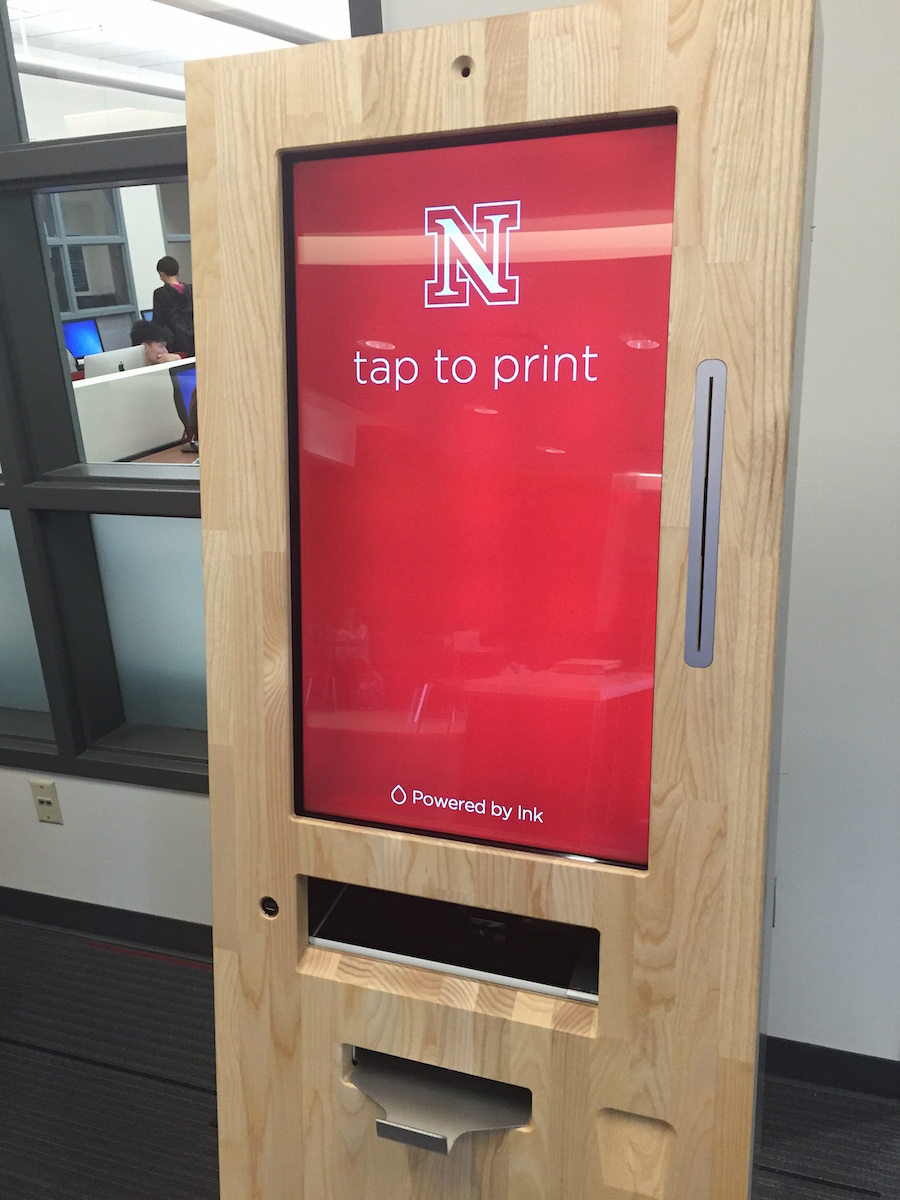
SmartStation kiosk at the University of Nebraska-Lincoln.
Ink's answer starts with the SmartStation -- a kiosk that features a large touch screen -- that connects exclusively to printer hardware from partner company, HP. To print, students first tap or swipe their campus card to authenticate their account. Then, the student can access their Dropbox, Google Drive, or a similar cloud service to select the document they want to print.
In addition to basic printing, the SmartStation supports document scanning and can display documents directly on the touch screen where students can digitally sign with a finger. Students can also email documents directly to a recipient, as well as edit and print photos. Students can also wirelessly use Apple AirPrint if they’re running a new version of iOS or MacOS.
One of the early campuses to leverage Ink's offering is the University of Nebraska-Lincoln, where the startup helped to replace print labs and network-based print ecosystem of Pharos Uniprint and Xerox printers. The system at Nebraska deployed a SmartStation kiosk where students can print, scan, copy, fax, digitally sign documents, send mail and print photos. Students can send print jobs to the SmartStation units from anywhere on campus, enabling them to time their printing with their commute to or between classes.
Five additional kiosks have been deployed across Nebraska's City Campus, primarily in residence halls, since the system went live in 2015. Two of the new kiosks have been moved outside of their respective computer lab spaces to provide 24/7 accessibility.
The Ink system features two pricing models. Campuses can either deploy machines for free and charge students a $.09 per-page fee, or a leasing option is available that enables the institution to handle student payment policies. In addition to Nebraska-Lincoln, Ink printing solutions are expected to be on 30 college campuses by year's end 2017, including Stanford, UCLA, SUNY and the University of Memphis.
Why do colleges and universities need a campus Identity Roadmap? Because every campus needs a clear plan when it comes to its identity environment, and how it delivers the many services therein. Simply put, the most successful and dynamic institutions don’t just focus on the day-to-day; they also plan for the future.
Planning for the future of your campus identity environment is vital to staying in line with industry trends, and avoiding the pitfalls of leaning on outdated hardware or technology. Having a vision for your campus’ identity future isn’t a straightforward proposition, though, so being able to leverage the experience of industry professionals can be invaluable to plotting a program’s future.
That’s where ColorID and its Identity Roadmap come in.
Adopting emerging technology is a reflection on an institution’s brand; forward-thinking campuses will attract like-minded students.
“The ability to unify existing campus services and successfully fold in emerging, advanced campus identity technologies like mobile, biometrics, contactless credentials and cloud solutions will be key to enhancing the student experience and their engagement on campus,” says Danny Smith, co-owner and executive vice president, ColorID. “Incorporating these new identity solutions is also being seen as a differentiator by institutions that recognize the technical expectations of the ‘Gen Z’ student. Adopting emerging technology is a reflection on an institution’s brand; forward-thinking campuses will attract like-minded students.”
Universities are complex ecosystems comprised of both independent and unified systems that provide everyday campus services. “These systems use many types of identifiers, along with a variety of backend systems that manage them, so it’s important that these technologies and business practices align to provide the most efficient delivery of services,” Smith says.
ColorID has spent the better part of two decades on the road speaking with hundreds of campuses about their issuance environments and identity needs. The company routinely sends certified personnel across the country as part of its customer support programs, and it hosts Campus Identity Summits where dozens of institutions come to catch up on industry trends.
Along their travels, ColorID has unearthed a common need for strategic documents and future planning for card programs and the many areas on campus that the ID influences – they call it the Campus Identity Roadmap.
“Ultimately, the Identity Roadmap is a physical document, but its creation process provides institutions with the ability to establish standards, policies and procedures,” says Smith. “It’s an effective approach to identifying ‘blockers’ – be it personnel, outdated technology, hardware, or political restrictions – as well as assist in breaking down departmental siloes, and shed some light on emerging technologies.”
A new dining initiative at Northwestern University is giving students a flexible option for times when fitting a sit-down meal into the daily schedule isn't possible. The new program will see reusable to-go containers made available to students visiting campus dining halls.
According to an official university release, the new takeout container option is designed to enable eating on the go without generating unnecessary waste. Students who opt to join the new "Choose to Reuse" program can receive the new takeout containers from the university's Elder Hall, and in the process skip the sit-down dining experience. And because the carry-out containers are exchanged, cleaned and reused, it’s an simple and sustainable way to provide students with meals on the go.
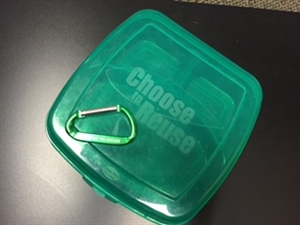
Students can add the Choose to Reuse option to their meal plans at a one-time cost of $5 per year by signing up at the dining hall cashier station or by visiting Northwestern Dining’s e-commerce website. Cash, credit, debit, Northwestern's Cat Cash, and dining dollars are all accepted forms of payment for the program.
After signing up, participants receive a Choose to Reuse card. They can then take this card to the dining hall, swipe for their meals using their Wild Cards, Northwestern's student ID card, and inform the cashier that they want to use a takeout container. The cashier will then take the Choose to Reuse card in exchange for a clean container. The student is then free to fill the container as they see fit and take their meal to go.
As with other reusable takeout container programs, Northwestern students can swap the used container for a clean one upon their next visit to the dining hall if they want to take another meal on the go. Students can also opt to return their containers and get their cards back for use at a later time.
The Choose to Reuse program is only available at Elder Hall. The university says that the program is intended to offer flexibility for students with tight schedules, and with Elder Hall’s newer menu options and extended hours, that location was deemed the best fit to launch the program. Northwestern Dining is planning to expand the Choose to Reuse program to additional campus dining facilities across its main and south campuses by 2018.
Students at San Francisco State University can now use their OneCards for discounted transit services, following an integration with San Francisco Municipal Transportation Agency. The integration effectively makes existing student ID cards into valid Clipper Cards, the Bay Areas's transit credential.
Underpinning the initiative is a new card printing process that reads the information on the Clipper Card and assigns it to a student ID number in the university's database. In one pass through the card printer, a student’s information, picture, and university logo and design are all printed onto the new SFSU OneCard, making it ready to use as both a student ID and transit pass.
The result is the SFSU Gator Pass. Acting as a Clipper Card -- the all-in-one transit card for the Bay Area -- the Gator Pass project began with the fall 2017 semester, and includes unlimited rides on SF Muni rail and buses, excluding cable cars. Student transit discounts and pass activation are sent to Clipper when students pay their Gator Pass fee. As part of tuition and fees, all students pay $180 per semester for the transit service.
“It’s the ability to integrate the transit card solution with the current SFSU OneCard system that makes this a superior card printing solution," says John Gates, director of fiscal operations at SFSU. "The integration allows for data sharing with many systems allowing the latest ID card information to be current as a new card is issued."
The transit discounts will be activated on the first day of fall or spring semester in which an individual is enrolled as a student. The service will be active on all weekdays, weekends and holidays throughout the academic year, excluding only the summer term and the January intercession term.
OneCard/Gator Pass discounts will be active on the first day of semester for all students who have paid tuition and fees and have signed the user agreement. Transit discounts will be valid until the last day of the semester and is only valid for enrolled students in any given semester.
When it came to implementing the new card-printing solution, experience and proximity to SFSU's campus were primary factors in the university's decision to select Capture Technologies for the integration. Serving as the systems integrator on the project, the Oakland-based company has previously provided similar solutions to Santa Clara Valley Transportation Authority, Mission College, Evergreen College and San Jose City College.
“Capture Technologies provided highly competent consultation and timely support which helped us to recard 30,000 students and launch our new transportation discount program in collaboration with MTA, BART and Clipper/Cubic," adds Gates.
In addition to the new transit pass capabilities, SFSU's Gator Pass OneCard functions as the student ID card and is used for photo identification, meal plan access, declining balance usage, physical access, and library and print/copy services.
It was only in 2014 that CR80News first covered campus mobile ordering – a then fledgling, student-facing dining solution. At the time, mobile ordering was little more than an explorative service that only a handful of early-adopter campuses had launched.
Over the span of a few short years, though, mobile ordering has become a standard offering on campuses large and small across the country. And spearheading the trend is Tapingo.
Looking back at CR80News’ first coverage of Tapingo, much of the story was speculative, discussing services that were yet to be fully developed. We were dealing in potentialities. But things have since come full circle for both Tapingo and mobile ordering as a service.
[pullquote]The average resident student uses Tapingo three times a week, with many using the app daily.[/pullquote]
After establishing its first inroads on college campuses in 2014, Tapingo has since grown its network to include millions of student users and nearly 200 active campuses across the country – fifty of which now comprise Tapingo’s delivery markets that the company runs itself. That is a significant, market leading number, and it includes some of the largest institutions in the country.
Tapingo’s success – and its ability to add upwards of fifty campuses year on year – can be boiled down to the popularity of the service being provided. Mobile ordering has become a natural and expected service by the modern student, and use of the service has exploded.
“Tapingo has become an active marketplace. The average resident student uses Tapingo three times a week, with many using the app daily,” says Ben Anderson, director of corporate marketing at Tapingo. “It’s become an effective way for universities to consistently engage with their students.”
Anderson estimates that Ohio State University processes some 100 deliveries a day from their on-campus pizza location alone. “When a campus starts to understand the power of the mobile platform and what it can do from a technological perspective, they start to think of ways it can help them solve their real-world problems,” he says.
With usage rates reaching such significant levels, it’s little wonder that campuses across the country have folded mobile ordering into their dining services operations. It’s popular and it also delivers benefits to the food service operator. Managing peak times, improving throughput and refining the customer buying experience are core to the app.
“If you know that there’s a wait time, instead of standing in line wouldn’t you rather sit comfortably at a table studying, and then receive a notification when it’s ready?” Anderson asks. “Mobile ordering has proven many times to be the only way students can grab a last-minute latte while walking onto campus, or between classes. That’s a narrative that we’re hearing all across the country.”
El Camino College's has installed a new copy and print system from Pharos at its Schauerman Library as part of a planned modernization that promised to overhaul student printing.
As reported by The Union, the new system has incorporated automated touch screens that see students swipe their campus cards with a at the machine to access their account and release print jobs. Alternatively, students with $5 or more in their account can release print jobs via an online portal available at the library homepage rather than swipe their ID at the kiosk.
The new Library print webpage provides a step-by-step instructional page on how to navigate the new system, including how to use the add value machines and manage print jobs. In addition to overhauling the in-library print experience, students can also leverage the system to call up a print job from anywhere on campus. The price to print remains unchanged, the path to print has hindered some students.
As with any new deployment, there have been minor growing pains with the new system but library officials expect that working closely with Pharos will help to resolve and troubleshoot any kinks over the coming weeks.
Leveraging the student ID for copy/print is also expected to provide greater protection for student accounts, as the unique card numbers are now attached to print jobs. The cards' magnetic stripe, meanwhile, will be used to release jobs and add value to copy/print accounts via new hardware provided by Ricoh.
The library overhaul consists of five copy machines and six printers. Following the overhaul, El Camino College has no future update plans, as it continues to polish and troubleshoot early kinks with the aim to have the system completely functional by the end of the semester.