Related article: Campus Identity Roadmap Part I
Charting a course for identity decision making.

As part of a pilot program beginning this semester, 300 Ohio University students will be outfitted with reusable takeout containers for use at campus dining halls in place of existing disposable, to-go boxes.
According to an official university release, students participating in the pilot will have the option to use the new green containers at three of Ohio's dining facilities. The reusable containers are intended to reduce the number of disposable boxes sent to the landfill each year.
The Preserve 2 Go reusable containers are made by namesake company, Preserve, with each box measuring 9 x 9 x 3 inches. The boxes are dishwasher and microwave safe and feature three divided compartments.
Beginning this semester, students with Traditional or Flex Meal Plans may choose to participate in the pilot. The results of the pilot will help determine if the reusable to-go box program is worthy of full implementation at Ohio’s dining halls in the future.
Each participant will receive a Preserve 2 Go reusable container, will use the container over the course of the spring semester, and provide feedback via two surveys.
Students choosing the new to-go option will swipe into the dining court of their choice and inform the cashier they are choosing the takeout container option. They will then enter the dining court and fill the reusable box and exit the dining court. The student may return the unwashed box, free of large food debris, to any residential dining court. At this point they may either swap it for a clean box, or receive a voucher card to be turned in the next time they want a reusable conatiner.
The idea for the program was proposed by the winners of Ohio University's 2017 Eco Challenge Competition, and was presented to the university's Culinary Services Development Committee and Student Senate as a way to reduce waste and save money.
Reusable takeout containers have become an increasingly popular green initiative in campus dining. In 2013, Preserve partnered with the Rhode-Island based OZZI, to use the company's kiosk hardware to complete the reusable to-go system.
OZZI's system for collecting reusable containers adds an element of accountability to campus-wide programs by enabling students to deposit their containers in OZZI machines in exchange for a credit on their student ID card. That credit can then be put toward a new takeout container the next time they reach the dining hall register. Containers are then manually removed from the OZZI machine and are properly sanitized by dining hall staff for the next use.
There is no word yet on whether Ohio has deployed OZZI kiosks as part of its pilot program, but the Preserve 2 Go containers have been designed for complete compatibility with the OZZI collection system.
The University of Cincinnati recently outfitted its Scioto Hall, a dorm for on-campus students, with wireless electronic locks at individual dorm room doors, and all signs point to the good.
According to a Commercial Integrator report, the recently renovated Scioto Hall is the first facility in a wireless-lock upgrade program that will span nine campus residence halls and another 30 campus buildings. Scioto Hall is a twelve-story, apartment-style residence that houses 456 students.
Tem House, software applications developer for Cincinnati's Campus Services Operations, served as the administrator on the lock system upgrade. House says the university wanted to upgrade to a wireless lock system to simplify the process of providing access for students and staff, and to bring higher levels of security and accountability.
“The facility’s exterior doors have been part of our Blackboard Access system for about 12 years, but the individual suite doors remained mechanical lock and key,” House told Commercial Integrator. “Whenever somebody lost a key, the lock had to be re-cored and new keys reissued.”
As with other, similar deployments, Cincinnati stands to save considerably by not having to reissue lost metal keys and fix or replace broken mechanical locks. These long-term savings are expected to offset the up-front installation cost of the new locks.
The new ASSA ABLOY locks operate via Wi-Fi, and remove the costly and time-consuming process of running wires throughout the building to connect the new locks. According to House, in addition to the time and cost savings, the new system will also help to monitor and manage access through audit trails and increased accountability.
The project saw 148 battery-operated Sargent IN120 Wi-Fi locks installed at Scioto Hall. The IN120 Wi-Fi locks integrated with the university's existing IT infrastructure and leverage multiCLASS SE technology from HID Global.
The system also supports multiple credential technologies, offering easy migration to higher security credentials, mobile access, or a combination of mixed credentials over time, as needed.
“The system flexibility was important. We support our Bearcat Card, which is a Blackboard card system, as a one-card system," added House. "The one card encompasses all of a student’s needs; they have their money, their meal plan and now access to the residence halls. It’s well accepted, and our students love it.”
The performance of the new locks has been impressive thus far. “We’ve run the wireless battery-operated locks for just over a year now and out of the 148 locks, only two are down to 70% battery life; the rest are higher. This is excellent performance,” said House. “We have the locks configured for optimized battery life, and they’re giving us the performance that we need.”
Following the early success at Scioto Hall, a second residence hall upgrade is now on the docket -- a project that will include 177 wireless locks -- and a third facility requiring an additional 338 locks is scheduled to begin in the near future.
Students at Western Michigan University already get free access to all campus sporting events with a valid student ID card, but the university's rewards program provides additional incentive for loyal student fans.
As reported by the Western Herald the WMU Student Fan Rewards Program, now in its third year, awards students that attend a WMU sporting event, with points that can be redeemed for prizes. The program also features a free mobile app, called Bronco Fan Rewards to which current students can link their Western Identification Number (WIN) and their university e-mail account to conveniently gain access to the service.
The check-in system at sporting events leverages geofencing technology to issue students with loyalty points. When students arrive at the specified area of the arena or football stadium, they connect to either a beacon or are identified based on their presence within the geofenced area to complete their check in. The beacons have a range of roughly 300 feet, which university officials say prevents people from gaming the system from afar and not actually attending the events.
The WMU loyalty program is powered by a service called FanMaker. The service has gained traction at a number of Big Ten schools, including Indiana University, the University of Maryland and the University of Wisconsin, along with fellow Mid-American Conference member, Eastern Michigan University. The company also provides rewards and attendance services for professional sports franchises including the NHL's Minnesota Wild and Nashville Predators, and the NBA's Phoenix Suns.
At Western Michigan, the points that students accrue for attending games varies on the type of event they check in for. “The less popular sports get more points, so there’s a larger incentive for students to come out,” said Kayla Lalik, a graduate assistant who helps run the program, in a Western Herald interview. “For football, we usually do 300 points for each game, but for women’s basketball, we do upwards of 600.”
Reward-point values also vary depending on the time of week the event takes place. Mid-week games award higher point totals as they're generally less attended than weekend events. There are also other event-specific incentives -- for example if coaches have scouts attending -- that will lead to more points being available to try to draw a larger crowd.
When it comes time for a student to cash in the reward points they have accrued, students can choose from an array of prizes including university-branded cups, t-shirts and souvenirs; gift cards from local sponsors like Applebees and Ticketmaster; and free haircuts from SportClips.
Reward points reset with the start of each new academic year. The WMU Student Fan Rewards Program currently boasts an active user base of just under 7,000 students, with plans to expand.
Campus card technology provider, CBORD, has today announced a partnership with mobile ordering company, Tapingo. The partnership enables all CBORD account holders to seamlessly implement Tapingo’s pickup and delivery services.
Tapingo’s high engagement within the college demographic was a major factor in driving the partnership. “CBORD is committed to providing world-class services, as well as choices, to our customers and their end users,” says Jim Hoefflin, CEO of CBORD.
Tapingo has seen significant market growth over the past couple years, extending its client network to many of the nation's largest campuses.
“Tapingo is a well-known app among college students, and demand for their product was high within our network," adds Hoefflin. "We’re pleased to be able to bring Tapingo’s technology to our customer base as a powerful complement to GET Food, leveraging our highly secure ‘Pay with GET’ transaction engine to provide a consistent, high-quality and broad choice in the student dining experience.”
The partnership will also create the ability for deep integration between the two companies’ technology solutions, benefitting university clients and end users alike. “CBORD is one of the great companies in the campus technology sector,” says Daniel Almog, cofounder and CEO of Tapingo. “We’re excited about pairing our product with their systems in order to provide a great service for college students across the country.”
CBORD and Tapingo plan a rollout of the integrated mobile ordering solution in the first quarter of 2018 following a successful pilot with the University of South Carolina and Minnesota State University Moorhead.
“This partnership will produce immediate benefits for the higher-ed community,” says Jeff Hardy, Chief Revenue Officer at Tapingo. “Integrating Tapingo into the GET offering will create a more seamless experience for campus card professionals and ensure all students have access to the most robust offering of mobile services.”
A couple of former Auburn University students have developed a new mobile app designed to alleviate parking headaches at their alma mater.
As reported by local NBC affiliate WSFA, the War Eagle Parking app is now available for download. The app monitors parking lots spaces in real time, updating occupancy statuses and saving commuters time when looking for a space.
Mobile apps have become a popular solution to the age-old challenge of campus parking. With third-party offerings being the common route, there's always room for homegrown options as well.
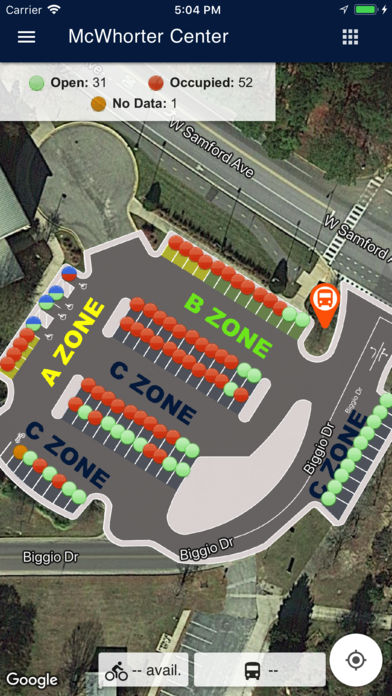
War Eagle Parking app.
To help differentiate itself, the War Eagle Parking app is branding itself as trip planning tool. "We want you to enter your destination, and we will show you the available options near that destination. We'll give you driving directions to the parking lot that has available parking in it," says Parker Roan, one of the app's developers. "That might not mean parking in the closest lot that’s full, but parking in the next closest one that is 70% occupied. But we’ll give you a way to get there, so it overall saves time.”
Using cameras installed at campus parking lots, the app uses digital video parsing technology to process live video streams that accurately monitor open and filled parking spaces. Users can then access this information via the War Eagle Parking app to reveal the location of available spaces, the length of time cars have been parked and other useful information that both the customer and parking manager can leverage.
Auburn Parking Services officials say the app could also help students save time by utilizing other transit services offered by the university. "It will hopefully get students to use those lots that right now are being underutilized, but are still serviced by our Tiger Transit and bike-share programs,” says Don Andrae, Auburn University Parking Services Manager .
The app currently monitors 2,000 parking spaces across campus, but the developers hope to add another 2,000 spaces year-on-year until all 12,000 campus spaces are available on the app. War Eagle Parking is free to download in both the Apple and Google Play stores.
ColorID has announced the return of David Stallsmith to the company's ranks. Stallsmith's homecoming will see him take on the role of Director of Strategic Initiatives.
Working on the isthmus between Product Management and Marketing, Stallsmith's focus with ColorID will be educating market segments on identity technology, helping customers select and install sophisticated identity systems, and developing marketing strategies for new ColorID product offerings.
"I really am excited to be working with my friends at ColorID again, particularly in this new role that will allow me to do what I love: help guide customers through the muddy waters of identity solutions," says Stallsmith.
"We are ecstatic to welcome David back home to our ColorID team," says Danny Smith, Executive Vice President, ColorID. "Everyone that has worked with David understands and appreciates his professionalism and the integrity he brings to his work each day."
Stallsmith will add a wealth of knowledge and experience to the ColorID team, and his return represents a natural fit for both parties. "David has a special gift of being able to explain and break down complex technical identity solutions into layman's terms," Smith adds. "Whether in a one-on-one conversation or presenting to large groups, David provides his audience with trusted concepts they require in developing their identity roadmap for new technology migration, adoption and deployment. This approach is in harmony with ColorID's corporate culture and how we strive to support our partner customers."
Over the last two decades ColorID has established itself as a trusted supplier of security, identification, access control, biometrics and support solutions. Though primarily focused on specific North American markets, ColorID also provides these solutions to organizations around the world. Through highly knowledgeable and customer-focused sales and product management teams, the company helps customers select the best products and services from well-known and innovative manufacturers.
We at CR80News are happy to see Stallsmith imparting his experience and wisdom to campuses of all shapes and sizes, and wish him the best as he takes on this new role.
Singapore's Nanyang Technological University is now issuing smart cards to students that will be used to make payments and enable access to campus facilities.
According to a Today report, the new smart cards will be used pay for meals at campus dining locations, reserve campus facilities like sports venues and study rooms, pay for campus parking, as well as act as a public transit card.
Dubbed the NTU Smart Pass, the new student ID cards will act as the identity credential for the university's some 33,000 students and staff members. The cards feature an embedded contactless chip, and have Nets FlashPay functionality to support the university's partnership with payment solutions provider, Nets.
The smart card initiative comes as part of a larger initiative to transform NTU into the “largest smart campus in Singapore.” The smart card was officially launched this week, and is ready for use at 80% of the university’s canteens, with further on-boarding scheduled over the next few months. The majority of campus retail and dining locations are already equipped with the Nets contactless payment system, so the university expects the transition to contactless payments to be a smooth one.
The smart cards are also expected to ramp up safety and security on campus, as they will serve as personalized keys for student access to residence halls, offices, laboratories and facilities. That aspect of the transition is expected to take longer to deliver, as additional time will be needed for older campus facilities to be properly outfitted to accommodate the new smart card credentials.
The campus medical center will also benefit from the new smart cards, as future plans will see students use the card to register for health checks and consultations. At residence halls, meanwhile, the university plans to install smart vending machines complete with contactless and cash-free payment systems.
Solidifying your Campus Identity Roadmap is an important first step toward deploying the modern technology that students have come to expect from their universities. Planning for the future today is vital but knowing where to begin, and more importantly what to include in the Roadmap, can be difficult.
An Identity Roadmap helps both the institution’s and vendor partners’ boots on the ground to better and more efficiently get to the root of a problem. If a campus has a Roadmap in place, everyone can benefit from having clear marching orders when it comes to migrating technologies and making refinements to a campus environment.
“Establishing an ID Roadmap helps everyone understand exactly where the institution is going, what its technology standards are on campus, and what they can do going forward,” says Todd Brooks, Director of Product Management at ColorID.
|
Related article: Campus Identity Roadmap Part I Charting a course for identity decision making. |
In addition to his responsibilities at the company’s North Carolina headquarters, Brooks spends considerable time in the field, on campuses across North America as part of ColorID’s Summit Conferences and stakeholder meetings. It is from this ground-level experience that Brooks has been able to identify some of the most common pitfalls that campuses face when there’s not a strategic, guiding document in place.
“On campuses that don’t have a Roadmap in place, we often see decisions happen without proper consultation across the stakeholder groups,” Brooks says. “Things like installing a brand new access control system, but hanging Prox readers. In that case, they’re installing tech from 30 years ago that’s no longer secure – it’s puzzling.”
What Brooks and the rest of the ColorID team routinely preach to universities is that a knee-jerk decision today could have far reaching ramifications. “Once you install some of this hardware on campus, it can last for upwards of ten years, and those decisions can be hard to go back on,” he says.
Perhaps the most important area for a campus to have an established Roadmap is physical access and security. In addition to being vital for student and campus safety, physical access is also where some of the most expensive mistakes can happen.
“Campuses need to be thinking about technologies when making a decision on reader hardware. You want to be sure the readers you put in now will support your credential needs down the line,” says Brooks. “Generally with hardware once you put it on the wall, you’re keeping it for a long time.”
Brooks sees campuses facing the same challenges time and again. “The main campus could be using HID readers on the wall at exterior doors, for example,” he says. “If all of a sudden a new residence hall is built and Schlage locks are hung on the doors, it’s the card office that has to face the conundrum of making all that work together.”
Campuses need to think about technologies when deciding on reader hardware. Be sure the readers you put in now will support your credential needs down the line.
Were the campus to establish a standard and working document to dictate the hardware selection process, these types of challenges could be avoided. “Selecting the wrong hardware often leads to a recard event or buying more expensive credentials to support multiple technologies in the card,” explains Brooks.
Sometimes it can be difficult to avoid knee-jerk decisions. “Seeing a lockset that you really like that may work for most of your needs – but not thinking about the credential technology that drives that hardware – can be costly,” says Brooks. “We see that in housing a lot.”
Sweden's Lund University had been leaning on the same access control system for nearly 20 years, but a new security overhaul has seen the university's Faculty of Law outfitted with a new system from ASSA ABLOY.
In many respects, Lund University is like any other large institution in that it serves a constantly evolving population of students, professors, researchers, support staff and visitors. The campus community also requires access to various campus areas and facilities. But when it came time for a security upgrade, the university wanted to avoid a campus-wide recard -- a particularly expensive proposition as Lund was already issuing smart cards. The university decided on Aperio wireless locks to control access for its campus community of nearly 50,000.
A major factor in the decision was the seamless integration between Aperio locks and Pacom’s Unison security management platform, which had been previously implemented at the university. The battery-powered escutcheons and cylinders, complete with card readers, are fully integrated with Pacom’s Unison system and have been installed wirelessly at the university's Law Faculty.
Aperio locks also work with the university’s existing MIFARE smart cards, so there was no need for 42,000 students and some 7,500 staff to return their cards for reprogramming, or to reactivate their permissions using update readers. The new locks are also managed centrally from a single administrative interface, so the transition has gone largely unnoticed by students and staff.
Wireless locks, and the flexibility they offer, now has Lund University officials refocusing efforts to more security-related endeavors, and spending less time on legacy practices like key management.
Because the locks can be managed online, security personnel can block lost or stolen cards immediately without the need to visit the door to replace a lock. Equally simple is revoking privileges for any staff or student that leaves the university. There’s no changing locks and no security threat associated with lost or copied physical keys; a feature that also saves the university on hardware-related costs.
For most students at most universities, visiting the dining hall is part of the daily routine. And accessing dining services follows a fairly standard formula across the board: walk in the door, wait in line, swipe or tap your ID card at the POS, and walk in.
That’s not the case at Fremont, Nebraska’s Midland University, though, where campus administrators and food-service partner Fresh Ideas decided on a different dining hall experience. Midland deployed Lucova’s FIIT POE registers, used within the new SaaS platform solution, in the fall of 2016 and launched the accompanying mobile app at the beginning of spring 2017 semester, and the results have been seismic for the small university.
“Two years ago Midland was in need a dining service revamp,” says Jodi Benjamin, CFO of Midland University. “We had been with the same company for nearly 40 years and there was a lot of complacency, and also student demands had changed.”
The answer for Midland was a partnership with Colombia, Missouri based food-service provider, Fresh Ideas. It was Fresh Ideas, in turn, who proposed the FIIT POE register and Midland hasn’t looked back since.
A cloud-based solution, the FIIT POE (Point-of-Experience) system is a smart register that leverages communication between the mobile app on a student smartphone and the POS register itself. This communication over Bluetooth enables students to conduct a hands free check-in at the dining hall POS register without the need of a traditional card.
We wanted our dining hall to feel like an extension of home because our students enter the dining facility upwards of three times per day over nine months.
In addition to supporting traditional POS utilities, the FIIT POE platform also features a built-in messenger service to add a personal touch, the ability to adjust mobile menus, as well as analyze orders and available resources. The system integrates with existing payment processors and points of sale, and is available through a monthly pricing structure with no transaction-based costs.
The system also promises the ability to provide a fast and easy way for students to pre-order food, digitize meal cards, check account balances and freely choose between meal plan, card and cash transactions.
Midland has deployed two FIIT POE registers – one at its campus dining hall and another at its on-campus Warrior Grille location.
The change in dining service at Midland was, in part, spurred by a paradigm shift in its student population. At the university’s flagship, Fremont campus, enrollment has grown from just under 600 students in the spring of 2009 to now 1,200 students today. That growth is largely driven by a rebirth of extracurriculars – specifically athletics. In fact, some 800 of the 1,200 total enrollees are student athletes.
“We went with Fresh Ideas primarily for their desire to create a program that met our students at their needs, rather than pick a plan from a binder of pre-packaged options,” explains Benjamin. “We also wanted our dining hall to feel like an extension of home, because our students enter the dining facility upwards of three times per day over nine months.”